Article · 26 August 2026
When ADA Incidence Misleads: Interpreting Highly Sensitive Immunogenicity Assays in Biosimilar Programs
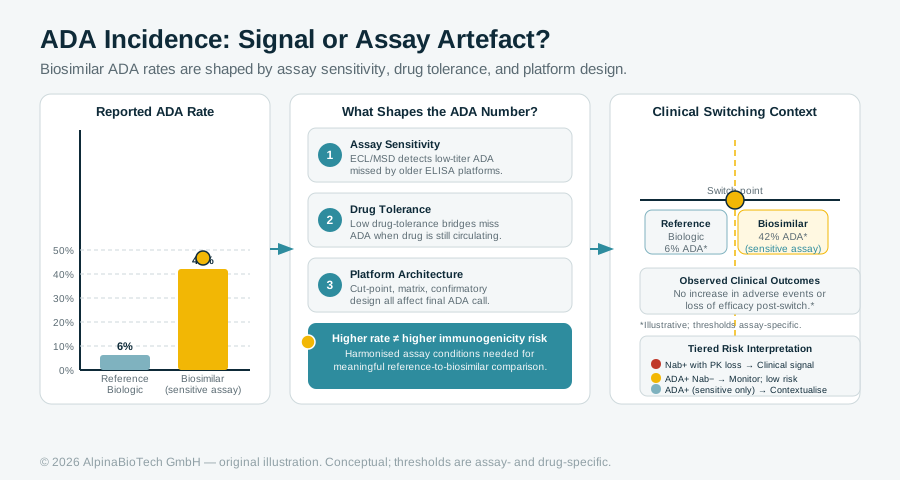
A biosimilar immunogenicity report showing a 42 percent ADA rate against a reference biologic's labeled 6 percent is not automatically a safety signal. The number is shaped as much by assay sensitivity, drug tolerance, and platform architecture as by the patient's immune response. This article explains how to interpret highly sensitive ADA data in biosimilar programs and what clinical switching data reveal about the stakes of getting it wrong.
AlpinaBioTech
All assays and reagents discussed in this article are intended for Research Use Only and are not approved for use in clinical diagnosis unless otherwise specified.
When ADA Incidence Misleads: Interpreting Highly Sensitive Immunogenicity Assays in Biosimilar Programs
A biosimilar immunogenicity report lands on your desk. The anti-drug antibody incidence is 42 percent. The reference biologic's labeled rate is 6 percent. Is this a safety signal, a regulatory problem, or an artifact of the assay you chose?
The answer depends almost entirely on assay architecture. A 2026 paper in Bioanalysis has brought this problem back into focus with sharper analytical language [3], and real-world pediatric switching data published the same year add clinical weight to the argument [2]. Getting this distinction right is not an administrative exercise. It shapes which patients receive dose adjustments, which biosimilar programs pass regulatory scrutiny, and which ADA-positive results prompt an unnecessary clinical intervention.
The Core Problem: Sensitivity Has Outpaced Clinical Interpretation
Recent improvements in immunogenicity assays have led to unexpectedly high immunogenicity rates, even in fully human products, creating new challenges in assessing immunogenicity and its clinical relevance [1]. This gap between analytical detection and clinical meaning is the central tension in biosimilar immunogenicity work.
A supersensitive ADA assay is one that can detect single to low double-digit nanograms per milliliter of ADA in the testing sample [1]. That capability is a genuine advance in bioanalytical science, but it creates an immediate interpretive problem: the number you report is a function of your cutpoint, your drug tolerance limit, your sample pretreatment protocol, and your platform, as much as it is a function of the patient's actual immune response.
The regulatory threshold history makes this concrete. Previously, FDA recommended a screening assay sensitivity of at least 250 to 500 ng/mL. The 2019 final guidance, "Immunogenicity Testing of Therapeutic Protein Products," revised that requirement downward to at least 100 ng/mL, citing data suggesting that concentrations as low as 100 ng/mL may be associated with clinical events [4, 5]. The FDA guidance also specifies that a drug tolerance level exceeding the trough drug concentration is a desirable feature of ADA assays [5]. When the assay gets more sensitive, incidence rates go up. Without a corresponding increase in pharmacokinetic disruption or clinical harm, the additional positives may be analytically real and clinically silent.
The Adalimumab Number That Illustrates the Problem
No analyte makes this clearer than adalimumab. The drug insert ADA-positive rate for rheumatoid arthritis patients is labeled at approximately 5 percent, but this figure may be substantially underestimated because the drug tolerance level for the original anti-adalimumab assay was less than 2 micrograms per milliliter, while adalimumab trough levels in RA patients are typically 5 to 9 micrograms per milliliter [1]. The practical consequence: a large fraction of samples drawn from patients at or near their dosing trough contained enough circulating drug to suppress ADA signal in the assay used to generate the labeled rate. What the insert reports is not the true immunogenicity burden; it is the immunogenicity burden the assay of its era could detect, in samples drawn when drug levels permitted detection.
In drug-tolerant assays, complexes of ADA and the biologic are dissociated prior to ADA detection, minimizing false-negative results. As a result, modern immunoassays often provide higher readouts compared with traditional assay formats, and historic data cannot be used for comparative purposes or for establishing margins of clinically acceptable difference in ADA rates between biosimilars and reference products [3].
This asymmetry is not theoretical. In many cases, the contemporary ADA and neutralizing antibody assay methods applied to biosimilar clinical studies have higher sensitivity and drug tolerance compared with those applied to support authorization of the reference medicine [3]. If your biosimilar immunogenicity data are generated on a newer electrochemiluminescence platform and the originator's labeled rates come from an older-generation ELISA, you are not comparing immunogenicity across two products. You are comparing assay eras.
What "Highly Sensitive" Actually Requires in a Biosimilar Program
The regulatory framework addresses this with a tiered strategy, but execution varies widely across laboratories. State-of-the-art, highly sensitive and drug-tolerant bioanalytical assays are used to identify the proportion of participants with ADA and neutralizing antibodies. FDA and EMA, along with other international health authorities, recommend a tiered strategy for immunogenicity sample testing with sequential screening and confirmatory assays, followed by semi-quantitation and characterization of ADA in terms of titer assessment and evaluation of neutralizing capacity [4].
A single assay for detection of ADA directed to either a biosimilar or its reference medicine has been recommended for comparative clinical studies to minimize the confounding influence of inter-assay variability [3]. That single-assay requirement is operationally critical. Running the biosimilar and originator through different platforms and then interpreting the results as comparable is methodologically indefensible.
Head-to-head immunogenicity assessment of biosimilars and their reference biologics should be a critical component of a biosimilar's clinical development program [6]. Various bioanalytical platforms may be used to detect and characterize immune responses, each having relative strengths and weaknesses, and regulators must be able to interpret immunogenicity results in an assay-specific context, as well as in perspective of clinical pharmacology, efficacy, and safety [6].
Drug Tolerance Is the Controlling Variable
The validation of ADA assays is vital in biologics development, with regulatory bodies including EMA and FDA emphasizing drug tolerance. Drug tolerance assessments should reflect actual clinical use [5]. A high-sensitivity assay run on samples drawn at trough, when circulating drug levels are low, will behave very differently from the same assay run on a sample drawn near peak exposure. If your drug tolerance limit is not characterized against the actual drug concentrations seen in your patient population at the time of sampling, the incidence number you report cannot be interpreted.
A calibration gap compounds this problem. Lab-to-lab variations between ADA detection techniques underscore the requirement for universal ADA standards when comparing binding data from different laboratories [10]. That gap means every laboratory is, in effect, operating on a local scale. Incidence figures are only interpretable alongside the full assay characterization package, not as standalone numbers.
When developing an ADA assay for a biologic used in high-exposure settings, various assay formats should be tested using multiple positive controls and drug concentrations that mimic real-world exposure and drug-to-ADA ratios. Assessing different positive controls at various concentrations is key to characterizing sensitivity and drug tolerance [5].
The Clinical Anchor: Pediatric Adalimumab Biosimilar Switch Data
The abstract analytical argument becomes concrete when you look at real-world switching cohorts. Children and young adults with IBD generally maintained stable disease control after an insurance-mandated, nonmedical switch from the adalimumab originator to a biosimilar, according to findings published in JPGN Reports in 2026 [2]. Adalimumab, an anti-TNF biologic, is an established treatment option for pediatric Crohn's disease and ulcerative colitis [2]. Adult patients with IBD who switch to a biosimilar have comparable outcomes, but pediatric data are limited, making this cohort particularly informative [2].
That treatment continuity is exactly what is at risk when clinicians over-interpret a post-switch ADA positivity rate without the assay context needed to evaluate what it means.
The broader literature supports this pattern. A 2026 multicenter retrospective cohort study, led by Valeria Dipasquale at the University Hospital "G. Martino" in Messina, Italy, and published in the Journal of Pediatric Gastroenterology and Nutrition, examined whether multiple sequential intramolecular switches between biologics of the same anti-TNF class affected efficacy, safety, or immunogenicity in children with IBD [9]. The study used the term "intramolecular switching" to describe switches between agents targeting the same molecular target, covering infliximab-to-infliximab and adalimumab-to-adalimumab transitions across originator and biosimilar versions.
A total of 185 patients (57 percent male; median age at diagnosis 11.9 years), including 136 with Crohn's disease and 49 with ulcerative colitis or IBD unclassified, who underwent at least one anti-TNF switch were followed for a median of 5.5 years [9]. Each switch was classified as originator-to-biosimilar, biosimilar-to-originator, or biosimilar-to-biosimilar, and further categorized as medically driven or non-medical [9]. The authors acknowledged that therapeutic drug monitoring and ADA testing were not systematic across the cohort [9], which is precisely the monitoring gap that assay-contextualized immunogenicity data is designed to fill. Immunogenicity monitoring across all these switch types requires the same assay used at baseline, not a different platform introduced at the time of the switch.
Evolving Approaches: From Tiered Testing to Adaptive Strategies
The European Bioanalysis Forum has been actively rethinking standard testing architecture. When a screening assay shows good specificity, a one-tier approach using a 1 percent false-positive rate cutpoint can yield results very similar to a two-tier approach that screens at 5 percent and confirms at 1 percent [7]. Removing the confirmatory tier will theoretically result in more false-positive samples when a screening cutpoint at a 5 percent false-positive rate is used. It is therefore recommended to use a screening cutpoint at a 1 percent false-positive rate in a one-tier ADA approach [7].
This is not a recommendation to reduce rigor. It is a recognition that the confirmatory step, as traditionally implemented, may add workflow without adding information if the screening assay is already highly specific. The practical implication for laboratory scientists: document your assay specificity data as carefully as your sensitivity data, because regulators and clinicians alike will need both to make sense of what you found.
The traditional immunogenicity paradigm resulting in ADA and neutralizing antibody positive or negative status and ambiguous or imprecise titers may overlook clinically relevant effects of ADA on pharmacokinetics and pharmacodynamics. Employing risk-based strategies that integrate PK and PD analyses with ADA magnitude using signal-to-noise can provide early insight into the potential clinical impact of immunogenicity [8].
Practical Implications for Monitoring Scientists
Three decisions at the assay design stage determine whether your immunogenicity data are actionable.
First, characterize drug tolerance against clinical drug levels. Assay formats should be tested using positive controls and drug concentrations that mimic real-world exposure and drug-to-ADA ratios at the time of sampling [5]. A tolerance limit validated only at low drug concentrations will produce unreliable results for trough samples drawn in high-dose regimens.
Second, use a single assay for biosimilar and reference medicine comparisons. Any head-to-head incidence comparison run on different platforms, or against historical originator data from older, less sensitive methods, is a cross-study comparison that cannot support regulatory conclusions about comparative immunogenicity [3, 6].
Third, report signal-to-noise alongside positive or negative calls. A sample that screens positive at barely above the cutpoint in a supersensitive assay carries different clinical weight than a high-titer, persistent, neutralizing-antibody-positive result correlated with trough drug levels below target [8]. Collapsing both into "ADA positive" discards most of the information the assay actually generated.
"Essential for tailored therapeutic strategies based on immunopharmacological evidence from individual patients (personalized medicine) is the use of assays for anti-drug antibodies (ADA) that are accurate and relevant in the clinical setting." [10]
Accuracy starts at the bench. It only becomes clinically relevant when the scientist reports the assay's full characterization, including sensitivity, drug tolerance, and platform, alongside every incidence figure.
All assays and reagents discussed in this article are intended for Research Use Only and are not approved for use in clinical diagnosis unless otherwise specified.
Sources
- [1] ncbi.nlm.nih.gov
- [2] centerforbiosimilars.com
- [3] tandfonline.com
- [4] ncbi.nlm.nih.gov
- [5] fda.gov
- [6] tandfonline.com
- [7] tandfonline.com
- [8] tandfonline.com
- [9] onlinelibrary.wiley.com
- [10] ncbi.nlm.nih.gov
More articles
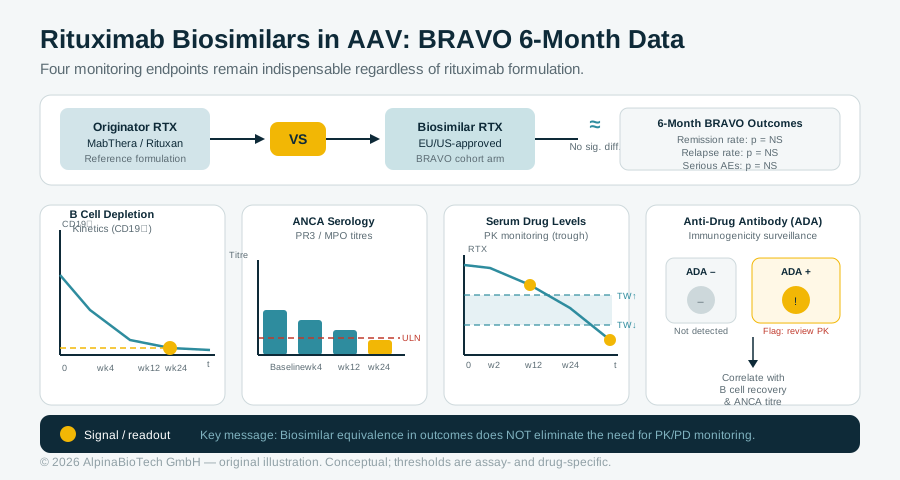
Rituximab Biosimilars in AAV: What Six-Month Real-World Data Tell Monitoring Scientists
The BRAVO multicenter cohort study found no statistically significant differences in remission rates, relapse rates, or serious adverse events between biosimilar and originator rituximab at six months in granulomatosis with polyangiitis and microscopic polyangiitis. For laboratories supporting drug-level and immunogenicity testing in biosimilar-treated AAV populations, the findings reinforce rather than reduce the case for structured pharmacokinetic and pharmacodynamic monitoring. B cell depletion kinetics, ANCA serology, serum drug levels, and anti-drug antibody assays each remain indispensable endpoints regardless of which rituximab formulation the patient receives.
Read more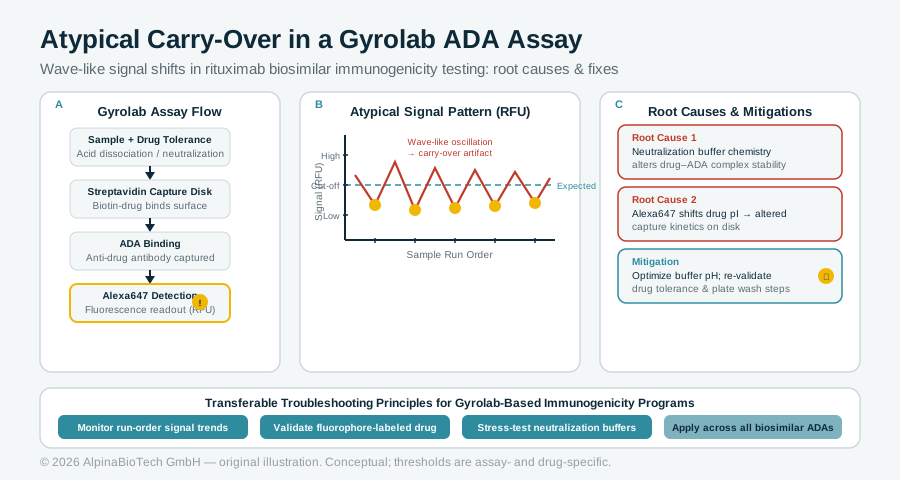
Atypical Carry-Over in a Gyrolab ADA Assay: Lessons from a Rituximab Biosimilar Case Study
A published case study targeting MabionCD20, a rituximab biosimilar, identified wave-like signal fluctuations in Gyrolab-based ADA assays caused by neutralization buffer chemistry and fluorophore-induced isoelectric point shifts. The investigation offers transferable troubleshooting principles for any laboratory running Gyrolab-based immunogenicity programs, particularly around drug tolerance and repeatability.
Read more