Article · 11 November 2026
When ADA Titer Is Not Enough: Rethinking the Gate to Neutralizing Antibody Testing
A series of papers published in Bioanalysis throughout 2026 argues that titer-gated neutralizing antibody testing can miss clinically relevant neutralization while generating incidence numbers that mislead development teams. The papers converge on signal-to-noise ratio from the screening tier as a continuous, biologically richer alternative to discretized titer scores, and call for NAb assay sensitivity to be matched to molecule-specific clinical endpoints rather than population-average tier thresholds.
AlpinaBioTech

The question that lands on every immunogenicity scientist's desk after a confirmatory positive is whether to run a neutralizing antibody (NAb) assay. For most of the past decade, the answer has been guided by a simple proxy: ADA titer. If the titer clears a program-specific threshold, the sample proceeds to NAb testing. If not, it does not. A series of papers published in Bioanalysis throughout 2026, capped by a November 4 review article from Lauren F. Stevenson at Translational Sciences, Immunologix Laboratories, Tampa, FL, argues that this approach has outlived its usefulness, that titer-gated NAb testing can miss clinically relevant neutralization while simultaneously generating incidence numbers that mislead regulators and development teams alike [1, 2].
All assays described in cited publications are for Research Use Only (RUO) and have not been reviewed or cleared by FDA or EMA for clinical diagnostic use.
The Three-Tier Structure and Its Gate-Keeping Problem
The standard tiered immunogenicity paradigm moves samples through screening, confirmation, and titration. For confirmed positives with a titer above a program-specific threshold, a fourth tier follows: neutralization testing using a cell-based or competitive ligand-binding assay.
The assumption embedded in this cascade is that titer magnitude reliably proxies for neutralizing potential. Immunogenicity is a biological response to pharmacologic therapeutic intervention and therefore fits squarely within established definitions of a biomarker, yet unlike most biomarker assays where analytical performance is tailored to context of use, ADA testing has converged on a largely uniform, three-tiered paradigm built around statistically derived cut points and titer reporting [2]. Titer-based readouts, while appropriate for large vaccine-like responses, are frequently insufficiently granular to capture the full spectrum of response magnitudes relevant to contemporary biotherapeutic modalities.
The second structural problem operates in the opposite direction. Immunogenicity datasets are often reduced to binary classifications that discard biological context, inflate reported incidence, and complicate efforts to relate immune responses to clinically meaningful outcomes such as pharmacokinetics, pharmacodynamics, efficacy, or safety [2].
The result is a testing cascade that can simultaneously over-trigger NAb workup on high-titer-but-irrelevant samples and under-trigger it on samples where neutralization is nonetheless occurring at modest magnitude.
A Year's Worth of Converging Evidence
The November 4, 2026 Stevenson review article, "From detection to decisions: refocusing immunogenicity assessment on clinical relevance," did not arrive in isolation [1]. It is part of a Bioanalysis collection titled "Refreshing the immunogenicity testing paradigm: Reflecting on the past, addressing the needs of the present and building towards a sustainable future," created October 26, 2026, updated November 6, 2026, with Stevenson as guest advisor [1].
The review is best understood as the capstone of a distinct foundational perspective paper published earlier in 2026. "From tiers to truth: a biomarker-based framework for clinically relevant immunogenicity assessment" appeared in Bioanalysis 18(4):403-413, authored by Stevenson at Translational Sciences, Immunologix Laboratories, and published online May 15, 2026 [2].
Immunogenicity is a biological response to pharmacologic therapeutic intervention and therefore fits squarely within established definitions of a biomarker [2]. Yet unlike most biomarker assays where analytical performance is tailored to context of use, ADA testing has converged on a largely uniform, three-tiered paradigm built around statistically derived cut points and titer reporting [2]. This perspective argues that this approach arose from understandable, risk-averse responses to rare, high-impact safety events, combined with early analogies to the vaccine field, rather than from first-principles thinking aligned with drug development needs [2].
The proposed alternative centers on a continuous readout. Reframing immunogenicity as a context-of-use-driven biomarker measurement leverages complete, continuous response profiles, such as screening-tier signal-to-noise, alongside pharmacokinetic and pharmacodynamic data and clinical outcomes, to identify clinically relevant immunogenicity thresholds [2].
A second Stevenson paper, published in Bioanalysis 18(5-6):503-516 and published online May 27, 2026, grounded the theoretical argument in Phase 1 assay data [5]. "Immunogenicity assays are biomarker assays: is the 3-tiered paradigm fit-for-purpose? An illustrative case study" demonstrates that using the full screening-tier dataset, specifically signal-to-noise and raw signal, produces clearer, more complete subject profiles than cut-point-censored titer-based outputs, supporting clear data interpretation and efficient identification of impactful responses [5]. Signal levels across the case study were generally low, with the highest observed signal at 581 relative light units, yet complete datasets visualized through figures allowed meaningful responses to be readily discerned from noise [5].
The European Bioanalysis Forum made the consensus explicit in a meeting report led by Kyra J. Cowan and colleagues. Published as Bioanalysis 18(3):217-226, published online March 19, 2026, the report explicitly advocates for a context-of-use-driven strategy across all assays and presents recommendations for an adaptive tiered approach [4]. The EBF highlights the benefits of adopting 1-Tier immunogenicity testing approaches, with 2-Tier strategies reserved for specific modalities or assay needs [4]. The EBF envisions the successful acceptance and general transition of the 3-Tier approach to a more science- and context-of-use-based approach [4].
The NAb Testing Decision: Where Titer Fails Most Visibly
The gate-to-NAb-testing question is where the limits of titer become most consequential for assay scientists. A Bioanalysis review published in volume 18, issue 10, pages 933-945, received April 17, 2026, accepted July 28, 2026, and published online August 7, 2026, addressed the problem from a mechanistic standpoint [3]. "Advanced assay design for characterizing anti-drug antibody responses in clinical serum samples" was authored by Gregor P. Lotz, Denise Sickert, Roland F. Staack, and Gregor Jordan [3].
Monitoring ADA responses is critical for evaluating the safety and efficacy of protein therapeutics, and while traditional three-tiered testing reliably identifies ADA incidence, onset, and magnitude, modern complex biologics necessitate adapting assessment strategies [3]. The primary objective of advanced ADA assay design is to characterize and mitigate clinical safety risks, and assessing true clinical relevance requires evaluating specific ADA characteristics using advanced assay designs [3].
For anti-TNF monoclonal antibodies, the clinical stakes are clearest. High-titer ADAs accelerate drug clearance, neutralize the mechanism of action, or form large immune complexes, and the recommended response is to deploy high drug-tolerant screening via dissociation analysis and pair active and total PK measurements to map functional impact [3].
The review introduces two concepts relevant to NAb assay design. The first is Model-Informed Assay Development (MIAD): a framework that uses mathematical modeling of drug-ADA-reagent kinetics to predict assay performance parameters, including drug tolerance thresholds [3]. The second is the ADA-Reagent-Drug complex (ARC): a ternary complex formed when circulating drug bridges the ADA and the labeled assay reagent, which can mask signal detection at high drug concentrations and must be accounted for when setting NAb assay cut points [3]. Both MIAD and ARC formation are listed as keywords in [3], and MIAD is described in a companion paper by Jordan and Staack referenced therein.
A risk-based testing strategy should distinguish integrated versus stand-alone NAb testing pathways, tailored to the molecule's clinical risk profile [3]. The implication for assay design is direct: the NAb assay format must be matched to the expected ADA titer range and the drug's mechanism of action, not to a universal sensitivity target.
Signal-to-Noise as a Replacement Metric
If titer is an unreliable gate for NAb testing decisions, what should replace it? The 2026 papers converge on signal-to-noise ratio (S/N) from the screening tier as a continuous readout that preserves more biological information than the discretized titer score.
By leveraging S/N and raw signal data from the screening tier, the Stevenson case study provides more complete subject profiles across the study population than cut-point-censored titer-based outputs [5]. Complete datasets are easily visualized through figures, as for PK and PD, and meaningful responses are readily discerned from noise, as clearly demonstrated by the presented case study [5]. One emerging alternative to conventional tiered analysis is a streamlined one-tier approach that leverages S/N data from screening assays to generate more nuanced datasets [3].
S/N provides a continuous distribution that lets the analyst observe the relationship between response magnitude and clinical endpoints, something a discretized titer value cannot do. Where S/N correlates with PK impact at a program-specific threshold, it can serve as the trigger for reflex NAb testing with a mechanistic rationale rather than an arbitrary tier structure.
Cut-Point Design: The Validation Consequence
These shifts carry direct consequences for how labs validate and report immunogenicity assays.
The cut-point paper by Joshua A. Weiner and colleagues, "Drawing a line in the sand: impact of analytical choices on anti-drug antibody cut-points and testing outcomes," published in Bioanalysis 18(8-9):711-722, received December 27, 2025, accepted June 30, 2026, and published online July 14, 2026, addresses the analytical choices that drive consistency [6]. The full author list is Weiner JA, Banks LA, Natarajan H, Lin S, Sami S, Kovacikova G, Carpenter MC, and Ackerman ME [6].
The paper finds that bootstrapping supports assay development efficiency by improving confidence in threshold setting in the context of limited numbers of test samples [6]. While the outlier exclusion approach led to different apparent levels of ADA positivity, immunogenic drug products were identified by differences in the distribution of sample profiles from naive and treated participants by each method evaluated [6].
Validation packages need to document the rationale for cut-point choice relative to program-specific clinical impact data, not universal regulatory defaults. Reports that lead with percent-positive incidence without anchoring to clinical endpoints are increasingly difficult to defend.
Adaptive tier design is the logical destination. The EBF highlights the benefits of adopting 1-Tier immunogenicity testing approaches, with 2-Tier strategies reserved for specific modalities or assay needs, and envisions the successful transition from traditional 3-Tier to adaptive tier testing [4].
NAb assay sensitivity alignment is equally important. The NAb assay must be validated with sensitivity sufficient to detect neutralizing activity across the titer distribution expected for the molecule in question, not only at the high-titer threshold that conventional cell-based formats are optimized for. The future of immunogenicity risk management and of advanced ADA assay design lies in combining bioanalytical data with computational modeling, which is expected to become standard practice [3].
Practical Guidance for the Lab
The shift described across these papers is not a call to abandon NAb testing. It is a call to design the conditions under which NAb testing is triggered, and to match the assays that execute it, to molecule-specific clinical endpoints rather than population-average tier thresholds.
For scientists building or reviewing immunogenicity assay packages, the key operational questions are:
- What PK or PD threshold constitutes clinical impact for this molecule, and does the assay cut point align with that threshold?
- Is the S/N dynamic range from the screening tier documented and correlated with available PK data from early clinical samples?
- Has the NAb assay been validated for sensitivity at the low-titer end of the program's ADA distribution, not just the high-titer end?
- If a simplified 1-tier or 2-tier strategy is proposed, does the validation package provide prospective justification rather than retrospective rationalization?
The obligation on assay scientists is to build that scientific judgment into the validation design, the cut-point rationale, and the clinical reporting structure, before the regulator asks for it.
All assays described in cited publications are for Research Use Only (RUO) and have not been reviewed or cleared by FDA or EMA for clinical diagnostic use.
Sources
- [1] tandfonline.com
- [2] tandfonline.com
- [3] doi.org
- [4] tandfonline.com
- [5] tandfonline.com
- [6] doi.org
More articles
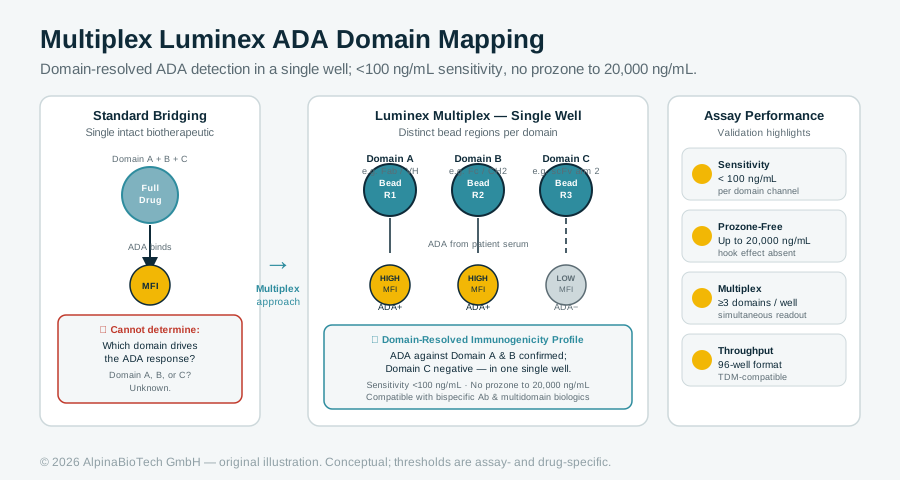
Multiplex Luminex Assay Enables Simultaneous Domain-Specific ADA Detection for Multidomain Biotherapeutics
Standard bridging immunogenicity assays cannot distinguish which domain of a multidomain biotherapeutic is driving an anti-drug antibody response. A Luminex bead-based multiplex approach published in Bioanalysis in November 2026 addresses this gap by enabling simultaneous, domain-resolved ADA detection within a single assay well, with sub-100 ng/mL sensitivity and no prozone effects up to 20,000 ng/mL. This article reviews the method, its validation considerations, and what it means for scientists building immunogenicity programs for bispecific antibodies and other multidomain drugs.
Read more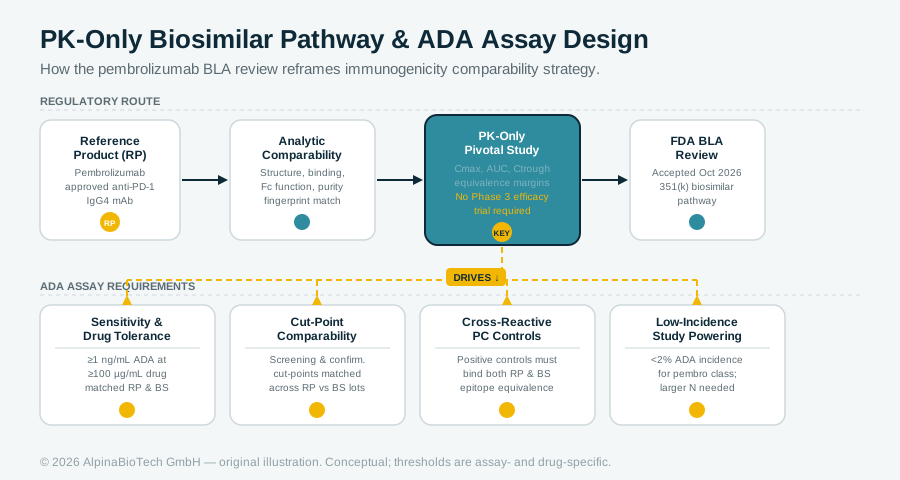
Pembrolizumab Biosimilars Are Entering Clinical Review: What the PK-Only Pathway Means for Immunogenicity Assay Scientists
The FDA accepted the first publicly announced pembrolizumab biosimilar BLA for review in October 2026, using a pharmacokinetic-only pivotal strategy that skips a comparative Phase 3 efficacy trial. For immunogenicity assay scientists, this regulatory pivot reframes how ADA comparability must be designed, validated, and interpreted in a drug class with low but clinically consequential reference product immunogenicity.
Read more