Article · 6 November 2026
Multiplex Luminex Assay Enables Simultaneous Domain-Specific ADA Detection for Multidomain Biotherapeutics
Standard bridging immunogenicity assays cannot distinguish which domain of a multidomain biotherapeutic is driving an anti-drug antibody response. A Luminex bead-based multiplex approach published in Bioanalysis in November 2026 addresses this gap by enabling simultaneous, domain-resolved ADA detection within a single assay well, with sub-100 ng/mL sensitivity and no prozone effects up to 20,000 ng/mL. This article reviews the method, its validation considerations, and what it means for scientists building immunogenicity programs for bispecific antibodies and other multidomain drugs.
AlpinaBioTech
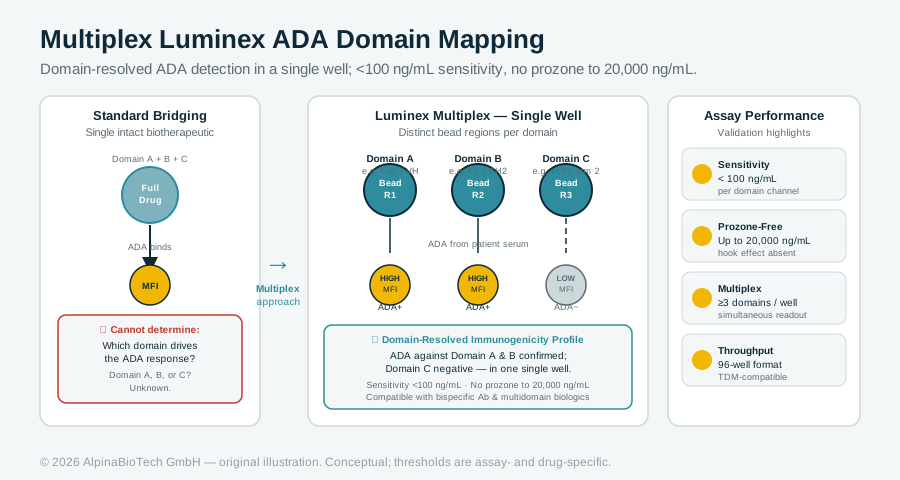
The pipeline of multidomain biotherapeutics is growing faster than the standard immunogenicity assay toolkit can keep up. Bispecific antibodies carry two structurally independent binding arms, each of which can independently trigger an immune response in treated subjects, yet standard immunogenicity testing platforms are designed for conventional monoclonal antibodies and are not built to differentiate ADA responses between those arms.
Critical hurdles for immunogenicity evaluation of bispecific antibody therapeutics include the limitations of widely used ADA assay formats, matrix interference, domain-specific characterization, and functional neutralization assessment [3]. That gap is exactly what a research article published in Bioanalysis on November 3, 2026 sets out to close. The paper, "The simultaneous detection of multidomain ADAs using a multiplex assay: a multiplexed approach to multidomain ADA detection," was authored by Jason Truesdale et al. and published online as a Research Article in Bioanalysis, Volume 16, Issue 21-22 [1].
Why a Single Bridging Assay Is Not Enough for Multidomain Drugs
A standard bridging ELISA or electrochemiluminescence assay measures total ADA signal but provides no information on which domain is driving the immune response. That matters for two reasons: clinical interpretation and regulatory characterization.
When a patient develops ADAs against a bispecific drug, the domain specificity of that response determines whether it is likely to affect drug clearance, neutralize a particular arm's pharmacological function, or remain clinically silent. No single assay format can universally address the matrix interference, domain-specific characterization, and functional neutralization assessment challenges that bispecific therapeutics present [3].
An integrated immunogenicity assessment framework combining predictive tools, clinical bioanalytical data, and reverse-translational investigations can refine therapeutic platforms and reduce immunogenicity risk in next-generation bispecific antibody development [3]. The Truesdale multiplex assay is one concrete implementation of that principle.
The practical stakes are high. For the beta-NGF/TNFR2 bispecific antibody program described in a 2026 AAPS Journal report, ADA mapping revealed a predominant immune response to the beta-NGF binding domain, leading investigators to explore the correlation of beta-NGF domain-specific neutralizing antibody (NAb) responses with clinical impact [7]. Without a domain-resolving assay, that kind of response attribution is invisible in a total ADA incidence number.
The Luminex Bead-Based Multiplex Platform
The Truesdale et al. approach uses a bead-based Luminex platform to run domain-specific ADA detection simultaneously within a single assay well. Rather than sequential single-plex assays, each bead population is coupled to a specific drug domain, allowing the signal from each domain to be read independently through spectral separation [1].
This work was connected to a poster that Jason Truesdale presented at WRIB 2026 on multiplexing immunogenicity assays using a Luminex platform [2]. The IQVIA WRIB 2026 conference blog reports the following performance characteristics from that poster presentation: on-demand bead coupling improved assay stability and consistency while enabling a more rapid workflow, and the method achieved sensitivities below 100 ng/mL without evidence of prozone effects up to 20,000 ng/mL across both the Cas9 and PEG domains of the multidomain construct under study [2].
These figures are attributed to the conference poster as described in the IQVIA blog [2] and should be interpreted in that context, as the peer-reviewed paper [1] is the primary published record. That said, the sensitivity and dynamic range represent a meaningful practical result. Prozone or hook effects, where high ADA concentrations paradoxically reduce signal, are a known failure mode in bead-based bridging assays. Demonstrating clean performance from sub-100 ng/mL through 20,000 ng/mL, across two structurally distinct domains simultaneously, is not a trivial outcome.
Adjusting bead ratios allowed balanced detection despite differing minimum required dilutions, while the multiplex format reduced reagent consumption, sample volume, and overall development effort relative to single-plex assays [2].
That last point has practical consequences for laboratories managing large clinical immunogenicity programs. Sample volume is a persistent constraint in pediatric studies and early-phase oncology trials. Running two or more single-plex assays in series burns volume; the multiplex format preserves it.
The Wider Context: Multidomain Drugs Demand Multidimensional Assays
The Truesdale paper is not an isolated development. Immunogenicity assessment for therapeutic bispecific antibodies often requires domain-specific characterization, including evaluation of neutralizing antibody responses to individual domains [3]. This is increasingly a regulatory expectation, not merely a scientific preference.
The beta-NGF/TNFR2 example illustrates the clinical stakes directly. The domain-specific NAb assay developed for that program demonstrated a robust, innovative solution for detecting neutralizing responses in the context of complex bispecific biologics, enabling reliable immunogenicity evaluation in drug development [7].
Chemical modifications further complicate the picture. Where PEGylation is part of a multidomain construct, as in the Truesdale study, domain-specific ADA detection is not optional. PEGylation introduced to extend serum half-life, and Fc glycosylation introduced to modify effector function, can create potentially immunogenic neoepitopes that require the development of additional, targeted assays [3]. Assessing total ADA signal alone cannot distinguish whether the patient's immune response targets the therapeutic protein, the conjugated modifier, or both.
Cut-Point Considerations in Multiplex ADA Assays
Adding multiplexing to an ADA assay does not remove the obligation to validate a statistically sound cut-point for each analyte channel. It complicates it. Each bead population carries its own signal distribution, and the cut-point for one domain channel is not necessarily the same as the cut-point for another.
A survey of 185 ADA assay screening cut-points investigated the impact of low cut-points and ultra-low cut-points on ADA assays, conducted to assess the overall rate of low and ultra-low cut-point determinations independent of factors such as drug modality, drug target, ADA assay format, or organization [4]. Of the 185 preclinical and clinical studies surveyed, 105 (57%) resulted in a low cut-point, and 65 (35%) resulted in an ultra-low cut-point [4].
An ultra-low cut-point, defined in that paper as a signal-to-noise ratio at or below 1.10, may raise concerns for the reliability of ADA assays and the recovery of a higher-than-expected number of false positive samples [4].
The authors do not treat this finding as automatically disqualifying. The paper examined the impact of low cut-points through a survey of recent ADA studies and specific case studies from two contract research organizations, finding that the use of low cut-points does not typically result in major reliability issues in ADA assay performance, especially when modern techniques result in highly sensitive assays [4].
However, low or ultra-low cut-points should not be accepted without scrutiny. For cut-points at or below 1.20 observed during validation, scientists should evaluate outlier exclusion and negative control response relative to the cut-point for individual studies [4]. During sample analysis, false positive rate and low positive control performance should be monitored to verify suitability of the cut-point, rather than presuming it may be inappropriate for intended use [4].
For multiplex ADA assays, that per-channel evaluation becomes a required element of the validation package. The probability of encountering at least one ultra-low cut-point in a given validation run increases as the number of independently read bead populations rises. Scientists building multiplex immunogenicity methods should budget validation time accordingly and document the cut-point rationale for each channel separately. The Denhoff et al. survey [4] and the Truesdale multiplex paper [1] appear in the same Bioanalysis issue, and together they frame the statistical diligence that domain-specific multiplex validation now requires.
What This Means for Assay Scientists Working on Multidomain Programs
Three practical implications follow from the Truesdale paper and the surrounding literature.
First, the assay format selection conversation needs to happen earlier. Deciding at the start of a program whether a single bridging assay is adequate, or whether domain-specific multiplex capability is needed, shapes the reagent development timeline, the validation plan, and the regulatory package. The scientific question of what needs to be measured, with what confidence, and for what decision, naturally takes precedence over assay format convention.
Second, bead ratio optimization is a development variable, not a fixed condition. On-demand bead coupling improved assay stability, and adjusting bead ratios allowed balanced detection across domains with different minimum required dilutions, while reducing reagent consumption, sample volume, and overall development effort relative to single-plex assays [2]. Reagent coupling chemistry, bead concentration, and drug-domain capture stoichiometry interact in ways that can favor one channel over another if not deliberately balanced.
Third, the multiplex format does not replace confirmatory or neutralizing antibody tier testing. Domain-specific ADA detection identifies which arm of the drug is targeted. For the neutralizing antibody component, a functional readout capable of detecting domain-specific NAb responses to individual domains is required [7]. The multiplex screening tier narrows the characterization question; it does not eliminate the need for functional follow-on work.
Conclusion
The Truesdale et al. Luminex-based multiplex assay published in Bioanalysis addresses a concrete and growing challenge in clinical immunogenicity science: simultaneous detection of ADAs against structurally distinct drug domains, with sub-100 ng/mL sensitivity and a clean upper performance boundary of 20,000 ng/mL without prozone effects, as reported from the WRIB 2026 conference presentation [2]. Sample volume and reagent demands are measurably lower than running equivalent single-plex assays in series [1][2].
For scientists building or reviewing immunogenicity programs for multidomain biotherapeutics, the question is no longer whether domain-specific characterization is needed. Immunogenicity assessment for therapeutic bispecific antibodies often requires domain-specific characterization, including evaluation of NAb responses to individual domains [3], and this expectation is consistent with the tiered testing approach described in the FDA's January 2019 guidance "Immunogenicity Testing of Therapeutic Protein Products: Developing and Validating Assays for Anti-Drug Antibody Detection" [8] and the EMA's 2017 "Guideline on Immunogenicity Assessment of Therapeutic Proteins" [9]. The question is whether the assay format in hand is capable of delivering domain resolution within the constraints of real clinical sample volumes and timelines.
For Research Use Only. Not for use in diagnostic procedures.
Sources
- [1] tandfonline.com
- [2] labs.iqvia.com
- [3] tandfonline.com
- [4] tandfonline.com
- [5] nebiolab.com
- [6] ncbi.nlm.nih.gov
- [7] link.springer.com
- [8] fda.gov
- [9] ema.europa.eu
More articles
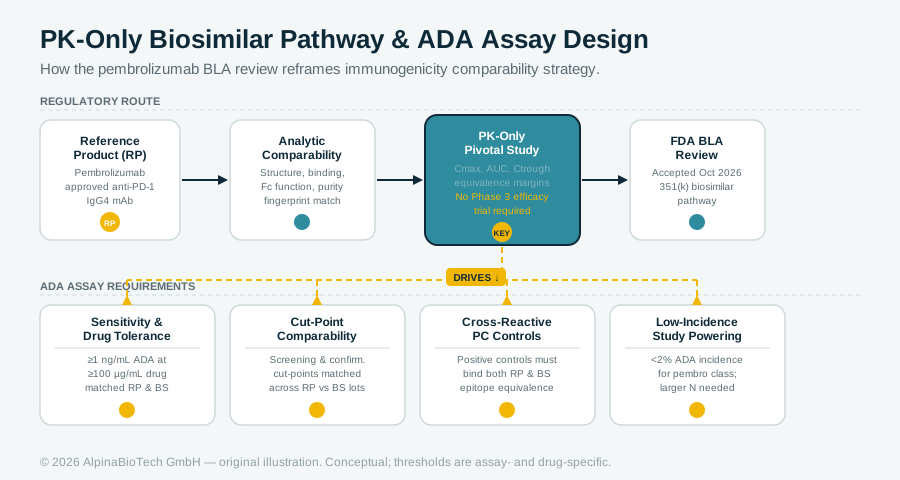
Pembrolizumab Biosimilars Are Entering Clinical Review: What the PK-Only Pathway Means for Immunogenicity Assay Scientists
The FDA accepted the first publicly announced pembrolizumab biosimilar BLA for review in October 2026, using a pharmacokinetic-only pivotal strategy that skips a comparative Phase 3 efficacy trial. For immunogenicity assay scientists, this regulatory pivot reframes how ADA comparability must be designed, validated, and interpreted in a drug class with low but clinically consequential reference product immunogenicity.
Read more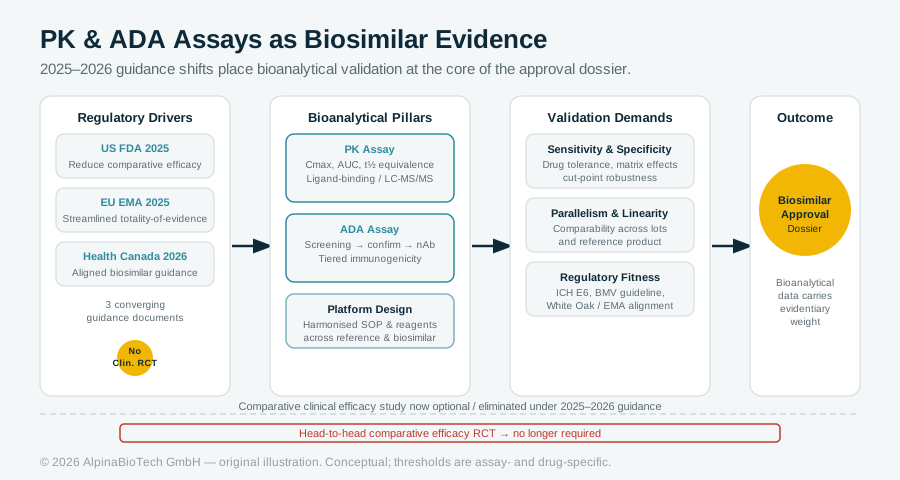
When PK and ADA Assays Become the Whole Argument: Biosimilar Regulatory Reform and What It Demands from Bioanalytical Scientists
Regulatory agencies in the US, EU, and Canada moved in 2025 and 2026 to reduce or eliminate comparative efficacy studies for biosimilar approval, placing pharmacokinetic and anti-drug antibody assays at the center of the evidentiary dossier. This article examines the three converging guidance documents, the validation demands they create, and the platform-level design principles scientists need to build biosimilar bioanalytical programs that can carry that evidentiary weight.
Read more