Article · 26 October 2026
When PK and ADA Assays Become the Whole Argument: Biosimilar Regulatory Reform and What It Demands from Bioanalytical Scientists
Regulatory agencies in the US, EU, and Canada moved in 2025 and 2026 to reduce or eliminate comparative efficacy studies for biosimilar approval, placing pharmacokinetic and anti-drug antibody assays at the center of the evidentiary dossier. This article examines the three converging guidance documents, the validation demands they create, and the platform-level design principles scientists need to build biosimilar bioanalytical programs that can carry that evidentiary weight.
AlpinaBioTech
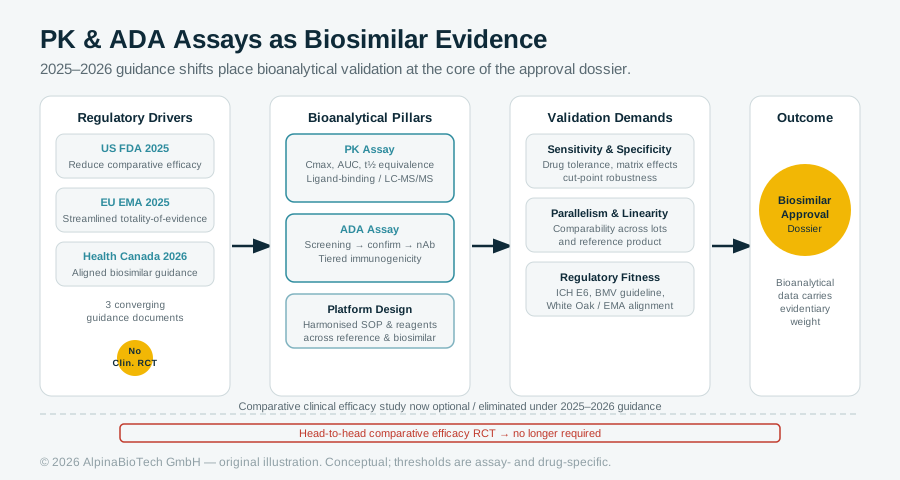
Regulatory agencies in three jurisdictions moved in 2025 and 2026 to reduce or eliminate comparative efficacy studies for biosimilar approval, placing pharmacokinetic and anti-drug antibody assays at the center of the evidentiary dossier. A review published in Bioanalysis on October 18, 2026 addresses the assay platform and validation implications directly. This article examines what that shift demands from scientists designing and running biosimilar bioanalytical programs today.
The Assay Is Now the Dossier Core
The FDA, EMA, and Health Canada now each recognize that establishing analytical similarity between a proposed biosimilar and the reference product, supported by a clinical pharmacokinetic study, can be sufficient to demonstrate biosimilarity without routinely requiring comparative efficacy studies [4]. That reframes the bioanalytical function entirely. PK and anti-drug antibody assays are no longer supporting documents in a dossier anchored by a Phase III trial. They are the primary evidence.
The journal Bioanalysis published a review on October 18, 2026 addressing exactly this shift: Bioanalytical assays for clinical similarity assessment of biotherapeutics: evolving platforms and regulatory considerations, by Vikas Chandnani et al. [1]. It arrives at a moment when three major regulatory documents have already reset expectations for what assay data must accomplish.
Understanding what the regulatory change actually requires, and where current assay practice is most exposed, is the practical question for any scientist designing or running a biosimilar bioanalytical program today.
Three Guidance Documents, One Direction
The timeline is worth stating precisely, because the convergence across agencies happened fast.
The FDA issued its draft guidance on October 29, 2025, proposing that comparative efficacy studies may not be needed where a comparative analytical assessment and a PK similarity study support a finding of high similarity [15]. That guidance, titled "Scientific Considerations in Demonstrating Biosimilarity to a Reference Product: Updated Recommendations for Assessing the Need for Comparative Efficacy Studies," was subsequently published in the Federal Register on November 20, 2025 (90 FR 52410) [13]. The EMA's Committee for Medicinal Products for Human Use (CHMP) adopted the Reflection paper on a tailored clinical approach in biosimilar development (EMA/CHMP/BMWP/60916/2025) on March 16, 2026, following a public consultation period that closed September 30, 2025 [5]. Health Canada published its final Guidance on Information and Submission Requirements for Biosimilar Biologic Drugs on May 19, 2026 [17]. Each document shifts the evidential weight of the biosimilar dossier away from the comparative efficacy trial and toward analytical, functional, pharmacokinetic, and immunogenicity data.
Health Canada's final guidance states directly that comparative clinical efficacy studies are not typically required for a biosimilar candidate when the biosimilar can be compared and extensively characterized by appropriate analytical studies [17]. Where a sponsor elects to include a comparative clinical efficacy study, the guidance now requires the sponsor to explain the role of those studies and the value of their results [18].
The EMA's adopted text concludes that for biosimilar candidates that can be thoroughly characterized using state-of-the-art analytical methods and have demonstrated similarity in physicochemical and functional properties, combined with pharmacokinetic data, comparative efficacy studies are no longer expected. The EMA anticipates this approach applying to most biosimilar candidates [5]. Respondents to the EMA's public consultation noted that analytical technology is more sensitive than comparative clinical data at detecting differences during biosimilarity assessment [5].
That is a strong claim with a direct corollary for bioanalytical scientists: if the assay is more sensitive than the efficacy trial, the assay must be designed, validated, and interpreted to carry that evidentiary weight.
What the Regulatory Shift Does Not Eliminate
The waivers are not unconditional. The FDA proposes that a comparative efficacy study may not be necessary where a comparative analytical assessment of attributes such as protein structure, physicochemical, and functional attributes supports a demonstration of high similarity, where the relationship between quality attributes and clinical efficacy is understood, and where a human pharmacokinetic similarity study is feasible and clinically relevant [15]. The EMA is equally explicit that comparative efficacy studies remain available when molecular characterization is insufficient to resolve residual uncertainty [5].
This means that the burden of characterization falls entirely on the analytical package. A molecule that cannot be thoroughly characterized is the molecule that still needs a clinical efficacy trial.
The economic rationale is documented from primary regulatory sources. The FDA stated in its October 29, 2025 news release that comparative efficacy studies can require one to three years and cost $24 million on average, yet generally have low sensitivity compared to many other analytical assessments [14]. A separate FDA March 2026 draft guidance on streamlining PK studies proposed changes that could save biosimilar developers up to 50% of PK study costs, or approximately $20 million per program [14]. These figures place direct pressure on assay quality in a way that regulatory language alone cannot.
The ADA Assay as Immunogenicity Comparator
In the previous paradigm, immunogenicity data from a comparative efficacy trial provided a large patient population and extended follow-up. In the streamlined model, the ADA assay embedded in the PK study does that work.
A 2025 WRIB white paper published in Bioanalysis captures the emerging consensus on what integrated immunogenicity assessment must accomplish in this context: the scope of biosimilar development is to demonstrate that there are no clinically meaningful differences to the innovator product, and the immunogenic profile of the biosimilar can be estimated with the risk of a different immunogenicity profile being low when high analytical similarity between biosimilar and innovator product is demonstrated [12].
Assay design must therefore be built for comparability, not just for detection. The ADA method must demonstrate equivalent sensitivity to antibodies raised against both the biosimilar and the reference product. The cut point must be derived with that equivalence in mind.
Under the auspices of the American Association of Pharmaceutical Scientists (AAPS) Ligand-Binding Assay Bioanalytical Focus Group (LBABFG), a Biosimilars Action Program Committee (APC) was formed in 2011 with the goal of providing a forum for in-depth discussions on issues surrounding the development and validation of PK and immunogenicity assays in support of biosimilar drug development [11]. Its recommendations state that the consensus for biosimilar PK assays is that a single ligand-binding assay to quantify both the biosimilar and the originator compound is recommended to support preclinical and clinical comparability studies [11]. The validation phase must provide formal proof that the method is capable of equally quantifying both products.
What the 3rd Immunologix Symposium Surfaced
On October 1, 2026, Immunologix Laboratories hosted the 3rd Annual Immunologix Bioanalysis Symposium: The Science of Fit-For-Purpose Bioanalysis, at Le Meridien Boston Cambridge. The program spanned three sessions centered on a single question: how to design and validate bioanalytical strategies that answer the specific clinical question a therapeutic program needs to address, rather than defaulting to legacy assay conventions [16].
That framing applies directly to the biosimilar context. When the clinical question is whether immunogenicity is comparable between biosimilar and reference product, the assay conventions inherited from originator programs are not automatically fit for purpose. Session One examined integrated immunogenicity assessment using a combined ADA, PK, and pharmacodynamic approach that revealed the clinical impact of antibody responses that isolated assay readouts had missed [16]. Session Three featured a speaker who spent more than 25 years at the FDA and who addressed how new approach methodologies can reduce clinical trial requirements [16].
In a biosimilar program operating under the new regulatory framework, the context of use is comparability, and the assay must be built outward from that requirement.
The Stakes: Irish Oncology Costs and the Pan-European Gap
The regulatory changes are accelerating in part because the cost of not deploying biosimilars at scale is now quantified and difficult to ignore. The cost of cancer drugs in Irish hospitals rose from approximately 4.7 million euros in 2013 to 151 million euros in 2022, a gain exceeding 3,100%, reflecting expenditure captured under the Irish Health Service Executive Oncology Drug Management Scheme [6]. Biosimilar uptake has grown in Ireland but remains well below the levels seen in countries such as Austria, the Netherlands, and Norway [6].
The Irish case illustrates a broader European pattern. Biosimilar market share across 27 European countries climbed from 3.6% in 2014 to an average of 40.7% a decade later [8]. A separate analysis documents the country-level spread: biosimilar market shares varied from above 50% in Norway and Italy to below 10% in Greece and Luxembourg [9].
The policy levers that close that gap are documented. A correlation exists between countries achieving high levels of uptake and two distinct policy approaches: combining multiple supply- and demand-side measures including incentives, substitution policies, and educational initiatives, and relying primarily on coordinated national tendering systems operating across hospital and retail markets [10].
For bioanalytical scientists, the relevance is direct: higher biosimilar uptake driven by policy pressure increases the number of programs that require PK and ADA comparability data, and narrows the margin for assay inadequacy. Reduced reliance on comparative efficacy studies can shorten development timelines and improve patient access to biosimilars [5]. Assay quality is therefore not a technical abstraction; it is the rate-limiting step in whether a program can reach patients.
Platform Considerations for Comparability-First Design
The regulatory shift places greater analytical weight on methods that were previously positioned as supporting evidence. Ligand-binding assays remain the dominant format for PK and ADA measurement in biosimilar programs, with ELISA as the most widely implemented method. The requirement to demonstrate equivalent detection of antibodies against two structurally similar but non-identical molecules places specific demands on sensitivity, drug tolerance, and selectivity.
The EMA's aim is to utilize experience and technical advances to optimize biosimilar development and reduce the amount of clinical data required for development and approval of biosimilar medicines in the EU [5]. That optimization depends entirely on assay packages that can carry the evidential weight the regulatory framework assigns to them.
Differences in clearance or biodistribution that are not resolved in chemistry, manufacturing, and controls comparability may surface in PK method development, making the assay an active analytical tool rather than a passive measurement instrument.
Drug tolerance in ADA assays is a particular concern in this framework. If the ADA assay used in the PK study cannot detect antibodies in the presence of drug concentrations typical of the dosing window, the immunogenicity comparison loses sensitivity precisely where it matters most. Increased assay sensitivity combined with higher-frequency sampling has allowed integrated immunogenicity summaries to demonstrate no clinically meaningful differences in PK, pharmacodynamic efficacy, and safety between biosimilars and approved products, yielding positive regulatory feedback [12].
Bridging assay formats must also account for the fact that the reference product's originator PK method may have been developed and validated years earlier, under different platform conditions and potentially with a lower sensitivity threshold. A direct head-to-head comparison of ADA incidence requires that both arms of the study are measured by an assay with equivalent performance characteristics against both molecules.
Expression-system glycan differences represent a documented source of immunogenicity divergence between biosimilar and reference product. Murine myeloma cell lines including Sp2/0 produce non-human glycan structures, including galactose alpha-1,3-galactose (alpha-gal) and N-glycolylneuraminic acid (NGNA), that are potentially immunogenic [19]. Where expression systems differ between biosimilar and reference product, characterizing and comparing these glycan structures is a meaningful part of the analytical package. Ustekinumab (Stelara) is produced in Sp2/0 cells; several of its biosimilars are produced in CHO cell lines, which provide a glycosylation profile closer to that of humans. Published clinical PK comparability studies of ustekinumab biosimilars have observed lower ADA incidence in the biosimilar arms, and differences in immunogenicity profiles across these programs have been attributed to differences in glycosylation patterns associated with the cell line of origin [19, 20]. Whether this structural variable produces higher or lower ADA incidence in any given program, the assay must be designed to detect and interpret the signal it generates.
Practical Design Principles for the Post-Waiver Framework
The convergence of FDA, EMA, and Health Canada guidance establishes a consistent framework. For scientists building or auditing a biosimilar bioanalytical package under the post-comparative-efficacy-study landscape, the following design principles follow directly from the regulatory and published evidence.
-
Start with comparability as the primary context of use. Assay cut points, sensitivity targets, and drug tolerance specifications should all be derived from this requirement, not retrofitted from originator program methods. Designing and validating bioanalytical strategies that answer the specific clinical question a therapeutic program needs to address, rather than defaulting to legacy assay conventions, was the organizing principle of the 3rd Annual Immunologix Bioanalysis Symposium [16].
-
Validate for equivalent quantification of both molecules. PK and immunogenicity assays that allow for the demonstration of biosimilarity are critical, and a single validated ligand-binding assay covering both the biosimilar and the reference product is the approach recommended by the AAPS Biosimilars Action Program Committee [11].
-
Embed ADA measurement in the PK study by design, not by addition. Sampling time points, study duration, and patient population selection should be determined with concurrent ADA comparability data as a primary objective. Health Canada's May 19, 2026 final guidance states that comparative clinical efficacy studies are not typically required when the biosimilar can be extensively characterized by appropriate analytical studies, placing the comparability argument squarely on the analytical and PK data package [17].
-
Document the analytical chain of inference explicitly. If the regulatory strategy is to waive a comparative efficacy study on the basis of analytical and functional similarity plus PK comparability, the submission must trace from structural characterization to predicted immunogenic risk to observed ADA incidence in the PK study [1].
-
Assess expression-system glycan differences as a link to immunogenicity risk. Non-human glycans produced by murine cell lines such as Sp2/0 are potentially immunogenic, and where expression systems differ between a biosimilar and its reference product, characterizing and comparing these glycan structures is a meaningful part of the analytical package [19]. Observed ADA incidence differences in ustekinumab biosimilar PK studies illustrate how this structural variable can manifest as a measurable immunogenicity signal that the assay must be designed to detect and interpret [20].
All assays and research tools referenced in this article are for Research Use Only (RUO). They are not approved for diagnostic or clinical decision-making purposes unless otherwise specified by the manufacturer.
Sources
- [1] tandfonline.com
- [2] iconplc.com
- [3] pmc.ncbi.nlm.nih.gov
- [4] evysaif.com
- [5] ema.europa.eu
- [6] link.springer.com
- [7] centerforbiosimilars.com
- [8] centerforbiosimilars.com
- [9] sciencedirect.com
- [10] centerforbiosimilars.com
- [11] pmc.ncbi.nlm.nih.gov
- [12] tandfonline.com
- [13] federalregister.gov
- [14] hhs.gov
- [15] healio.com
- [16] jonesday.com
- [17] bioanalysis-zone.com
- [18] canada.ca
- [19] mccarthy.ca
- [20] mdpi.com
- [21] doi.org
More articles
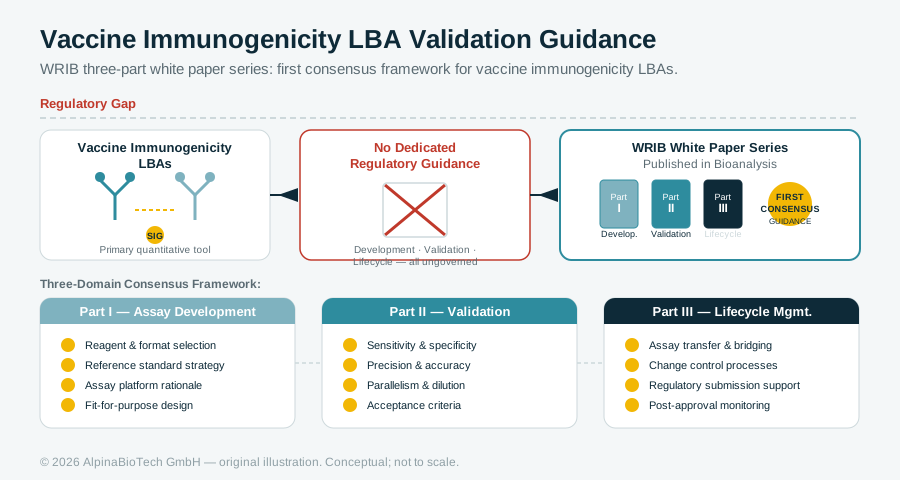
Vaccine Immunogenicity LBAs Have No Dedicated Validation Guidance: A Three-Part WRIB Series Sets Out to Change That
Ligand binding assays are the primary quantitative tool for vaccine immunogenicity studies, yet no dedicated regulatory framework has governed their development, validation, or lifecycle management. A three-part WRIB white paper series, now fully published in Bioanalysis, provides the first consensus-based guidance covering all three domains specifically for vaccine immunogenicity LBAs.
Read more
Enzyme Activity Assays in Rare Disease Drug Programs: Design, Validation, and Interpretation Across Four Clinical Contexts
A single enzyme activity assay format cannot equally serve diagnosis, pharmacokinetics, pharmacodynamics, and gene therapy efficacy readouts in lysosomal storage disorder programs. A 2026 review in Bioanalysis and supporting primary literature clarify how assay purpose, matrix, and immunogenicity monitoring must be aligned before validation begins. This article is for Research Use Only.
Read more