Article · 19 October 2026
Vaccine Immunogenicity LBAs Have No Dedicated Validation Guidance: A Three-Part WRIB Series Sets Out to Change That
Ligand binding assays are the primary quantitative tool for vaccine immunogenicity studies, yet no dedicated regulatory framework has governed their development, validation, or lifecycle management. A three-part WRIB white paper series, now fully published in Bioanalysis, provides the first consensus-based guidance covering all three domains specifically for vaccine immunogenicity LBAs.
AlpinaBioTech
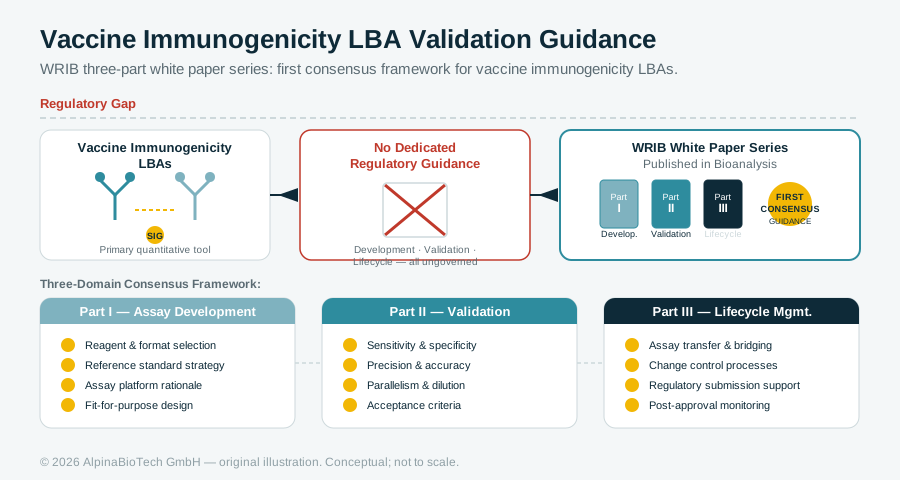
The ligand binding assay (LBA) is the primary quantitative tool for measuring vaccine immunogenicity, translating serum antibody responses into the data that determine whether a vaccine program advances. Yet the scientists running those assays have operated without a dedicated, harmonized regulatory framework. In contrast to bioanalytical methods evaluating chemical and biological drugs under ICH M10, there are no clear guidelines for methods supporting vaccine immunogenicity studies [2][3]. That gap has produced inconsistency between laboratories, between sponsors, and across regulatory submissions.
A multi-year initiative coordinated by the Workshop on Recent Issues in Bioanalysis (WRIB) has now closed that gap, at least provisionally. All three parts of a vaccine-specific LBA harmonization series are published. Part 1, "Harmonization of Vaccine Ligand Binding Assays Validation" (DOI: 10.1080/17576180.2024.2411925), appeared in Bioanalysis in 2024 [3][4]. Part 2, "Vaccine Ligand Binding Assay Development" (DOI: 10.1080/17576180.2026.2708544), is published in Bioanalysis, Volume 18, Issue 10, pages 839 to 851, epub August 21, 2026 [1]. Part 3, "Vaccine Ligand Binding Assay Life Cycle Management, Assay Maintenance, Monitoring and Transfer" (DOI: 10.1080/17576180.2026.2682709), is published in Bioanalysis, Volume 18, Issue 7, pages 547 to 559, epub June 22, 2026 [2].
The Part 2 white paper was developed through a collaborative effort by a working group of experts from 16 global vaccine manufacturers, national regulatory authorities, and a nonprofit global-health foundation convened under WRIB, and provides practical guidance to complement existing regulatory frameworks for bioanalytical method validation [1]. Together, the three parts represent the first consensus-based framework covering LBA development, validation, and lifecycle management specifically for vaccine immunogenicity studies.
For bioanalytical scientists who develop, validate, or transfer vaccine immunogenicity LBAs, the timing matters: the series fills a space that ICH M10 was never designed to occupy.
Why Vaccine LBAs Cannot Simply Follow the Biologic Drug Playbook
When a monoclonal antibody moves through development, the bioanalytical scientist anchors method validation to ICH M10. The analyte is structurally defined, the reference standard is well-characterized, and any antibody response is an anti-drug antibody evaluated through the established three-tier paradigm.
Vaccine immunogenicity assays present a structurally different problem. The analyte is not a drug molecule but the vaccinee's polyclonal, antigen-specific antibody response, which is dynamic across a clinical program that may last years or decades. Part 2 details the iterative process of LBA development, with emphasis on defining the Analytical Target Profile (ATP) as a foundational tool for guiding decision-making across the assay life cycle [1]. Key topics include assay purpose and analyte specificity, regulatory expectations, the use of statistical Design of Experiments (DOE) to systematically optimize assay conditions, and the selection of appropriate reagents, controls, and sample matrices [1]. The paper also addresses the unique challenges posed by the structural diversity of vaccine antigens and the need for representative reference materials [1].
That last point, reference materials, is a persistent problem without a clean solution. For most novel and complex vaccine antigens (in contrast to well-characterized antigens such as tetanus and diphtheria toxoids, for which WHO international standards carry IU/mL assignments), international reference standards are reported in arbitrary units and can provide only relative standardization. As stated in Part 1:
"In the case of LBAs used to evaluate vaccine immunogenicity, a true accuracy assessment is often impossible, because highly purified and fully characterized reference material does not usually exist, and standard curves cannot be generated from pure reference material but instead from samples whose exact composition is not precisely known and will only provide a relative measurement." [3]
The WRIB working group does not claim to have resolved this limitation. What the series provides instead is a structured decision framework for choosing the most defensible reference material approach for a given antigen class, vaccine platform, and development stage, and for documenting that choice in a way regulators can follow.
The Analytical Target Profile as the Assay Development Anchor
The conceptual centerpiece of Part 2 is the Analytical Target Profile (ATP). ICH Q14, finalized at Step 4/5 in late 2023, explicitly promotes science- and risk-based method development, introducing concepts like the ATP, critical method parameters, and Method Operable Design Regions (MODR) [1]. The WRIB authors apply this framework directly to vaccine immunogenicity LBA development: before optimization begins, the scientist specifies what the assay must measure, to what sensitivity and specificity, in which matrix, across which range of antibody titers, and at which stage of the clinical program.
Part 2 places the ATP as the foundational tool for guiding decision-making across the assay life cycle [1]. Every subsequent decision, from platform selection to reagent sourcing to cut-point strategy, is evaluated against that specification.
The Part 1 validation paper identifies an equivalent concept at the development stage. The immunogenicity objectives support the development of an assay target profile defining the key attributes, such as sensitivity, specificity, size of the dynamic range, and sample volume requirements, and the performance requirements of the candidate assay to be considered fit-for-purpose for its intended use [3][4].
The ATP keeps iteration anchored: it defines when an assay is good enough to advance and when a modification requires re-evaluation against the original performance criteria. Its explicit application to vaccine LBAs, where assay purpose can shift from seroconversion detection in Phase I to correlate-of-protection quantification in Phase III, is new in formal guidance.
Design of Experiments and Platform Selection
The DOE recommendation in Part 2 is practically significant. Vaccine antigen coating density, blocking buffer composition, serum dilution factors, and secondary detection reagent concentrations interact in non-linear ways. A one-factor-at-a-time optimization approach may reach a local optimum that under-performs when applied to seronegative versus highly immune sera, or to samples from different geographic populations. A factorial DOE conducted early in development surfaces those interactions explicitly, and the paper addresses the use of statistical DOE to systematically optimize assay conditions and the selection of appropriate reagents, controls, and sample matrices [1], supporting the documentation regulators expect when an assay is transferred between sites or scaled from a research laboratory to a Good Clinical Laboratory Practice (GCLP) setting.
Platform selection sits upstream of DOE. Plate-based ELISA remains the most common format for vaccine immunogenicity LBAs, valued for accessibility and the deep cross-laboratory experience base. Multiplexed bead-based platforms, electrochemiluminescence systems, and microfluidic formats are all in use across the industry, each with distinct sensitivity profiles and matrix tolerance characteristics. The white paper does not mandate a platform but requires that platform choice be driven by the ATP: if the endpoint is a correlate of protection with a defined minimum detectable concentration, the platform must demonstrably reach that concentration in the intended sample matrix [1].
Pivotal clinical and licensure-supporting studies, covering Phase 3 and post-licensure work, demand full validation, robust control strategies, and documented life cycle management plans consistent with applicable regulatory and ICH guidance [1]. Assays developed for early-stage discovery should be reassessed, and redeveloped if deemed necessary, before use in clinical testing, to ensure performance and robustness under increased variability and regulatory expectations [1].
The Three-Part Series in Context
The COVID-19 pandemic accelerated recognition that vaccine bioanalysis had outgrown available guidance. Since 2017, participation in WRIB working groups by vaccine assay validation experts and regulators had rapidly increased due to the forum's unique format where industry leaders and regulators can meet and exchange ideas [5]. In early 2021, vaccine manufacturers approached WRIB to support the authorship and publication of an overarching vaccine assay validation document based on the 2017 to 2020 discussions and consensus, starting from immunogenicity assays first and followed by future papers on molecular and cell-based assay validation [5].
The working group's scope included future papers on Molecular Diagnostics (MDx, including both PCR and NGS), Biofunctional Assays (BFA), and Cell-Mediated Immunity (CMI) assays validation [5]. Using the industry and WRIB vaccine network, a vaccine immunogenicity assay validation expert working group was assembled representing 16 global companies [5]. The work on the first three white papers officially began in April 2021, focusing on vaccine immunogenicity ligand binding assays [5].
The reading order of the series matters for how to apply it. Part 1 (2024) is the logical entry point: as the authors state, for too long, vaccine scientists have not had a clear validation guidance for vaccine immunogenicity assays [3][4]. Part 2 (2026) then addresses what must be established before a method reaches formal validation [1]. Part 3 (2026) addresses what happens after validation sign-off: the activities that are required to ensure consistency of assay performance following validation are discussed [2][7].
Part 2 was cleared by the main regulatory agencies and accompanies Part 1 (Vaccine LBA Validation), published previously in 2024, and Part 3 (Vaccine LBA Monitoring and Transfer) [1]. That publication timeline is independently confirmed by the primary white papers themselves and by the European Medicines Agency's scientific publications list [1][2][3][6].
What This Means for Laboratories Running Vaccine Immunogenicity Assays
The immediate practical implication for laboratory scientists is straightforward: the three-part series is now available as a reference framework for assay development plans, validation reports, and regulatory submissions. Collectively, the recommendations presented aim to supplement existing regulatory guidance with vaccine-specific considerations, ultimately supporting the development of safe and effective vaccines [1][2][3]. They do not replace existing ICH or FDA bioanalytical guidance; they supplement them with vaccine-specific considerations that those documents do not address.
For scientists building or transferring a vaccine immunogenicity LBA, Part 2 offers a structured companion to the ATP: what to establish before optimization begins, what DOE outputs to document, how to justify reagent choices, and how to characterize the assay's performance envelope across the range of sample types it will encounter in a clinical program [1]. The manuscript highlights the importance of ongoing performance assessment and the adaptability of assays as they transition from early exploratory phases to pivotal clinical studies [1].
For scientists who transfer assays between sites, Part 3 picks up where Part 2 ends: the activities that are required to ensure consistency of assay performance following validation are discussed, addressing a domain for which, in contrast to bioanalytical methods evaluating chemical and biological drugs under ICH M10, there are no clear guidelines for methods supporting vaccine immunogenicity studies [2][7].
That breadth of authorship across 16 global companies plus regulatory authorities increases the probability that the consensus positions in the documents will be recognized, if not formally adopted, by regulators during IND and BLA review.
What Comes Next
Recommendations on vaccine cell-based assays validation, covering ELISpot and flow cytometry to measure cell-mediated immunity, and vaccine molecular assays validation, covering PCR, NGS, and NanoString, are on the WRIB publications agenda [5][8]. These technologies are in routine use for T cell immunogenicity endpoints in infectious disease and cancer vaccine programs, but operate today under the same regulatory ambiguity that the LBA series was written to resolve. The LBA white papers are explicitly intended as the foundation on which those future documents build [1][2].
For scientists managing vaccine programs now, the most practical next step is to download all three published parts and map them against the laboratory's current development, validation, and transfer documentation. Part 1 is the first global effort to guide vaccine clinical assay validation work, and Parts 2 and 3 build directly on it [3][4][1][2]. Used together, the three documents provide enough structure to align method documentation with current regulatory expectations without waiting for a formal ICH or FDA guidance document that may be years away.
For Research Use Only. Not for use in diagnostic procedures. This notice applies to any LBA reagents or kits used in the assay formats described. The white paper guidance documents themselves carry no RUO designation; they are scientific consensus papers intended to inform assay development and regulatory submissions across the vaccine development lifecycle.
Sources
- [1] tandfonline.com
- [2] tandfonline.com
- [3] tandfonline.com
- [4] pubmed.ncbi.nlm.nih.gov
- [5] bioanalysis-zone.com
- [6] ema.europa.eu
- [7] bioanalysis-zone.com
- [8] pmc.ncbi.nlm.nih.gov
More articles

Enzyme Activity Assays in Rare Disease Drug Programs: Design, Validation, and Interpretation Across Four Clinical Contexts
A single enzyme activity assay format cannot equally serve diagnosis, pharmacokinetics, pharmacodynamics, and gene therapy efficacy readouts in lysosomal storage disorder programs. A 2026 review in Bioanalysis and supporting primary literature clarify how assay purpose, matrix, and immunogenicity monitoring must be aligned before validation begins. This article is for Research Use Only.
Read more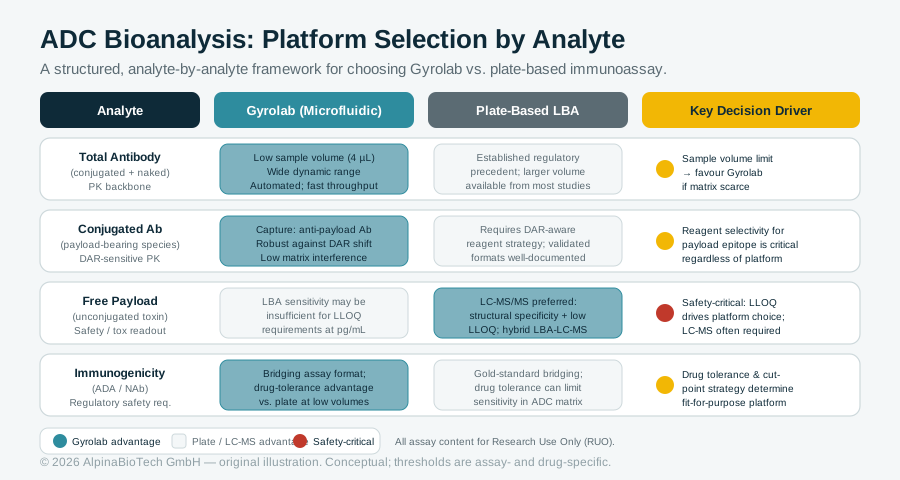
Platform Choice at the Core of ADC Bioanalysis: What the Gyrolab-vs-Plate Debate Actually Requires Scientists to Decide
Selecting between Gyrolab microfluidic and conventional plate-based immunoassay platforms for antibody-drug conjugate bioanalysis is not a single decision but a structured one made analyte by analyte. A sponsored interview published October 13, 2026, on Bioanalysis Zone, combined with the July 2026 AAPS ADC Working Group white paper in AAPS Journal, provides the clearest current framework for making those choices across total antibody, conjugated antibody, free payload, and immunogenicity assays. All assay content discussed is for Research Use Only.
Read more