Article · 14 October 2026
Platform Choice at the Core of ADC Bioanalysis: What the Gyrolab-vs-Plate Debate Actually Requires Scientists to Decide
Selecting between Gyrolab microfluidic and conventional plate-based immunoassay platforms for antibody-drug conjugate bioanalysis is not a single decision but a structured one made analyte by analyte. A sponsored interview published October 13, 2026, on Bioanalysis Zone, combined with the July 2026 AAPS ADC Working Group white paper in AAPS Journal, provides the clearest current framework for making those choices across total antibody, conjugated antibody, free payload, and immunogenicity assays. All assay content discussed is for Research Use Only.
AlpinaBioTech
Platform Choice at the Core of ADC Bioanalysis: What the Gyrolab-vs-Plate Debate Actually Requires Scientists to Decide
The antibody-drug conjugate field has grown fast enough that platform selection is no longer an academic question. As of April 2025, the U.S. FDA had approved 14 ADCs for various malignancies, and more than 370 candidates had been evaluated in clinical trials worldwide [8]. As of mid-2025, there were 15 FDA-approved ADCs covering multiple indications, including breast, lung, bladder, and hematologic cancers [9]. After a two-year hiatus without new ADC approvals, two additional ADCs were approved in 2025 [10]. The global ADC market was valued at USD 14.5 billion in 2025 and is projected to grow from USD 16.7 billion in 2026 to USD 32.1 billion by 2033, at a compound annual growth rate of 11.5% [14].
That commercial and clinical pressure lands directly on bioanalytical scientists. Every program entering the clinic needs assays for total antibody (tAb), conjugated antibody (cAb), free payload, and immunogenicity, and the platform choices made during method development shape data quality for the rest of the program.
A sponsored interview on Bioanalysis Zone, produced by Gyros Protein Technologies and published October 13, 2026, features Dr. Wibke Lembke, Senior Director LBS and MCB at Celerion Switzerland AG. The interview addresses how laboratories select appropriate analytical strategies for measuring total versus conjugated antibody alongside immunogenicity, practical approaches to managing matrix interference, and the rationale for adopting Gyrolab technology versus plate-based platforms [1]. Combined with the white paper published July 1, 2026, in AAPS Journal (Volume 28, article 121), developed by the ADC Working Group of the AAPS Bioanalytical Community comprising over 100 members from industry, contract research organizations, and regulatory agencies [6], this material provides the clearest current framework for structuring those choices analyte by analyte.
The question has no universal answer, but it does have a structured one.
For Research Use Only.
What ADC Bioanalysis Actually Has to Measure
Before any platform discussion, the analyte scope has to be fixed. The 2026 AAPS white paper addresses advances in bioanalytical quantitation strategies for tAb, conjugated ADC, free (unconjugated) payload, and drug-to-antibody ratio (DAR); novel immunogenicity assessment considerations; soluble target interference; critical reagent lifecycle management; payload-specific stability requirements; cross-validation strategies; and regulatory considerations [6].
Each analyte has a distinct assay logic. There are two principal conjugated-component assay types: conjugated payload assays, which measure the number of payloads on the ADC, and conjugated antibody assays, which measure the number of antibodies carrying at least one payload regardless of DAR [6]. Total antibody covers both conjugated and unconjugated species.
The drug-to-antibody ratio (DAR) introduces a quantitation hazard that runs through all of these measurements. A DAR-sensitive ligand-binding assay (LBA) will systematically misrepresent exposure if the circulating ADC population has shifted away from the reference standard DAR, which it typically does in vivo as deconjugation proceeds. DAR bias assessment during method development is therefore a non-negotiable starting point regardless of which platform is used [6].
For the small-molecule component, platform choice is already settled: quantifying unconjugated payload and metabolites relies on LC-MS/MS, adding small-molecule bioanalytical capacity requirements alongside biologics LBA capacity [6]. Most ADC programs therefore require at least two distinct bioanalytical platforms regardless of how the antibody components are measured.
The recommendations presented in the 2026 white paper reflect over a decade of scientific progress and are designed to serve as a comprehensive, empirically validated, and industry-aligned bioanalytical framework for contemporary ADC drug development [6].
What Plate-Based LBAs Provide and Where They Strain
Conventional plate-based immunoassays, including ELISA, remain the established baseline for tAb and cAb quantification. The format is well understood, reagent-flexible, and widely accepted by regulators.
The practical ceiling shows up in three places.
First, matrix interference. Matrix interference remains a significant challenge in ADC LBA development due to the molecule's structural complexity and the presence of circulating drug-related species [6]. Platform choice is therefore a meaningful variable, not a cosmetic one. As the 2026 AAPS white paper notes, different LBA platforms have key advantages over others, and the benefit of any specific platform feature needs to be demonstrated for the particular assay [6].
Second, sample volume. Gyrolab uses 5 to 10 microliters of sample for triplicate measurements compared to ELISA's 50 to 100 microliters per datapoint, reducing sample and reagent consumption by approximately 90% [3]. For early-phase clinical studies where sample volume is restricted and multiple assays are required simultaneously from a single draw, the plate format's consumption profile becomes a hard constraint.
Third, assay consistency. Traditional plate-based immunoassays, including well-optimized ELISAs, often struggle to deliver the same level of consistency, automation, and workflow efficiency; manual plate-based assays can address many of these requirements but often require considerably more optimization and operator intervention [3].
What Gyrolab Microfluidics Provides for ADC Programs
Gyrolab is an automated ligand-binding assay platform designed for the quantification of proteins with high sensitivity and broad dynamic range; its low minimum required dilution and microfluidic disc format enable efficient sample processing while maintaining assay robustness, making it a valuable tool across drug-development stages [2].
Sample volume is the most immediately consequential advantage for ADC programs. The roughly tenfold reduction versus standard plate ELISA [3] preserves material and makes simultaneous multi-assay analysis from a single draw feasible across tAb, cAb, ADA, and neutralizing antibody formats.
Throughput and repeatability matter in regulated settings. The figures most frequently cited by Gyros Protein Technologies, including first-time assay success rates of 90 to 95 percent compared to approximately 50 percent for ELISA [3], are vendor-reported benchmarks from Gyros Protein Technologies' own workflow comparisons and should be interpreted as marketing data rather than independently verified performance figures. Peer-reviewed regulated bioanalysis studies provide a more conservative reference point: approximately 4,000 samples tested across six GLP toxicology studies and two clinical studies on the Gyrolab xP achieved run pass rates of 83 percent or higher, with incurred sample reanalysis (ISR) pass rates above 94 percent [7]. Repeat analysis is not just a cost driver: it is a timeline driver in clinical programs where sample storage stability windows are fixed.
Dynamic range is relevant for ADC programs because circulating tAb and cAb concentrations can span several orders of magnitude during a dosing interval. Wide dynamic range on Gyrolab, spanning three to four orders of magnitude within a single run, reduces the number of dilution series required to bring samples into the assay working range [4].
For a validated Gyrolab method quantifying rituximab in human serum, intrabatch precision and accuracy were determined using spiked human serum samples and shown to have a coefficient of variation (CV) of less than 11%, with a mean bias of less than 20% [2]. The mean bias figure of less than 20% is consistent with LBA validation convention, where the 20% threshold applies specifically at the lower limit of quantitation (LLOQ) anchor point; tighter criteria of plus or minus 15% are expected at mid-curve concentrations. Scientists should not interpret this figure as a mid-curve performance ceiling. Interbatch precision (CV) and absolute mean bias were both less than 12%, with total error less than 25% [2]. The 2026 review by Mano et al. in Bioanalysis summarizes this and additional Gyrolab applications for PK, immunogenicity, and biomarker quantification across biotherapeutic programs [2].
Optimization throughput is particularly relevant in early development. Gyrolab enables rapid, high-throughput, low-volume analysis with minimal manual handling [4], which matters most when reagent supply is limited and the number of format-screening experiments is high. Using the Gyrolab platform, assay conditions can be established in as little as one week, with the first assay comparison confirming a much greater dynamic range than ELISA [4].
Immunogenicity in ADC Programs: Platform Considerations
The 2026 AAPS white paper addresses novel immunogenicity assessment considerations as a domain building on the foundational 2013 AAPS position paper [6]. ADCs present a specific immunogenicity challenge: because the molecule comprises three distinct structural domains, the antibody, the linker, and the payload, the immune system may respond to any of them. Research indicates that although patients generally develop ADAs only against the monoclonal antibody component, they may also simultaneously produce antibodies against the linker and payload, increasing the overall risk of immunogenicity [11]. An ADA assay for an ADC therefore needs to determine not just whether antibodies are present, but where the immune response is directed.
Drug tolerance is a critical performance parameter for ADC ADA assays, because circulating drug at trough is often still present when screening samples are collected. The standard approach, acid dissociation followed by neutralization, introduces variability in manual plate-based workflows. Gyros Protein Technologies offers a Mixing CD that enables automation of homogeneous bridging assays with acid dissociation, allowing full automation of the acid dissociation step, including reagent addition, mixing, and incubation of the reaction mixture within a dedicated mixing chamber [5]. Automation of this step reduces analyst-to-analyst variability and is directly relevant to the consistency of ADA incidence reporting across clinical sites.
A platform advantage in volume efficiency or automation does not substitute for demonstrated fit-for-purpose performance in the specific matrix and at the specific drug tolerance level required for the study. The benefit of any specific platform feature needs to be demonstrated for the particular assay [6].
Selecting the Analytical Strategy: A Framework
The 2026 review by Mano et al. summarizes published Gyrolab applications spanning biotherapeutic assays for PK and toxicokinetic studies, ADA assays for immunogenicity, and biomarker quantification, with practical considerations for both regulated and exploratory settings [2]. Comprehensive ADC bioanalysis requires assays and parameters covering total antibody, total conjugated drug, unconjugated payload and its metabolites, drug-to-antibody ratio, and immunogenicity, using ligand binding and mass spectrometry-based approaches, and entails an integrated understanding of antibody stability, linker chemistry, payload characteristics, and potential immunogenicity [6].
The four non-negotiable starting points identified in the 2026 AAPS white paper, namely payload-specific stability, DAR bias assessment, soluble target interference testing, and critical reagent lifecycle management, apply regardless of which platform is selected [6].
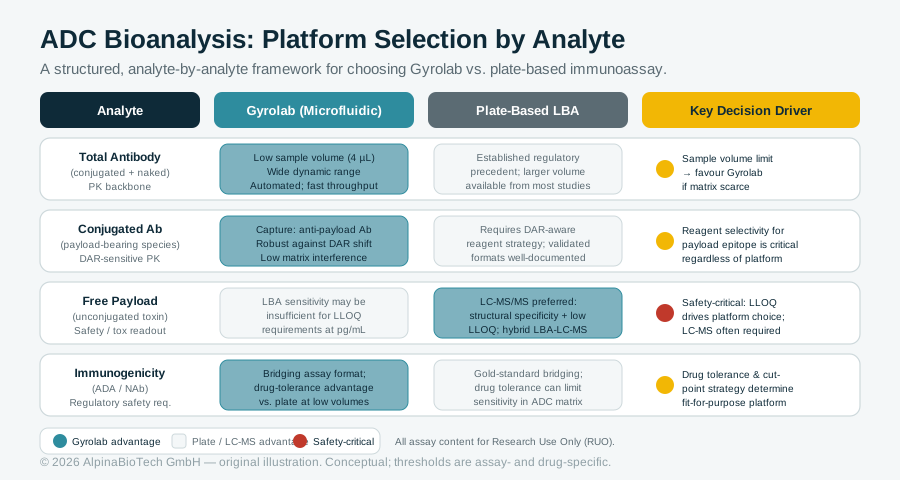
In practice, platform selection for each assay type follows the analyte's chemical nature and the regulatory expectations for that measurement:
- Total antibody (tAb): LBA or microfluidic LBA. Capture and detection reagents must be selected to be DAR-insensitive; anti-Fc or anti-hinge capture formats that do not contact the conjugation site are commonly used. Where sample volume is limited, Gyrolab's volume advantage is directly enabling [1].
- Conjugated antibody (cAb): LBA with anti-payload detection, or hybrid LBA-LC-MS/MS. DAR sensitivity is intentional here. Hybrid LBA-LC-MS/MS platforms address traditional LBA limitations such as matrix interference and lack of DAR differentiation, enhancing analytical rigor in ADC quantification [12].
- Free unconjugated payload and metabolites: LC-MS/MS. Immunoassays lack the selectivity needed to distinguish free payload from ADC-conjugated payload in complex matrices [6].
- ADA and neutralizing antibody: Bridging immunoassay on plate or microfluidic platform. Gyrolab's Mixing CD automates the acid dissociation step, including reagent addition, mixing, and incubation within a dedicated mixing chamber, to improve drug tolerance [5]. The AAPS white paper addresses novel immunogenicity assessment considerations as an explicit updated recommendation [6].
Programs entering Phase III face larger sample sets, tighter timelines, and more rigorous cross-site validation requirements, exactly the conditions where automation-driven repeatability and reduced reanalysis rates matter most. More than 370 ADC candidates have been evaluated in clinical trials worldwide [8], and those pipelines will generate regulated sample sets that stress both platforms at scale.
What This Means for Bioanalytical Scientists Choosing a Platform
The Gyrolab-versus-plate question does not resolve to one answer for all ADC programs. It resolves differently for each assay type within a program, and it should be revisited as the program advances from exploratory to validated methods.
For early development, volume and reagent savings from microfluidic formats are most valuable when reagent supply is limited and the number of format-screening experiments is high [4]. For regulated studies supporting IND or BLA submissions, the decision criterion shifts from convenience to demonstrated fit-for-purpose performance. Either platform can meet regulatory expectations if properly validated. The validation burden differs: plate-based ELISAs carry higher optimization demands and more manual intervention [3], while microfluidic platforms require upfront investment in instrumentation and training but deliver more consistent inter-run precision under benchmarks reported from peer-reviewed regulated bioanalysis programs [7].
The AAPS community's 2026 white paper, building on the 2013 position paper and covering payload-specific stability, DAR bias, soluble target interference, and critical reagent lifecycle management, is designed to serve as a comprehensive, empirically validated, and industry-aligned bioanalytical framework for contemporary ADC drug development [6]. Scientists designing ADC bioanalytical programs should treat those four domains as non-negotiable starting points, and then let the analyte's chemistry and the study's sample constraints drive the platform selection from there.
Research Use Only. All assay content discussed in this article is intended for Research Use Only and is not for use in diagnostic procedures.
Sources
- [1] bioanalysis-zone.com
- [2] tandfonline.com
- [3] gyrosproteintechnologies.com
- [4] gyrosproteintechnologies.com
- [5] gyrosproteintechnologies.com
- [6] link.springer.com
- [7] link.springer.com
- [8] pmc.ncbi.nlm.nih.gov
- [9] zs.com
- [10] pmc.ncbi.nlm.nih.gov
- [11] oaepublish.com
- [12] pmc.ncbi.nlm.nih.gov
- [13] pmc.ncbi.nlm.nih.gov
- [14] grandviewresearch.com
More articles
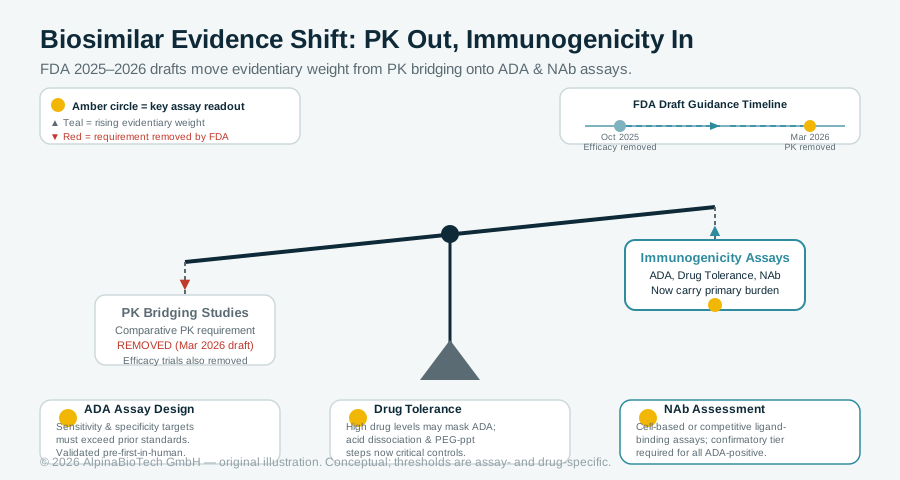
When PK Studies Slim Down, Immunogenicity Assays Carry More Weight: What FDA's 2026 Biosimilar Guidance Means for Bioanalytical Scientists
FDA's March 2026 draft guidance removes the default requirement for comparative PK bridging studies in biosimilar development, building on a prior October 2025 draft that proposed eliminating routine efficacy trials. Both actions shift evidentiary weight onto immunogenicity assays, raising the bar for ADA assay design, drug tolerance, and neutralizing antibody assessment before any clinical samples are collected.
Read more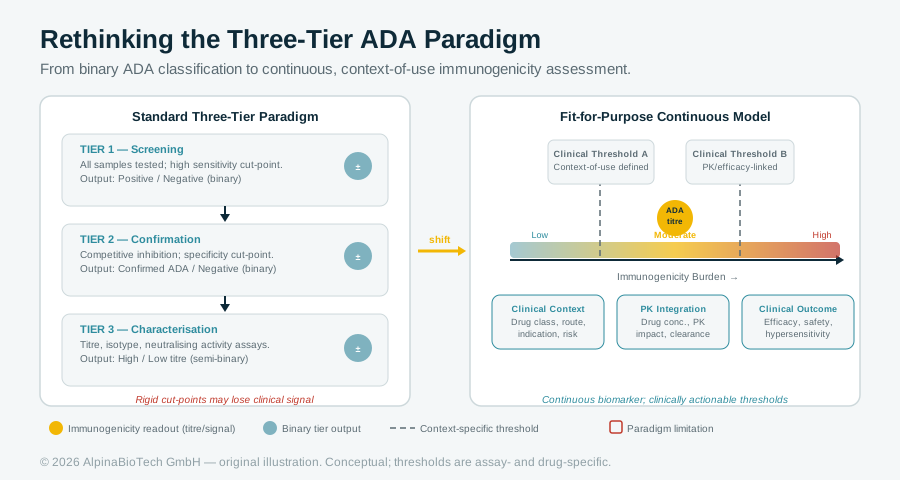
When ADA Positivity Is Not the Answer: Rethinking the Three-Tier Immunogenicity Paradigm
The standard three-tier ADA testing paradigm has governed biologic immunogenicity assessment for more than two decades, but a growing body of evidence questions whether it consistently delivers clinically meaningful data. New publications from Immunologix Laboratories, the European Bioanalysis Forum, and IQVIA Laboratories converge on a fit-for-purpose, context-of-use-driven alternative that treats immunogenicity as a continuous biomarker endpoint rather than a binary classification.
Read more