Article · 2 October 2026
When ADA Positivity Is Not the Answer: Rethinking the Three-Tier Immunogenicity Paradigm
The standard three-tier ADA testing paradigm has governed biologic immunogenicity assessment for more than two decades, but a growing body of evidence questions whether it consistently delivers clinically meaningful data. New publications from Immunologix Laboratories, the European Bioanalysis Forum, and IQVIA Laboratories converge on a fit-for-purpose, context-of-use-driven alternative that treats immunogenicity as a continuous biomarker endpoint rather than a binary classification.
AlpinaBioTech
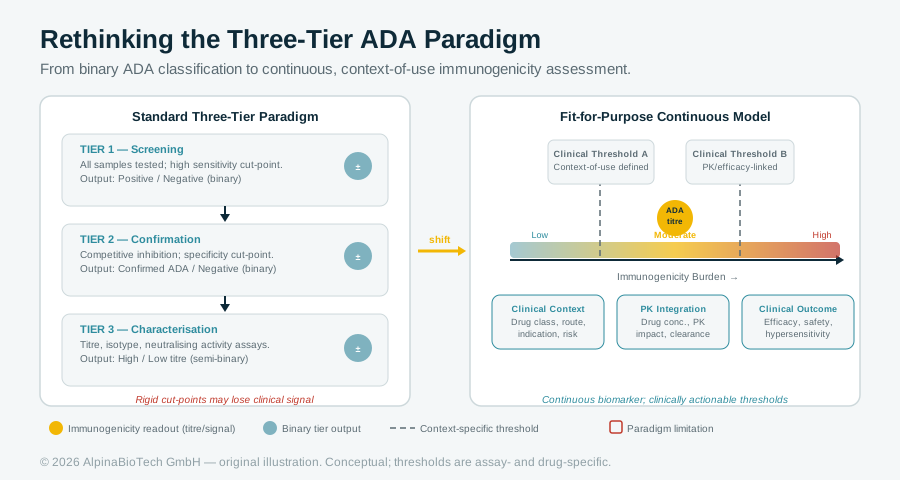
The standard three-tier anti-drug antibody assay has been the industry's default for more than two decades. Screen at a 5% false-positive rate, confirm positives, titer the confirmed responders, then route high-risk samples to neutralizing antibody testing. Regulators have expected it, sponsors have built it, and CROs have validated it for every biologic program, regardless of molecule type or immunogenicity risk profile. An IQVIA Laboratories white paper published to Bioanalysis Zone on October 1, 2026, and two peer-reviewed papers by Lauren F. Stevenson of Immunologix Laboratories published in Bioanalysis in 2026, together put a pointed question on the table: is this paradigm still fit for purpose, and is it time to replace procedural habit with clinical relevance? [1][3][8]
These assay strategies are discussed for Research Use Only applications.
What the Three-Tier Paradigm Was Built to Do
As biologics became more complex and regulatory expectations matured, the industry transitioned toward the now-familiar three-tier testing paradigm consisting of screening, confirmatory, and titer assessment, often followed by neutralizing antibody (NAb) characterization. This paradigm was initially developed in the context of high-risk biologics that mimicked endogenous biological counterparts, where detection of ADAs was critical to understanding serious safety events. [1][3]
The canonical architecture is designed to ensure no true positives are missed. The screening tier incorporates a statistical cut point at a 5% false-positive rate. The confirmation tier corrects for false positives that pass through screening. The titration tier determines the magnitude of true responses. [3] That design made sense when the field had limited clinical experience with biologics and the consequences of undetected immunogenicity were less predictable. More than two decades ago, biotherapeutics were simpler in structure and complexity, yet less humanized, and early clinical experience meant limited data sets to inform what factors would truly differentiate high-risk from low-risk responses. [3]
For many years, that paradigm served the industry well, and that success is now contributing to its own evolution. Over the last two decades, the field has generated an enormous volume of ADA and NAb data across virtually every therapeutic modality. [1][2] The IQVIA Laboratories white paper frames the central tension directly: a growing body of evidence suggests that traditional three-tier ADA testing strategies may not always deliver the clinical insight expected, raising the question of whether decades-old immunogenicity testing paradigms are still fit for today's therapeutic landscape. [1]
The Problems That Accumulate Over 20 Years
The Stevenson case study in Bioanalysis (Vol. 18, Issues 5-6, pp. 503-516) is direct about what accumulated clinical experience reveals. [3] Three specific failure modes stand out.
False positives near the cut point. Confirmation of very low responses, including false positives near statistical cut points that represent biological variability only, can inflate immunogenicity incidence that does not correlate with clinical impact. [3] The limitations of traditional cut points are particularly acute when increasing assay sensitivity creates signal that may ultimately represent biological noise rather than actionable findings.
Validated but not fit for purpose. The Stevenson case study used a real Phase 1 monoclonal antibody program. A Meso-Scale Discovery (MSD) bridging ADA assay with acid sample pretreatment was fully validated at a GLP-compliant bioanalytical laboratory according to current immunogenicity guidance and published best practices to support clinical studies for a low-risk antagonistic monoclonal antibody therapeutic. [3] The review of validation data revealed that while the assay met or exceeded expected validation criteria for all parameters, for this category of low-risk molecule there are no direct safety concerns related to immunogenicity, with clinically relevant ADA responses being those of sufficient magnitude to impact drug exposure levels and thereby, potentially, efficacy. [3] A fully validated assay is not automatically an appropriate assay.
Cut points that create binary blindness. Immunogenicity is a biological response to pharmacologic therapeutic intervention and therefore fits squarely within established definitions of a biomarker, yet ADA testing has converged on a largely uniform, three-tiered paradigm built around statistically derived cut points and titer reporting. [8] When the analysis discards the negative data set entirely after the screening tier, it discards population-variability information that could contextualize the positive calls. Immunogenicity datasets are often reduced to binary classifications that discard biological context, inflate reported incidence, and complicate efforts to relate immune responses to clinically meaningful outcomes such as pharmacokinetics, pharmacodynamics, efficacy, or safety. [8] Titer-based readouts, while appropriate for large vaccine-like responses, are frequently insufficiently granular to capture the full spectrum of response magnitudes relevant to contemporary biotherapeutic modalities. [8]
The Case for Signal-to-Noise as a Continuous Biomarker Endpoint
What the IQVIA white paper and the two Stevenson publications in Bioanalysis converge on is a reframing: immunogenicity assays are biomarker assays. [1][3][8] Clinical immunogenicity testing requires a context-of-use-driven approach, highlighting why a one-size-fits-all three-tier paradigm is misaligned with program risk and clinical decision needs.
The practical proposition is to use the screening assay's signal-to-noise (S/N) ratio as a continuous endpoint, rather than as a binary gate that routes samples into or out of confirmatory analysis. By leveraging S/N and raw signal data from the screening tier, the analysis provides a more granular, contextualized view of immunogenicity. [3] Placebo data further inform longitudinal variability within the study population. [3] This approach demonstrably clarifies apparent baseline positivity, distinguishes true treatment-emergent responses, and reveals that some subjects classified as ADA-positive under the traditional paradigm reflect biological variability or low-level, clinically irrelevant responses. [3]
Stevenson's companion paper, "From tiers to truth: a biomarker-based framework for clinically relevant immunogenicity assessment," published in Bioanalysis Vol. 18, Issue 4, March 2026 (PMCID: PMC13215301), extends this argument into a formal framework. [8] Reframing immunogenicity as a context-of-use-driven biomarker measurement leverages complete, continuous response profiles, such as screening-tier signal-to-noise, alongside pharmacokinetic and pharmacodynamic data and clinical outcomes, to identify clinically relevant immunogenicity thresholds. [8]
This is not a proposal to reduce rigor. Continuous readouts such as S/N enhance interpretation relative to titers and enable earlier insight into response dynamics without requiring additional assay tiers. [3] These findings collectively underscore limitations of the current paradigm, including potential inflation of incidence, loss of clinical context, and mischaracterization of program risk. A biomarker-based framework offers an opportunity to generate more informative immunogenicity data more efficiently, supporting improved decision-making and facilitating timely regulatory evaluation. [3]
The European Bioanalysis Forum's Adaptive Proposals
The IQVIA perspective does not stand alone. The European Bioanalysis Forum (EBF) continues to champion a reevaluation of the traditional three-tier immunogenicity testing model, advocating for a context-of-use-driven strategy across all assays. [4]
The EBF's formal recommendations were published by Kyra J. Cowan, Rob Nelson, Annelies Coddens, Karien Bloem, and colleagues in Bioanalysis Vol. 18, Issue 3, 2026 (DOI: 10.1080/17576180.2026.2641928). [4] The paper recommends transitioning toward adaptive one-tier or two-tier combined approaches tailored to molecule context-of-use, prioritizing the clinical impact of ADAs over mere incidence and advocating careful consideration of assay characteristics during assay development.
The one-tier approach is technically defined. The EBF proposes a simpler, context-driven one-tier approach, a recent paradigm shift that emphasizes clinical relevance and the impact of anti-drug antibodies over mere incidence. [5] This means eliminating confirmatory and titer steps, instead using a cut point based on a 1% false-positive rate to determine ADA status, and using the S/N ratio rather than titer to measure ADA magnitude. [5] Earlier EBF discussion papers from the same working group, including Cowan, Bloem, Coddens, and colleagues in Bioanalysis 2025 (PMCID: PMC12128674, DOI: 10.1080/17576180.2025.2487377), documented the cross-industry expert discussions that preceded the formal 2026 recommendations. [5]
Overall there is strong support for the one-tier approach, but the EBF is explicit that it is not a shortcut: the Forum continues to call for published case studies, industry collaboration, and proactive dialogue with regulatory authorities to challenge the traditional three-tier approach. [5]
When the Confirmatory Tier and NAb Assay Still Add Value
A fit-for-purpose framework does not eliminate tiered testing globally. It makes the choice molecule-specific and scientifically driven rather than procedurally automatic. [1][2]
Partridge et al. published a risk-based NAb framework in The AAPS Journal in August 2025 (DOI: 10.1208/s12248-025-01118-6). [6] That manuscript proposes a risk-based strategy to determine if and when to employ a stand-alone NAb assay: for molecules where immunogenicity carries serious safety consequences, such as biological mimics of endogenous proteins, a dedicated NAb assay remains indicated. For lower-safety-risk molecules, however, a stand-alone NAb assay does not materially enhance interpretation of clinical data. [6] Instead, integrating ADA status, magnitude, persistence, pharmacokinetics, and pharmacodynamics can serve as a practical surrogate for stand-alone NAb assay data, while also capturing downstream functional readouts of neutralizing activity. [6]
Real-world evidence for regulatory acceptance of this approach appears in a June 2026 paper in Bioanalysis (Vol. 18, Issues 8-9, pp. 797-805) by Kirstee Martin, Marit Lichtfuss, Devangi Mehta, and colleagues at Immunologix Laboratories and other institutions. [7] The paper demonstrates, through clinical case examples, how integrated immunogenicity assessments can replace standalone NAb assays while remaining scientifically rigorous, clinically informative, and aligned with regulatory expectations. [7] Immunogenicity strategies should be developed based on the specific safety risks attributable to immunogenicity and on identifying the most appropriate methods to fully characterize any resulting clinical impact. [7] For complex molecules with endogenous counterparts or multi-specific architectures, confirmatory testing may still be required; the EBF proposal and the Partridge risk framework do not foreclose that option. [4][6]
What This Means for Assay Scientists and Sponsors
Three practical implications follow for any program conducting ADA assessment.
Context-of-use must precede assay design. The bioanalytical strategy for a therapeutic should be driven by the overall immunogenicity risk of the molecule. [1] The industry's shift is from rigid, one-size-fits-all immunogenicity workflows toward fit-for-purpose bioanalytical strategies that prioritize clinical relevance over procedural convention. Consequently, the standard three-tier testing paradigm designed to detect very low levels of antibody may not be the best approach to generate clinically relevant data for every program. [1][3]
Validation alone does not establish clinical utility. A fully validated assay can still inflate incidence by capturing biological noise as ADA positivity. [3] The S/N ratio, used as a continuous endpoint alongside pharmacokinetic and pharmacodynamic data, offers a more granular readout that enables earlier and more accurate characterization of response dynamics without requiring additional assay tiers. [3][8]
Regulatory dialogue cannot be deferred. Any sponsor considering an adaptive strategy should engage health authorities early, document the immunogenicity risk rationale thoroughly, and be prepared to demonstrate that S/N-based reporting provides equivalent or superior clinical interpretability relative to the standard paradigm. Real-world regulatory acceptances are beginning to appear in the literature, [7] and the EBF continues to call for the published case studies and proactive dialogue that will build the shared evidentiary base regulators need to accept alternative approaches more broadly. [4][5]
Conclusion
The three-tier paradigm was built for a specific era of biologic development. Two decades of ADA data have identified where it delivers clinical insight and where it generates detectable signal without clinical meaning. The shift toward fit-for-purpose, context-of-use-driven ADA testing is not a regulatory gamble; it is a scientific maturation. The question for assay scientists designing immunogenicity programs today is not merely whether to validate the assay, but whether the assay, once validated, will actually answer the clinical question being asked.
All assay strategies referenced in this article are discussed in the context of Research Use Only applications. Platform suitability for regulated clinical studies should be confirmed against applicable regulatory guidance.
Sources
- [1] bioanalysis-zone.com
- [2] labs.iqvia.com
- [3] pmc.ncbi.nlm.nih.gov
- [4] tandfonline.com
- [5] pmc.ncbi.nlm.nih.gov
- [6] link.springer.com
- [7] tandfonline.com
- [8] pmc.ncbi.nlm.nih.gov
More articles
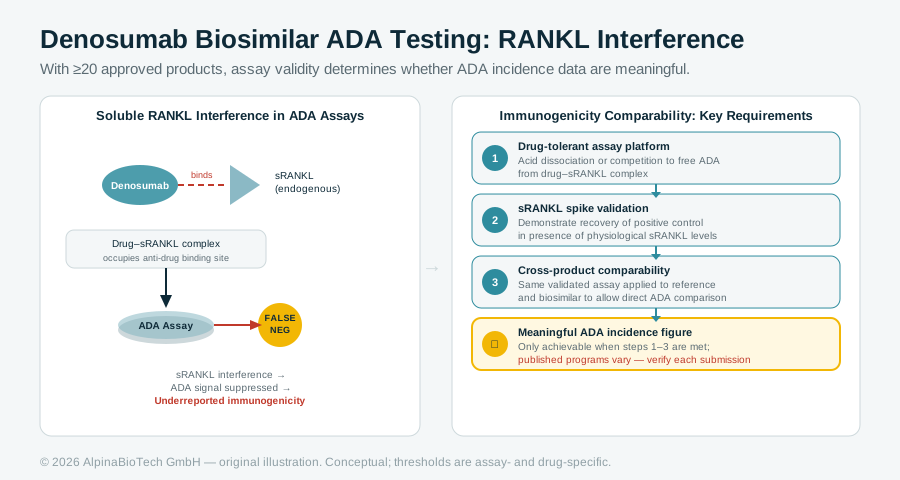
Degevma's FDA Approval and a Market with More Than 20 Denosumab Biosimilars: What Immunogenicity Comparability Testing Actually Requires
The FDA's approval of denosumab-adet (Degevma) on September 28, 2026 brings the cumulative total of approved denosumab products to at least 20, raising a concrete methodological question: in a market this saturated, with interchangeability-driven pharmacy substitutions, what does a reported ADA incidence figure actually tell you? The answer depends entirely on whether the assay has solved the soluble RANKL interference problem, and the published literature shows that not every program has.
Read more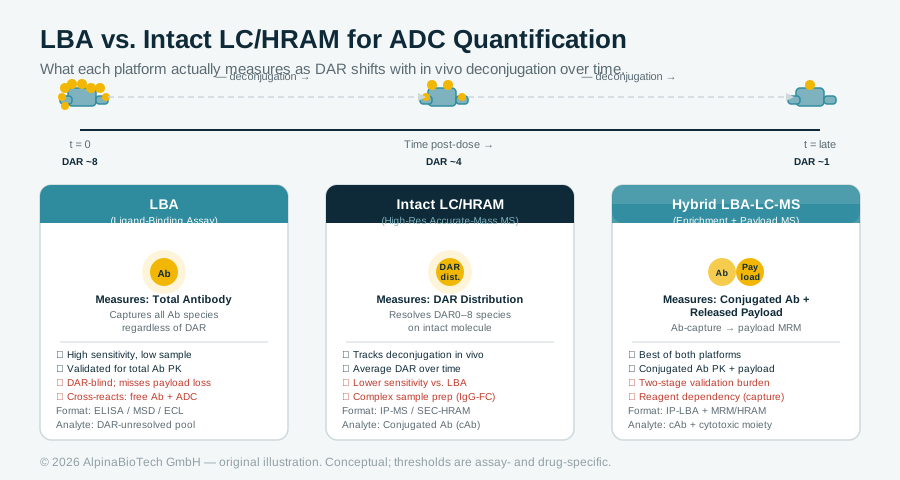
LBA vs. Intact LC/HRAM for ADC Quantification: What Each Method Actually Measures
Selecting a bioanalytical platform for antibody-drug conjugates is a structural decision: deconjugation and DAR shift mean the circulating analyte changes continuously after dosing. Two 2026 publications, an AAPS ADC Working Group white paper and a peer-reviewed PPD hybrid assay validation, sharpen the practical framework for LBA, intact LC/HRAM, and hybrid LBA-LC-MS approaches in regulated ADC studies.
Read more