Article · 28 September 2026
LBA vs. Intact LC/HRAM for ADC Quantification: What Each Method Actually Measures
Selecting a bioanalytical platform for antibody-drug conjugates is a structural decision: deconjugation and DAR shift mean the circulating analyte changes continuously after dosing. Two 2026 publications, an AAPS ADC Working Group white paper and a peer-reviewed PPD hybrid assay validation, sharpen the practical framework for LBA, intact LC/HRAM, and hybrid LBA-LC-MS approaches in regulated ADC studies.
AlpinaBioTech
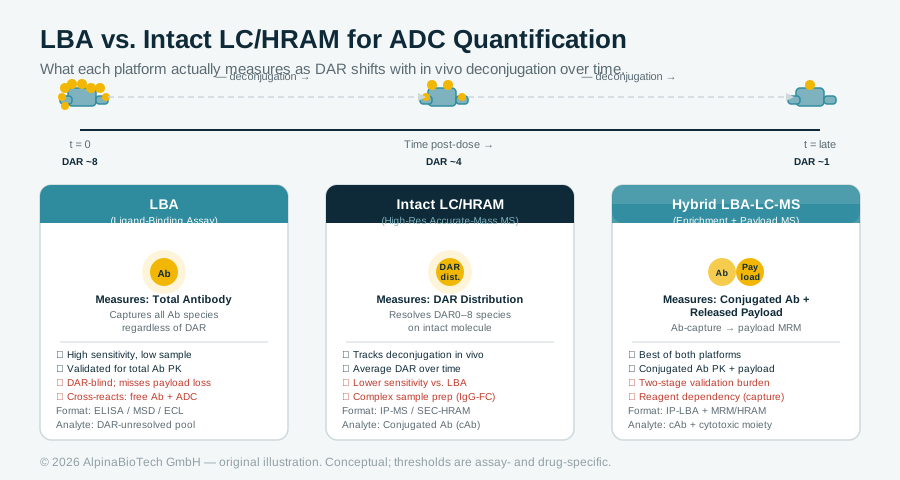
LBA vs. Intact LC/HRAM for ADC Quantification: What Each Method Actually Measures
Antibody-drug conjugate bioanalysis forces a structural choice that most other biotherapeutic modalities do not: the analyte circulating at trough is not the same molecule that was dosed. Deconjugation, DAR shift, and payload biotransformation happen continuously in vivo, and the platform you select determines whether you detect that process or miss it entirely. The FDA had approved 16 ADCs as of December 2025, including datopotamab deruxtecan (Datroway) and telisotuzumab vedotin (Emrelis), both added that year [1]. Behind them sits a pipeline dense with site-specific conjugation chemistries, non-cleavable linkers, and novel payloads that stress-test every assumption the foundational 2013 AAPS position paper on ADC bioanalysis was built on [3].
Two recent publications sharpen the practical decision framework considerably. The ADC Working Group of the AAPS Bioanalytical Community, comprising over 100 members from industry, contract research organizations, and regulatory agencies, published an updated white paper in July 2026 that addresses the full scope of contemporary ADC bioanalysis [4]. Separately, a peer-reviewed primary methods paper from PPD Laboratory Services, published online in Bioanalysis in August 2026, describes a validated first-in-human hybrid assay for a site-specific, non-cleavable ADC [5]. Taken together, they represent the clearest regulatory and technical anchors currently available for teams building or selecting ADC PK assays.
What You Are Actually Trying to Measure
The July 2026 AAPS ADC Working Group white paper addresses advances in bioanalytical quantitation strategies for total antibody, conjugated ADC, free (unconjugated) payload, and drug-to-antibody ratio (DAR), along with immunogenicity assessment considerations, soluble target interference, critical reagent lifecycle management, payload-specific stability requirements, cross-validation strategies, and regulatory considerations [4].
These are not interchangeable readouts. A conjugated payload assay measures the number of payloads on the ADC, while a conjugated antibody assay measures the number of antibodies carrying at least one payload, regardless of exact drug load. Total antibody captures everything, conjugated and unconjugated alike. ADCs are heterogeneous mixtures with different DAR values, and the DAR distribution changes dynamically in vivo, which makes their bioanalysis particularly challenging [7].
That in-vivo DAR shift is the crux of the assay selection problem. As an ADC enters circulation, payloads are slowly released and the average DAR decreases over time until reaching zero. The rate of that change reflects payload release from the antibody, and simultaneously the molar concentration of cytotoxic molecules in circulation increases, affecting both efficacy and safety [7].
The LBA Case: High Sensitivity, Structural Opacity
Ligand-binding assays, including ELISA, MSD, Gyrolab, and Luminex formats, remain the dominant platforms for ADC total antibody and conjugated antibody measurements in regulated studies. For total antibody (DAR 0 to 8) as well as conjugated antibody assays (DAR 1 to 8), ELISA remains the gold standard due to its sensitivity and throughput. However, ELISA is limited regarding structural information [13].
The throughput and sensitivity advantages are real. Compared with traditional ELISA, LC-MS offers a shorter development cycle and better standardization, but that comparison applies primarily to development burden. ELISA retains the sensitivity floor that late-stage clinical trough measurements require [7].
The structural limitations are a direct consequence of how LBAs work. Perhaps the most significant disadvantage of using LBAs for ADC bioanalysis is their inability to capture information about the ADC's structure or possible biotransformation [4]. More specifically, traditional total ADC LBA assays typically measure conjugated antibody concentration and are therefore not DAR sensitive [7]. When the in-vivo ADC population shifts toward low-DAR or DAR0 species, a standard LBA cannot resolve that process.
There is also a reagent dependency problem. Quantitating ADCs with traditional ligand binding assays requires cytotoxic payload-targeting reagents for capture and detection. LBAs are DAR insensitive and prone to under- or over-estimating DAR species [4]. For early-phase programs where payload-targeting reagents are not yet available or are difficult to qualify, this creates a practical bottleneck that can delay method development by weeks or months.
Interference from unconjugated antibody may reduce the specificity and accuracy of LBAs used for quantitation of an intact ADC, and a different assay format may therefore be needed [4]. This is not a marginal edge case: any ADC with a heterogeneous DAR distribution in circulation will present this problem to a sandwich ELISA designed around a single nominal DAR.
The Intact LC/HRAM Case: DAR Resolution, Sensitivity Trade-off
LC-MS methods enable quantification at multiple levels of structural resolution, including intact analysis under native or denaturing conditions, partially reduced middle-down analysis, and peptide-level characterization by bottom-up approaches. Each level trades structural resolution for throughput and sensitivity differently [7].
The core advantage is transparency into biotransformation. The intact quantification approach can provide unique structural and drug biotransformation information that can be acquired a posteriori, compared to the commonly used LBA or surrogate LC-MRM methods that require a priori insights into expected biotransformations of the macromolecule [4]. For novel linker-payload combinations, the ability to detect unanticipated catabolites without redesigning the assay is a real operational benefit. LC-HRMS not only can quantify macromolecules but also determine the DARs of ADCs, facilitating improvement of biological characterization [7].
The sensitivity trade-off is the limiting factor for standalone use in late clinical PK. One validated hybrid LB/LC-HRAM workflow for intact ADC quantification was validated for selectivity, sensitivity, accuracy, precision, carry-over, dilution integrity, and reinjection reproducibility, meeting acceptance criteria from international recommendations [8], with an LLOQ of 0.500 µg/mL at the intact protein level [8]. That sensitivity is workable for preclinical and some early clinical studies but is typically insufficient for late-stage studies where trough concentrations fall into the sub-100 ng/mL range.
Importantly, the sensitivity gap between intact HRAM and LBA narrows when the LC-MS format shifts from intact top-down to surrogate peptide detection. Using a microflow LC-MS/MS approach with immunoaffinity capture, standard curves for surrogate peptides have been reported from 1.00 ng/mL (LLOQ) to 5000 ng/mL with correlation coefficients above 0.99 [10]. The sensitivity limitation on standalone intact HRAM therefore applies specifically to top-down and native intact modes, not to all LC-MS architectures.
The Hybrid Approach: Two Analytes, One Workflow
The hybrid LBA-LC-MS format combines immunoaffinity capture with LC-MS/MS or LC-HRAM detection. It is now the practical middle path for programs that need DAR sensitivity without sacrificing throughput entirely. LBA-LC/MS represents the simultaneous use of two techniques: LBA for immunocapture or enrichment of the target analyte, and LC-MS for separation of complex mixtures and identification and quantification of different species [4].
To support ADC bioanalysis, total antibody assays and conjugated antibody or antibody-conjugated drug assays are both needed. Often, two of these quantitative measurements can be obtained in a single hybrid LBA/LC-MS method, which directly reduces the number of distinct methods a program must develop and validate, with real timeline consequences in early clinical development [4].
The August 2026 PPD Bioanalysis paper provides a peer-reviewed implementation benchmark [5]. The hybrid LBA-LC-MS/MS assay described measures concentrations for a novel ADC (identified as "BMS-X") with an engineered, site-specific, non-cleavable linker and a unique payload. Recombinant target protein extracellular domain fused with mouse IgG-Fc was used for ADC pull-down in human serum, and pepsin digestion released unique toxin-linker peptide complexes for two conjugation sites. The DAR-sensitive hybrid LBA-LC-MS/MS approach enabled direct assessment of site-specific DAR distribution changes and ADC biotransformation that cannot be achieved with conventional DAR-insensitive ligand binding assays. The validated assay successfully supported a first-in-human clinical study, demonstrating robust analytical performance and providing a versatile platform for bioanalysis of site-specific, non-cleavable ADCs [5].
This paper is distinct from the Bioanalysis Zone editorial comparison [6], which provides a general platform-comparison perspective from the same PPD group. The Bioanalysis paper [5] is the primary, peer-reviewed, fully validated methods report.
The combined approach delivers what neither platform achieves alone: immunocapture enrichment extends sensitivity toward clinically relevant concentration ranges, while MS detection provides the structural specificity to generate a DAR-sensitive conjugated payload readout from a single workflow. LC-MS-based assays enable drug-antibody ratio-sensitive quantification of the conjugated payload in ways that standalone LBAs cannot [7].
Validation: Where the Regulatory Gap Still Lives
Regardless of platform choice, the validation framework governs what you can submit. ICH M10 requires validation of analytical methods for quantitative drug concentration analysis in non-clinical safety studies and clinical trials. The problem is that hybrid and intact LC/HRAM methods straddle the LBA and chromatographic method categories that ICH M10 addresses separately. Assay validation parameters are currently evaluated starting from industry white papers, which recommend validation based on a combination of existing criteria for LBA and chromatographic bioanalytical methods [4]. Official health authority guidance for validating hybrid LC-MS bioanalytical methods as a unified category remains absent.
Building upon the foundational 2013 AAPS position paper [3] and recent publications governing regulatory frameworks on PK considerations, the 2026 white paper addresses advances in bioanalytical quantitation strategies and is designed to serve as a comprehensive, empirically validated, and industry-aligned bioanalytical framework for contemporary ADC drug development [4]. The cross-validation guidance within it is particularly relevant for sponsors who use one platform in early development and a different one to generate bridging or pivotal data.
The inherent structural complexity of ADCs demands a sophisticated and multi-faceted bioanalytical approach spanning preclinical discovery through late-stage clinical development [4]. The 2026 AAPS white paper represents the most comprehensive industry-aligned document currently available for anchoring that approach to a regulatory-defensible framework.
What This Means for Your Assay Selection
The practical question is which architecture, validated against which acceptance criteria, produces data that regulators will accept across the development lifecycle from first-in-human through registration. No single platform dominates every use case. The decision maps across three scenarios:
-
LBA only: Appropriate for total antibody and conjugated antibody quantification where DAR resolution is not required and payload-targeting reagents are available. ELISA remains the gold standard for total antibody and conjugated antibody assays due to its sensitivity and throughput [13]. Structural changes in the circulating ADC population are not captured.
-
Intact LC/HRAM: Best suited for DAR species profiling, biotransformation surveillance, and early-phase studies where structural characterization informs toxicology interpretation. The intact approach provides unique structural and drug biotransformation information acquired a posteriori, compared to methods that require a priori insights into expected biotransformations [4]. Sensitivity in top-down intact modes limits standalone use in late clinical PK, though surrogate peptide microflow formats substantially close that gap [10].
-
Hybrid LBA-LC-MS/MS: Practical for regulated studies requiring DAR-sensitive conjugated payload quantification. LBA-LC/MS combines immunocapture enrichment to extend sensitivity with MS detection to identify and quantify different ADC species [4]. The August 2026 PPD paper demonstrates this architecture in a validated, first-in-human context for a site-specific, non-cleavable ADC [5]. Hybrid assays are complementary to, or viable alternatives to, ligand-binding assay for ADC bioanalysis and PK/PD modeling [4].
When LBA and LC-MS approaches are used in combination, they address complementary bioanalytical gaps: one delivers the sensitivity and throughput that regulated clinical studies require, the other delivers the structural resolution that a heterogeneous, in-vivo-evolving molecule demands. The 2026 AAPS ADC Working Group white paper gives teams a clearer map for making that call, with guidance reflecting, in its own framing, over a decade of scientific progress and designed to serve as a comprehensive, empirically validated, and industry-aligned bioanalytical framework [4].
All assays and methods described in this article are for Research Use Only and are not intended for use in diagnostic or therapeutic procedures.
Sources
- [1] susupport.com
- [2] biochempeg.com
- [3] tandfonline.com
- [4] link.springer.com
- [5] tandfonline.com
- [6] bioanalysis-zone.com
- [7] pmc.ncbi.nlm.nih.gov
- [8] sciencedirect.com
- [9] pubmed.ncbi.nlm.nih.gov
- [10] pubs.acs.org
- [11] ncbi.nlm.nih.gov
- [12] dmpkservice.wuxiapptec.com
- [13] waters.com
- [14] pubmed.ncbi.nlm.nih.gov
- [15] pmc.ncbi.nlm.nih.gov
- [16] link.springer.com
More articles
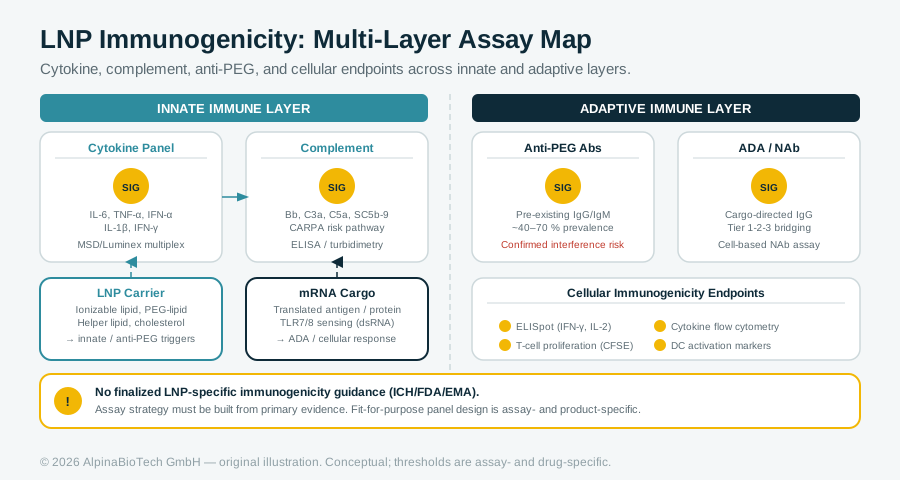
Immunogenicity Assessment for LNP-Based Therapeutics: Mapping the Assay Demands Across Innate and Adaptive Endpoints
LNP-based therapeutics generate immunogenicity signals across at least two immune layers, involving carrier and cargo independently, against a background of pre-existing anti-PEG antibodies in a substantial fraction of patients. No finalized LNP-specific immunogenicity guidance exists, leaving bioanalytical scientists to build assay strategies from the LNP-specific evidence base up. This article maps the cytokine, complement, anti-PEG, and cellular endpoints that a fit-for-purpose panel must address.
Read more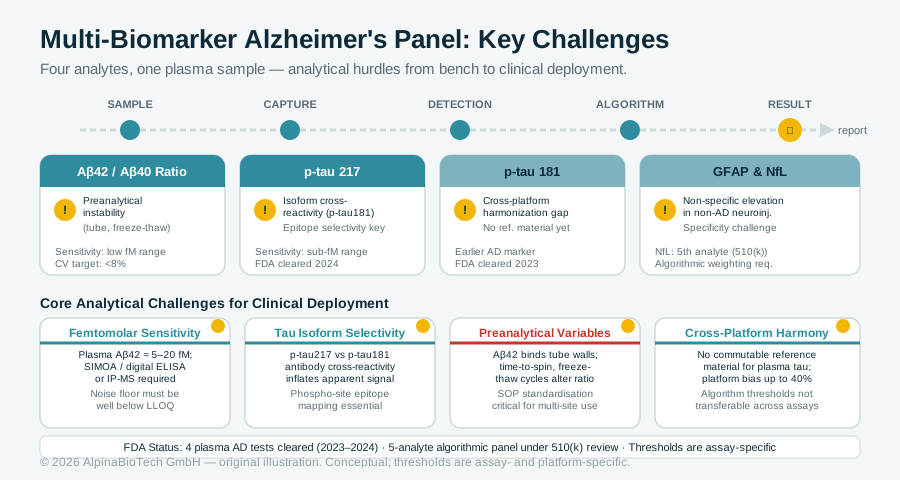
Four Analytes, One Plasma Sample: The Assay Science Behind Multi-Biomarker Alzheimer's Testing
Four blood-based Alzheimer's disease biomarker tests were cleared by the FDA within fifteen months, and a five-analyte algorithmic panel is under 510(k) review. For immunoassay scientists deploying these panels, the analytical challenges of femtomolar sensitivity, cross-reactivity between tau isoforms, preanalytical instability of Aβ42, and cross-platform harmonization are the least-settled problems in making multi-biomarker results hold up outside a research cohort.
Read more