Article · 30 September 2026
Degevma's FDA Approval and a Market with More Than 20 Denosumab Biosimilars: What Immunogenicity Comparability Testing Actually Requires
The FDA's approval of denosumab-adet (Degevma) on September 28, 2026 brings the cumulative total of approved denosumab products to at least 20, raising a concrete methodological question: in a market this saturated, with interchangeability-driven pharmacy substitutions, what does a reported ADA incidence figure actually tell you? The answer depends entirely on whether the assay has solved the soluble RANKL interference problem, and the published literature shows that not every program has.
AlpinaBioTech
When the FDA approved denosumab-adet (Degevma) on September 28, 2026, it completed Teva's denosumab biosimilar portfolio and extended a market that already held at least 20 approved products [4][6]. By end of December 2025, the FDA had approved a total of 18 denosumab biosimilars. On March 30, 2026, the FDA approved Ponlimsi (denosumab-adet), which became the tenth Prolia/Xgeva biosimilar approved by the FDA [13]. Degevma's approval on September 28, 2026 [4] brings the cumulative total to 20 individual FDA-approved denosumab products.
The approval is consequential for clinical and formulary teams, but it raises an equally concrete question for immunogenicity scientists: in a market this saturated, with patients being switched at the pharmacy under interchangeability designations, what does a reported ADA incidence figure actually tell you, and how comparable are those figures across programs?
The answer depends on assay methodology, and the denosumab literature is specific about where that methodology can break down.
Degevma: What the Approval Covers
Degevma is a biosimilar to Xgeva (denosumab, Amgen), indicated for prevention of skeletal-related events in adults and treatment of adults and skeletally mature adolescents with giant cell tumour of bone. It is available as a 120 mg/1.7 mL solution for injection.
The CHMP adopted a positive opinion recommending marketing authorisation for Degevma, with the European Union granting marketing authorisation following that recommendation [19]. The U.S. FDA approval followed on September 28, 2026 [4]. Teva had already secured U.S. approval for Ponlimsi (denosumab-adet) on March 30, 2026, a biosimilar referencing Prolia [13]. The shared INN suffix denosumab-adet confirms both Degevma and Ponlimsi are the same active substance, designated TVB-009 in Teva's development program. Together, they establish a comprehensive U.S. denosumab biosimilar portfolio spanning the indications of both Xgeva and Prolia [4].
The Phase 3 Trial and Its Switching Arm
The FDA approval of Degevma was based on a totality of evidence, including analytical and clinical data demonstrating similar efficacy, safety, and immunogenicity between denosumab-adet and reference denosumab. Teva's clinical development program for its denosumab biosimilar candidate, TVB-009P, included a randomized, double-blind, multinational Phase 3 study (NCT04729621) comparing the biosimilar candidate with reference denosumab (Prolia) in postmenopausal women with osteoporosis [17]. The study's official title is "A Randomized, Double-Blind, Multinational, Multicenter Study to Compare Efficacy, Safety, and Immunogenicity of TVB-009P and Denosumab (Prolia) in Patients With Postmenopausal Osteoporosis," registered by Teva Pharmaceuticals USA [17].
The Phase 3 design included a feature directly relevant to immunogenicity surveillance. At Week 52, patients in the reference arm were re-randomized to continue reference denosumab or transition to the biosimilar, specifically to assess immunogenicity and safety after switching [16]. That controlled switching arm generates ADA incidence data in a population first exposed to the originator, which more closely approximates real-world transition scenarios than a de novo treatment cohort alone.
The co-primary endpoints were percent change from baseline in lumbar spine bone mineral density at Week 52, with a least squares mean difference of 0.21% (95% CI: -0.73%, 1.15%), within the predefined equivalence margin, and percent change from baseline in serum C-terminal telopeptide of type 1 collagen (sCTX-1) at Week 26 [16]. Low and comparable immunogenicity was observed between groups.
The Market Context: 20 Products and the Exposure-History Problem
By end of December 2025, the FDA had approved a total of 18 denosumab biosimilars. Adding Ponlimsi (approved March 30, 2026 [13]) and Degevma (approved September 28, 2026 [4]) brings the confirmed cumulative total to 20 individual FDA-approved denosumab products across all INN suffixes and presentations.
Amgen's FY2025 Form 10-K, filed with the SEC, reports worldwide Prolia sales of $4,414 million and worldwide Xgeva sales of $2,084 million for full-year 2025 [18], a combined $6.5 billion. Global Prolia sales for the first half of 2026 fell 33% year over year, driven by lower volume and lower net selling prices, and Amgen has stated it continues to expect accelerated sales erosion driven by increased competition, as multiple biosimilars have launched in the United States and internationally [22]. In Q2 2026 alone, Prolia sales declined 32% to $759 million and Xgeva revenues fell 34% to $352 million, with multiple biosimilars affecting volumes and pricing [22][23].
The market further evolved in late October 2025 when the FDA granted interchangeability designations to two pairs of denosumab products. On October 29, 2025, Fresenius Kabi announced that its products Conexxence and Bomyntra were designated as interchangeable biosimilars to Prolia and Xgeva, respectively [14]. One day later, Stoboclo and Osenvelt (denosumab-bmwo; Celltrion USA) became the second pair of denosumab biosimilars to receive this status [11][14]. Interchangeability allows substitution at pharmacies without prescriber consultation, subject to state laws.
That substitution pathway creates a monitoring complication. A patient switched at the pharmacy from one biosimilar to another, then switched again at formulary renewal, presents an immunogenicity exposure history that originator ADA databases were not designed to interpret. If your lab detects a rising ADA signal in that patient, attributing it to a specific product or a specific switch event requires knowing which product the patient was on when the sample was drawn, and that chain of custody is frequently incomplete in real-world practice. It is reasonable to expect additional denosumab products to seek interchangeability designation as regulatory pathways continue to evolve, which would further increase the frequency of undocumented transitions.
The Interference Problem That Shapes Every Denosumab ADA Number
The phrase "low and comparable immunogenicity" appears across multiple denosumab biosimilar programs. Getting to that number accurately requires solving a specific interference problem, and the published literature makes clear that not every program solved it the same way, or detected it before running clinical samples.
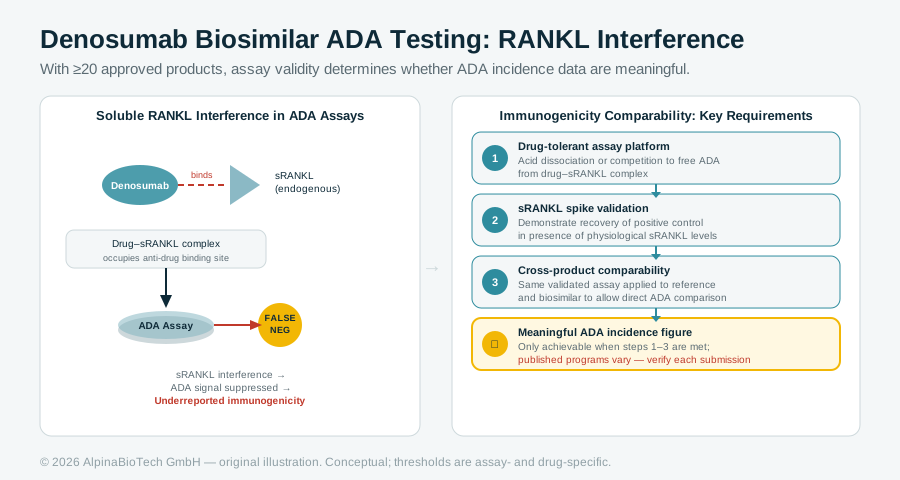
Denosumab's target is soluble RANKL (sRANKL), a trimeric protein released from the membrane-bound precursor by ectodomain shedding. In a standard bridging immunoassay, dimeric or multimeric forms of soluble drug targets such as sRANKL can interfere with ADA assays by bridging the assay reagents, potentially resulting in false-positive results [9][10].
The scale of the artifact is not trivial. Acid dissociation significantly exacerbated target interference in the FKS518 program, resulting in ADA positivity rates of approximately 96 to 98% in clinical studies; introducing a specificity tier corrected incidence to 3.9% or below [9]. The mechanism is direct: denosumab shows high affinity for both sRANKL and membrane-bound RANKL, favoring persistent drug-target complexes in circulation. These multimeric complexes can act as bridging agents in immunoassays, particularly after acid dissociation steps that liberate sRANKL from complexes [9]. When sRANKL concentrations are elevated post-treatment, its multivalency enables re-binding to labeled denosumab during assay incubation, generating artificial bridges and false-positive ADA signals [10][11].
The RGB-14 Phase 1 Finding: A Documented Failure Case
The RGB-14 denosumab biosimilar program (Gedeon Richter) provides the starkest published example of what happens when post-dose sRANKL concentrations exceed what validation anticipated. The ADA assay validation included an assessment of target RANKL interference, and the assay passed the test up to a 30 pg/mL RANKL level, a concentration anticipated to be the maximum present in clinical samples [12].
Despite the successful validation, most of the analyzed samples from the RGB-14 Phase 1 clinical trial yielded false-positive results for anti-denosumab antibodies; investigation concluded that unexpectedly high levels of RANKL were present in the samples and caused interference in the assay. Consequently, the assay was re-developed by adding a target-specific reagent, eliminating the acid dissociation step, and doubling the assay dilution to enhance target tolerance to 10,000 pg/mL RANKL. The re-developed assay underwent successful validation, and the samples from the RGB-14 clinical trials were subsequently analyzed with the improved assay [12]. This work is published as PMID 40368321 in the Journal of Immunological Methods [12].
"This case underscores the importance of monitoring clinical sample analysis results even when a validated assay is used, as clinical samples may differ from the spiked samples prepared for validation." [12]
Two Documented Mitigation Approaches
Two interference mitigation strategies have been reported in peer-reviewed publications for denosumab ADA assays, and they use different sequestering agents.
The first uses osteoprotegerin (OPG) as an sRANKL neutralizer, and was the approach developed for the FKS518 (Fresenius Kabi SwissBioSim) denosumab biosimilar program. To competitively block sRANKL, investigators introduced a specificity tier by adding OPG to the ADA bridging assay, enabling reanalysis of previously ADA-positive samples to confirm whether signals represented true ADA responses or artifacts. OPG was selected because the epitope binding site of denosumab/FKS518 overlaps with the major binding sites of OPG on RANKL, and OPG has high affinity for sRANKL [9]. Critically, OPG incorporation did not change the minimum required dilution of the assay and did not affect signals for negative and positive controls, confirming assay integrity [9]. This work was published in Bioanalysis in 2025 [9].
The second approach uses a neutralizing anti-RANKL monoclonal antibody added directly to the assay. The performance of three RANKL inhibitors was evaluated using healthy donor sera spiked with different concentrations of positive control ADA, sRANKL, or both, in an ECL-based immunoassay utilizing the Meso Scale Discovery (MSD) platform. Based on those data, the denosumab antibody assay was modified to include a neutralizing anti-RANKL monoclonal antibody to eliminate false positivity due to sRANKL; use of the anti-RANKL antibody did not impact the ADA-specific signal but inhibited the false-positive assay signal, resulting in accurate detection of ADA incidence [10][11]. Separately, in a denosumab bioequivalence study, approximately 50% of serum samples showed reactivity to denosumab in the absence of a specific reagent to sequester the sRANKL; upon addition of such a reagent, the overall ADA incidence was lowered to less than 1% [10][11].
Inhibition of interference posed by sRANKL in study samples is critical for accurate assessment of ADA incidence towards denosumab and any biosimilar for this product undergoing clinical development [10][11].
What Cross-Program ADA Comparisons Actually Mean
The practical implication for a lab evaluating biosimilar comparability data is direct: the ADA incidence figure attached to any denosumab biosimilar program reflects both the true immunogenic potential of that product and the specific mitigation strategy the assay used. A program that validated at 30 pg/mL sRANKL and did not reassess at observed post-dose concentrations will have generated a different number from one that incorporated OPG or an anti-RANKL antibody in every sample run [9][10][11][12].
When you compare ADA rates across the 20-plus approved denosumab products, you are not necessarily comparing equivalent measures. The totality-of-evidence framework that supported Degevma's approval integrates analytical, PK/PD, and clinical data [4][19], but that framework does not standardize the assay methodology used across different sponsors' programs.
The sCTX-1 endpoint used as a co-primary measure in the TVB-009P Phase 3 trial [16] remains a useful pharmacodynamic anchor in real-world monitoring. It is analyte-agnostic with respect to which denosumab product the patient is receiving, and it captures incomplete RANKL suppression regardless of whether the prescriber knows which biosimilar was dispensed.
Three Questions for Your Lab
The Degevma approval gives clinicians and formulary managers one more denosumab option with a full FDA-reviewed efficacy, safety, and immunogenicity data package. For the lab scientist, it highlights three practical questions.
-
First: Does your current denosumab ADA assay incorporate an sRANKL interference mitigation step, either OPG or a neutralizing anti-RANKL monoclonal antibody? If not, your incidence rate may be systematically inflated, particularly in post-dose samples where sRANKL concentrations can exceed validation-level expectations by orders of magnitude [10][11][12].
-
Second: Does your assay include a documented specificity tier capable of distinguishing true ADA positivity from bridging artifacts, particularly after acid dissociation pretreatment? Acid dissociation, without a corrective specificity step, can drive apparent positivity to approximately 96 to 98% [9].
-
Third: Can your monitoring program determine which denosumab product, originator or one of the 20-plus biosimilars, the patient was receiving when a positive sample was collected? The product history matters if you are trying to attribute an immunogenic event to a specific transition. Interchangeability designations allow substitution at the pharmacy without prescriber consultation, subject to state laws [11][14], and that substitution may not appear in the electronic health record.
The switching arm in NCT04729621 provides a controlled data anchor for one transition scenario under blinded conditions [16][17]. Real-world monitoring programs will encounter patients with more complicated histories: two or three biosimilar switches in 18 months, each driven by formulary changes that were never communicated to the treating physician. Patents for Prolia and Xgeva expired in 2025, and sales of these products are eroding significantly in 2026 as several biosimilars have been launched globally [18][22], a trajectory that will continue to increase the frequency of undocumented product transitions in clinical populations. The assay infrastructure needs to be fit for that reality now.
For Research Use Only. Not for use in diagnostic procedures.
Sources
- [1] biopharminternational.com
- [2] onclive.com
- [3] manilatimes.net
- [4] ir.tevapharm.com
- [5] endocrinologyadvisor.com
- [6] globenewswire.com
- [7] centerforbiosimilars.com
- [8] chaindrugreview.com
- [9] tandfonline.com
- [10] pubmed.ncbi.nlm.nih.gov
- [11] sciencedirect.com
- [12] pubmed.ncbi.nlm.nih.gov
- [13] gabionline.net
- [14] centerforbiosimilars.com
- [15] rheumatologyadvisor.com
- [16] asbmr.confex.com
- [17] clinicaltrials.gov
- [18] sec.gov
- [19] ema.europa.eu
- [20] biologicshq.com
- [21] pharmacytimes.com
- [22] sec.gov
- [23] finance.yahoo.com
More articles
LBA vs. Intact LC/HRAM for ADC Quantification: What Each Method Actually Measures
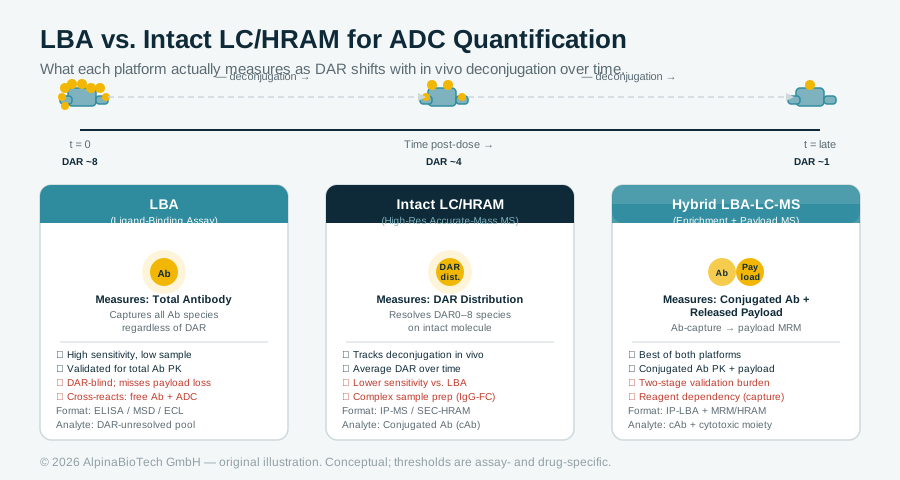
Selecting a bioanalytical platform for antibody-drug conjugates is a structural decision: deconjugation and DAR shift mean the circulating analyte changes continuously after dosing. Two 2026 publications, an AAPS ADC Working Group white paper and a peer-reviewed PPD hybrid assay validation, sharpen the practical framework for LBA, intact LC/HRAM, and hybrid LBA-LC-MS approaches in regulated ADC studies.
Read more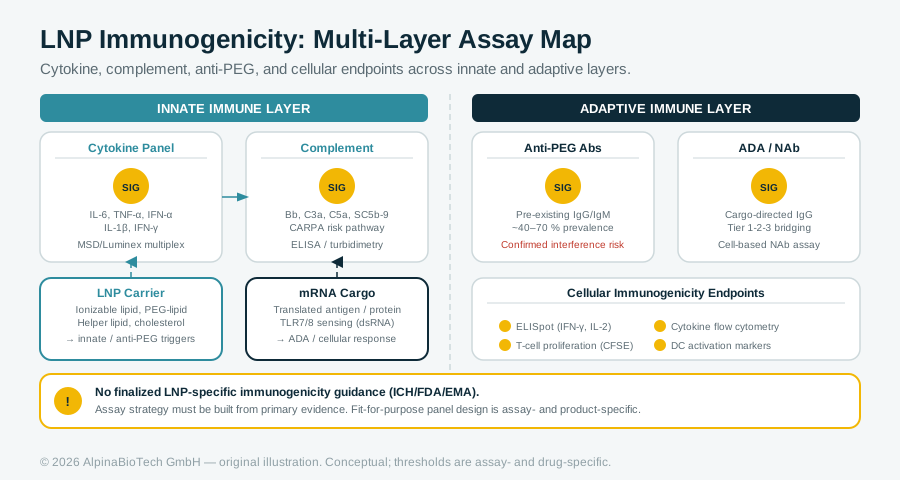
Immunogenicity Assessment for LNP-Based Therapeutics: Mapping the Assay Demands Across Innate and Adaptive Endpoints
LNP-based therapeutics generate immunogenicity signals across at least two immune layers, involving carrier and cargo independently, against a background of pre-existing anti-PEG antibodies in a substantial fraction of patients. No finalized LNP-specific immunogenicity guidance exists, leaving bioanalytical scientists to build assay strategies from the LNP-specific evidence base up. This article maps the cytokine, complement, anti-PEG, and cellular endpoints that a fit-for-purpose panel must address.
Read more