Article · 9 October 2026
When PK Studies Slim Down, Immunogenicity Assays Carry More Weight: What FDA's 2026 Biosimilar Guidance Means for Bioanalytical Scientists
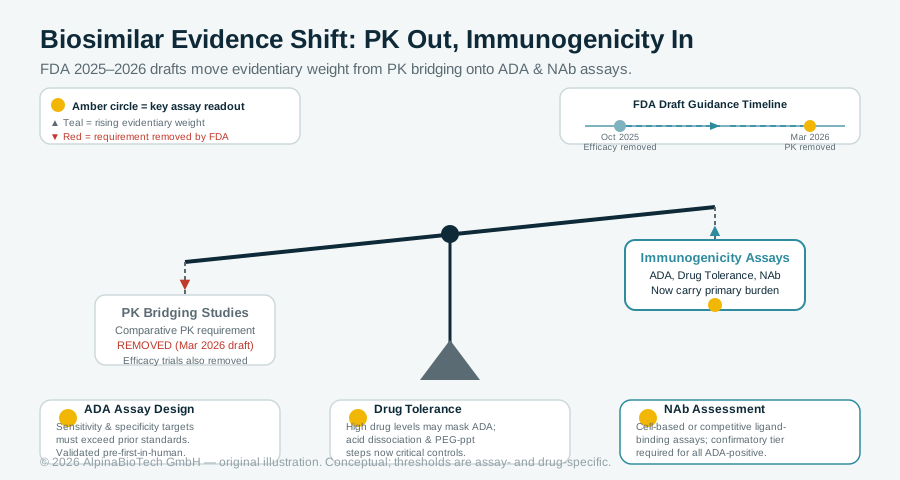
FDA's March 2026 draft guidance removes the default requirement for comparative PK bridging studies in biosimilar development, building on a prior October 2025 draft that proposed eliminating routine efficacy trials. Both actions shift evidentiary weight onto immunogenicity assays, raising the bar for ADA assay design, drug tolerance, and neutralizing antibody assessment before any clinical samples are collected.
AlpinaBioTech
For Research Use Only unless otherwise indicated.
When PK Studies Slim Down, Immunogenicity Assays Carry More Weight: What FDA's 2026 Biosimilar Guidance Means for Bioanalytical Scientists
On March 9, 2026, the FDA issued new draft guidance aimed at further reducing the time and expense of bringing biosimilars to market, the latest in a series of actions taken under the current administration to lower the cost of biologic drugs [1]. The guidance, titled "New and Revised Draft Q&As on Biosimilar Development and the BPCI Act (Revision 4)," revises and replaces the earlier draft guidance (Revision 3) issued in 2021 [2].
The FDA offers recommendations for streamlining unnecessary PK testing when "scientifically justified," a change that could save biosimilar drugmakers up to 50% of their PK study costs, which equates to about $20 million, the agency stated in its press release [1]. That figure comes from the FDA's press release rather than the guidance text itself. What it obscures is what it demands in exchange.
What the Guidance Actually Removes, and What It Does Not
PK studies evaluate how the body processes a drug and have traditionally been required as part of demonstrating that a biosimilar behaves like its reference product [3]. The new draft guidance removes the previous recommendation for biosimilar developers to conduct at least one clinical PK study directly comparing their proposed biosimilar with the U.S.-licensed reference product [2].
The March 2026 revision fundamentally changes the requirements for sponsors seeking to use non-U.S.-licensed (foreign) comparator products in clinical studies for biosimilars. Most notably, the FDA has eliminated the default requirement for a three-way PK bridging study, which previously mandated direct comparison among the proposed biosimilar, the U.S.-licensed reference product, and the foreign comparator [2, 4].
The March 2026 action builds on a prior FDA initiative. On October 29, 2025, FDA issued draft guidance proposing that comparative efficacy studies may not be needed to support a demonstration of biosimilarity [1]. That guidance is titled "Scientific Considerations in Demonstrating Biosimilarity to a Reference Product: Updated Recommendations for Assessing the Need for Comparative Efficacy Studies," and was published in the Federal Register as document 2025-20380 (90 FR 52410) [1, 3]. The comparative efficacy studies targeted in that October draft guidance can take one to three years and cost $24 million, according to the agency [1].
Together, these two actions progressively reduce the clinical trial burden on developers. But in every scenario the guidance describes, the immunogenicity assessment remains a non-negotiable element of the submission [2, 4]. Under the new approach, most biosimilar applications will no longer require comparative efficacy studies if pharmacokinetic and immunogenicity data show the product is biosimilar to its reference biologic [1]. Removing efficacy data from the dossier does not remove immunogenicity data. It elevates it.
The Analytical Characterization Burden Rises in Step
The guidance conditions each PK waiver on analytical rigor [2, 4]. This shift reflects the FDA's growing confidence in the power of analytical and PK data to establish biosimilarity, and it brings the U.S. regulatory framework into closer alignment with international standards, particularly those of the European Medicines Agency [3].
The phrase "appropriately designed," applied repeatedly to the immunogenicity assessment in the guidance, is load-bearing. The FDA's established document "Immunogenicity Testing of Therapeutic Protein Products: Developing and Validating Assays for Anti-Drug Antibody Detection" (February 2019) provides recommendations regarding the development and validation of screening assays, confirmatory assays, titration assays, and neutralization assays [3]. In the streamlined-PK era, that document moves from background reading to front-and-center operational reference for every biosimilar program.
Anti-drug antibody (ADA) screening and confirmatory assays must be designed, validated, and in place before PK samples are collected, not developed retrospectively. When the PK study carries the full safety burden of the removed efficacy trial, there is no fallback. The validated cut-point must be set from the outset in the relevant patient matrix and in a drug-tolerant format, because samples collected at or near peak drug concentration, common in PK study designs, will overwhelm standard bridging assays without prior optimization [2, 4].
Teva's Pipeline as a Case Study in the New Paradigm
No company better illustrates the practical consequences of this shift than Teva, whose denosumab biosimilar program reached completion as the new guidance took effect.
The FDA approved Ponlimsi (denosumab-adet) on March 27, 2026, the date recorded in the FDA's approval history [6]. Teva's public announcement press release was issued on March 30, 2026 [9]. The FDA approval of Ponlimsi was based on a totality of evidence, including analytical and clinical data demonstrating similar efficacy, safety, and immunogenicity profile as the reference product, Prolia [6].
Teva announced on September 28, 2026 that the FDA approved Degevma (denosumab-adet) as a biosimilar to Xgeva (Amgen) across all of the reference product's indications [7]. The FDA approval of Degevma was based on a totality of evidence, including analytical and clinical data demonstrating similar efficacy, safety, and immunogenicity profile as the reference product, Xgeva [7, 8]. Both Ponlimsi and Degevma carry the biosimilar qualifier denosumab-adet, confirmed in Teva's announcements for both approvals [7, 8, 9].
In an interview with The Center for Biosimilars, Robert Cook, PhD, head of generics R&D and senior vice president of global technical development at Teva, discussed the clinical program behind the approvals, the company's two-application regulatory strategy, interchangeability, in-house manufacturing, and how manufacturers can differentiate in a crowded denosumab market [5].
Cook explained that while efficacy data were compelling, taken together with all the other clinical efficacy studies run across the biosimilar industry, they offer little incremental benefit over the analytical characterization work. Industry and regulatory working groups have pushed to move away from clinical efficacy studies and toward analytical characterization, Cook said, a shift that puts industry and regulators "in a good place" [5]. For Teva, that means future programs will pair analytical characterization with PK studies that confirm equivalent blood levels and exposure and test for markers of immunogenicity. It is not a full clinical efficacy study, Cook said, but it is "a considerable clinical safety package" [5].
The Omalizumab Program: A Different Immunogenicity Challenge
The denosumab biosimilars are approved and awaiting U.S. launch. Teva's next program under regulatory review presents a more analytically demanding immunogenicity challenge in one specific respect.
Teva's applications for a proposed biosimilar candidate to Xolair (omalizumab) have been accepted by both the FDA and the EMA, consisting of a Biologics License Application (BLA) to the U.S. FDA and a Marketing Authorization Application (MAA) to the EMA [11]. TEV-45779 is a humanized IgG1/kappa monoclonal antibody directed against IgE, being developed as a biosimilar candidate to omalizumab [12]. That mechanism creates a distinct immunogenicity assay design problem.
Because omalizumab binds free IgE, endogenous IgE is present at high levels in the target patient population. This creates potential interference in both drug-level assays and ADA screening assays. Any assay capturing the biosimilar or antibodies directed against it must be qualified in a matrix reflecting the target population's endogenous immunoglobulin burden, not validated only in healthy volunteer pools. Neutralizing antibody assays must additionally distinguish suppression of drug function from the molecule's own IgE-binding pharmacology. A cell-based or competitive ligand-binding neutralizing antibody assay designed specifically for the IgE-binding mechanism is required; a format borrowed from another mechanistic class will not suffice.
The phase 3 trial, NCT04976192, is a multinational, randomized, double-blind study evaluating efficacy, pharmacokinetics, pharmacodynamics, safety, tolerability, and immunogenicity of TEV-45779 compared to omalizumab in patients with chronic idiopathic urticaria who remain symptomatic despite antihistamine treatment [11, 12]. Running immunogenicity assessment in an actively allergic, high-IgE population is precisely the scenario that demands the most rigorous up-front assay design and matrix qualification.
What This Means for Assay Design in the Streamlined Era
The FDA press release estimated the March 2026 guidance could save biosimilar developers up to 50% of their PK study costs, approximately $20 million per program [1]. Each dollar removed from the PK and efficacy trial budget transfers its evidentiary weight to the assay laboratory. Five specific implications follow.
-
Earlier ADA assay readiness. Because PK studies now carry the full safety burden of the removed efficacy trial, ADA screening and confirmatory assays must be validated and in place before PK sample collection begins. Immunogenicity assessment is a required companion to PK similarity data, not an optional add-on [2, 4].
-
Drug tolerance requirements. PK studies often collect samples at or near peak drug concentrations. Drug-tolerant ADA formats, such as acid dissociation followed by bridging capture, become non-optional in programs where the PK study is the primary immunogenicity data source. Cut-point validation in a drug-tolerant format must be part of the initial validation plan, not a retrofit [3].
-
Neutralizing antibody assessment. FDA guidance on ADA assay development includes specific recommendations for neutralization assays [3]. Where the mechanism of action is well characterized, such as IgE binding for omalizumab or RANKL binding for denosumab, a cell-based or competitive ligand-binding neutralizing antibody assay must be designed to reflect that mechanism specifically.
-
Reproducibility and single-assay validation. When efficacy data is absent from the dossier, a bridging ELISA that passes cut-point qualification but fails lot-to-lot reproducibility is a liability with no phase 3 safety backstop. The regulatory path tolerates less residual analytical uncertainty when the immunogenicity package must stand alone [2, 4].
-
Foreign comparator bridging. Under the proposed guidelines, clinical data from a comparator product approved outside the U.S. could be used to demonstrate similarity to the U.S.-licensed reference product, in certain circumstances eliminating the need for an additional three-way PK study [2]. Immunogenicity assays developed against an EU reference product must demonstrate that ADA detection sensitivity and specificity is equivalent to what would be obtained against the U.S. product. This is a comparability exercise layered on top of the validation exercise.
The Broader Trend: Fewer Phase 3 Trials, Stricter Analytical Standards
In the October 2025 biosimilarity draft guidance, FDA explains that modern analytical tools can more sensitively detect and characterize differences between a proposed biosimilar and its reference product, making comparative efficacy studies generally unnecessary to show biosimilarity, particularly for therapeutic proteins [1, 3]. The March 2026 PK guidance builds on that foundation by removing a second category of default clinical requirement [2].
The denosumab market illustrates how crowded the reference product space has become. Ponlimsi is the tenth Prolia/Xgeva biosimilar approved by the FDA [6]. To date, four denosumab biosimilars have launched in the United States: Sandoz's Jubbonti/Wyost (denosumab-bbdz), Celltrion's Stoboclo/Osenvelt (denosumab-bmwo), Fresenius Kabi's Conexxence/Bomyntra (denosumab-bnht), and Hikma's Enoby/Xtrenbo [9]. In that environment, the marginal information value of an additional phase 3 efficacy trial is genuinely low. But the efficiency gained at the trial level transfers directly to the assay laboratory.
For immunogenicity scientists working in biosimilar programs today, the practical message is direct: the analytical package is no longer supporting documentation. It is the primary submission. Assay teams that treat ADA development as a late-phase activity, or that borrow neutralizing antibody formats without mechanistic justification, will face an evidentiary gap that no amount of characterization data can fill after the fact.
This article is for informational purposes and reflects publicly available regulatory guidance and published data. Products and assays discussed are for Research Use Only unless otherwise indicated. AlpinaBioTech does not represent Teva Pharmaceutical Industries or any regulatory body referenced herein.
Sources
- [1] centerforbiosimilars.com
- [2] goodwinlaw.com
- [3] thefdalawblog.com
- [4] biologicshq.com
- [5] centerforbiosimilars.com
- [6] drugs.com
- [7] pearceip.law
- [8] onclive.com
- [9] bigmoleculewatch.com
- [10] centerforbiosimilars.com
- [11] centerforbiosimilars.com
- [12] centerforbiosimilars.com
More articles
When ADA Positivity Is Not the Answer: Rethinking the Three-Tier Immunogenicity Paradigm
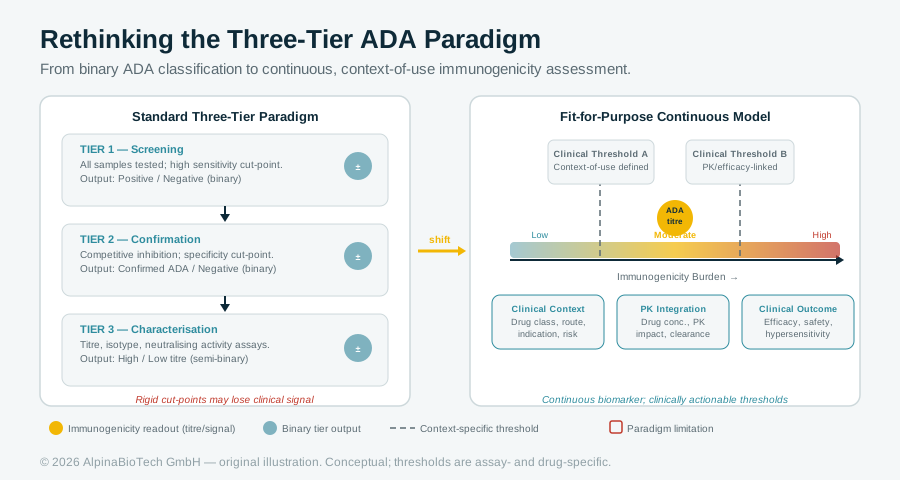
The standard three-tier ADA testing paradigm has governed biologic immunogenicity assessment for more than two decades, but a growing body of evidence questions whether it consistently delivers clinically meaningful data. New publications from Immunologix Laboratories, the European Bioanalysis Forum, and IQVIA Laboratories converge on a fit-for-purpose, context-of-use-driven alternative that treats immunogenicity as a continuous biomarker endpoint rather than a binary classification.
Read more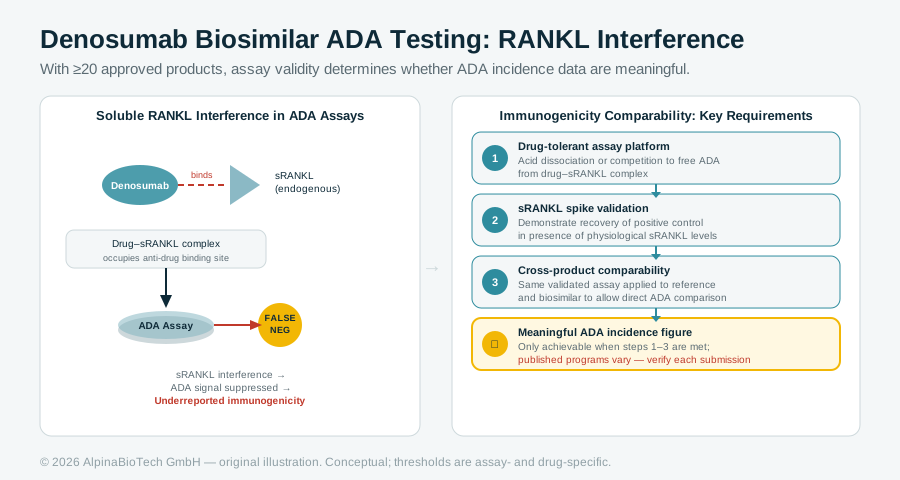
Degevma's FDA Approval and a Market with More Than 20 Denosumab Biosimilars: What Immunogenicity Comparability Testing Actually Requires
The FDA's approval of denosumab-adet (Degevma) on September 28, 2026 brings the cumulative total of approved denosumab products to at least 20, raising a concrete methodological question: in a market this saturated, with interchangeability-driven pharmacy substitutions, what does a reported ADA incidence figure actually tell you? The answer depends entirely on whether the assay has solved the soluble RANKL interference problem, and the published literature shows that not every program has.
Read more