Article · 2 November 2026
Pembrolizumab Biosimilars Are Entering Clinical Review: What the PK-Only Pathway Means for Immunogenicity Assay Scientists
The FDA accepted the first publicly announced pembrolizumab biosimilar BLA for review in October 2026, using a pharmacokinetic-only pivotal strategy that skips a comparative Phase 3 efficacy trial. For immunogenicity assay scientists, this regulatory pivot reframes how ADA comparability must be designed, validated, and interpreted in a drug class with low but clinically consequential reference product immunogenicity.
AlpinaBioTech
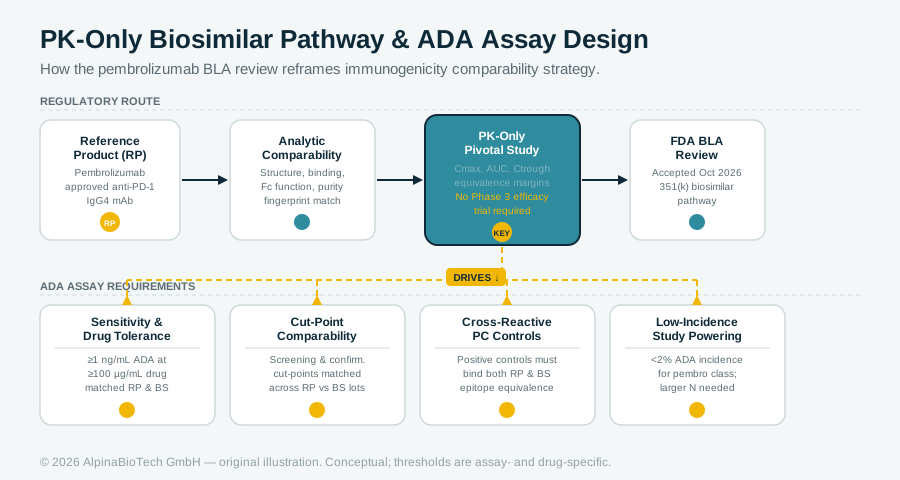
The first publicly announced U.S. Biologics License Application for a pembrolizumab biosimilar is now under FDA review, and the regulatory strategy behind it is not standard. On October 13, 2026, Formycon and Zydus announced that the FDA accepted for review the BLA for FYB206, a proposed biosimilar to Merck's Keytruda (pembrolizumab) [1][2][3]. Formycon reached an agreement with the FDA in February 2025 that a comparative Phase 3 efficacy trial would not be required for the program [2][4][11]. For scientists designing assays in this class, that regulatory pivot is the technical story.
Why Pembrolizumab Is the Next Biosimilar Frontier
The commercial stakes are substantial. Merck's FY2025 Form 10-K discloses that biosimilar competition could begin in December 2028 when the primary compound patent expires for Keytruda [18]. Two further patents in the same composition-of-matter family expire in May and November 2029, extending the full U.S. patent landscape beyond the primary compound expiry [18]. While the expiration of the compound patent generally results in loss of market exclusivity, other patents may provide additional market exclusivity associated with certain aspects of the product that extends beyond the compound patent expiration [18]. Worldwide sales of Keytruda, including the subcutaneous formulation Keytruda Qlex, reached USD 31.7 billion in 2025, and combined sales in the first half of 2026 totaled USD 16.40 billion, confirming Keytruda remains the world's best-selling biologic medicine [14].
At least 13 companies have run biosimilar pembrolizumab clinical trials recorded on the ClinicalTrials.gov registry or announced in press releases [13]. Formycon's FYB206 appears to be the front runner, having demonstrated pharmacokinetic bioequivalence with Keytruda in its Dahlia study, with results reported in February 2026 [6][7]. Amgen also confirmed on September 15, 2026 that its Keytruda biosimilar has successfully completed clinical trials, with an FDA submission likely later in 2026 [19]. Formycon and Zydus are currently first in line at the FDA, but the pipeline behind them is real and moving quickly.
The competitive landscape is not purely regulatory. Merck's Keytruda patent estate extends well beyond the 2028 core expiry through layered method-of-use, formulation, and new fixed-dose combination filings [18]. A subcutaneous pembrolizumab formulation co-formulated with hyaluronidase carries independent patent protection covering the formulation, delivery device, and administration method, creating a practical barrier to biosimilar substitution that persists beyond the 2028 core patent expiry. The FDA approved pembrolizumab and berahyaluronidase alfa-pmph subcutaneous injection (Keytruda Qlex) on September 19, 2025 [17], positioning Merck to retain patients on a formulation that biosimilar IV pembrolizumab cannot automatically substitute.
Market uptake faces structural headwinds tied to product type. Oncology, ophthalmology, and pegfilgrastim biosimilars have reached an average biosimilar market share of 81% by five years post launch, while immunology, filgrastim, epoetin alfa, and insulin glargine biosimilars achieved only an average of 26% market share after five years [20]. Pembrolizumab is an oncology product billed under the medical benefit, a coverage pathway that has historically driven higher biosimilar penetration than the pharmacy benefit. However, biosimilar pembrolizumab will be entering a market where no comparable checkpoint inhibitor biosimilar has yet launched in the U.S., leaving the formulary dynamics genuinely uncertain at this stage.
The Regulatory Pivot: PK Equivalence as the Pivotal Endpoint
The scientific architecture of FYB206's development program is what demands attention from assay scientists. The peer-reviewed journal BioDrugs published a scientific article on Formycon's innovative scientific concept for a streamlined clinical development approach for FYB206, describing the scientific and regulatory principles of a modern, evidence-based developmental approach for biosimilars and using the example of FYB206 to illustrate how a PK-focused clinical development program can be successfully implemented [5]. The tailored clinical development of FYB206 demonstrates how advances in analytical science, pharmacology, and evolving regulatory guidance are reshaping biosimilar development for monoclonal antibodies with well-defined mechanisms of action, such as pembrolizumab [5].
The substitute for a Phase 3 trial was a well-controlled pharmacokinetic equivalence study. Formycon and FDA agreed in February 2025 that FYB206 does not require a comparative Phase 3 efficacy trial [2][4][11]. The program instead included analytical and functional comparability work and the pivotal Dahlia pharmacokinetic study, which demonstrated pharmacokinetic equivalence to the reference product [6][7]. The Dahlia study was conducted in patients with completely resected Stage IIB/IIC or Stage III melanoma [6][10].
Why does PK serve as a sufficient surrogate here? At clinically used doses, PD-1 is fully saturated, and pembrolizumab displays a stable linear PK profile. When receptor saturation is achieved at clinical doses, interindividual differences in PK predominantly reflect formulation and manufacturing rather than pharmacodynamic variability. That property makes PK equivalence a scientifically defensible surrogate for efficacy comparability in this context, an approach that FDA's acceptance of the dossier for substantive review appears to validate. In August 2025, FDA issued draft guidance proposing that comparative efficacy studies may not be needed in some cases [2], providing a regulatory anchor for this development strategy.
Structural and Functional Comparability Underpins the PK Data
PK equivalence alone does not establish biosimilarity. The Dahlia data sat atop an extensive analytical package. Under the streamlined strategy agreed upon with the FDA, Formycon aimed to establish therapeutic comparability with the reference product through analytical characterization combined with pharmacokinetic data [5][6]. Scientists running these assays in a biosimilar comparability context need receptor-binding potency assays that are sufficiently sensitive to detect differences in affinity, not just binding presence, because PD-1 saturation at clinical dose means small affinity differences could be masked by the PK profile itself.
The BLA was submitted in the third quarter of 2026, and the companies expect an FDA decision in the third quarter of 2027 based on the agency's review timeline [1][11]. That expectation is grounded in BsUFA review standards: under the Biosimilar User Fee Amendments, the FDA aims to complete its review within 12 months of submission, comprising up to 60 days for the filing review and 10 months for the substantive review; based on this timeline, a decision could be expected in the third quarter of 2027 [1][11].
Immunogenicity of Pembrolizumab: What the Reference Product Data Actually Show
Before any biosimilar immunogenicity program can be designed, scientists need a precise picture of the reference product's immunogenicity. For pembrolizumab, that picture is well defined and notably unusual in its clinical consequences.
A pooled analysis published in the Journal for ImmunoTherapy of Cancer (PMC6686242) assessed pembrolizumab immunogenicity across a large multicenter dataset [8]. The analysis investigated the immunogenicity of pembrolizumab across a variety of advanced tumor types, with an additional study involving 496 patients with stage III melanoma treated with 200 mg adjuvant pembrolizumab every 3 weeks after complete resection analyzed separately [8]. Of 3,655 patients, 2,000 were evaluable for immunogenicity analysis; 36 (1.8%) were treatment-emergent ADA-positive, and 9 (0.5%) of those treatment-emergent-positive patients had antibodies with neutralizing capacity [8]. In the adjuvant subset, 17 of 495 evaluable patients, or 3.4%, were treatment-emergent ADA-positive [8]. None of the adjuvant patients had neutralizing antibodies [8].
The current Keytruda U.S. prescribing information reports a partially overlapping but distinct dataset. In clinical studies in patients treated with Keytruda at dosages of 2 mg/kg every 3 weeks, 200 mg every 3 weeks, or 10 mg/kg every 2 or 3 weeks, 27 (2.1%) of 1,289 evaluable patients tested positive for treatment-emergent anti-pembrolizumab antibodies, of whom 6 (0.5%) had neutralizing antibodies [15][16]. Across both datasets, the ADA incidence remains low and the neutralizing fraction remains at or below 0.5%.
A critical confound in these analyses is drug interference in the ADA assay. In the pooled pembrolizumab analysis from 12 non-adjuvant clinical studies, 1,655 of the 3,655 treated patients (45.3%) were classified as immunogenicity-inconclusive because their serum pembrolizumab concentrations exceeded the assay's drug tolerance level, despite testing ADA-negative [8]. This structural limitation in ADA detection is a central design constraint for any biosimilar immunogenicity program.
The low ADA incidence reflects pembrolizumab's humanized antibody scaffold and the immunosuppressive tumor microenvironment in the population being treated. However, real-world cases illustrate the individual clinical risk that population-level incidence can obscure. A subset of patients develop anti-drug antibodies which can form immune complexes with pembrolizumab; one patient whose trough serum samples from three treatment cycles contained both ADA with neutralizing activity and low levels of pembrolizumab was identified through screening [9]. Low population-level incidence does not eliminate individual clinical risk, and the neutralizing ADA cases that are documented show concordance between ADA positivity and reduced drug exposure.
The Drug Tolerance Problem in Pembrolizumab ADA Assays
One structural challenge in pembrolizumab ADA assay design is drug interference. As stated in the Keytruda prescribing information, the observed incidence of anti-drug antibodies is highly dependent on the sensitivity and specificity of the assay, and differences in assay methods preclude meaningful comparisons of ADA incidence across studies, including those of Keytruda or of other pembrolizumab products [15][16]. Pembrolizumab is dosed every 3 to 6 weeks at 200 mg or 400 mg, and trough concentrations are measurable and clinically relevant across the dosing interval.
For a biosimilar program, the ADA assay must be validated using the biosimilar itself as the drug, not the reference product, since even minor structural differences could affect epitope accessibility and the assay's drug tolerance threshold. The incidence of treatment-emergent neutralizing ADAs against pembrolizumab was low in patients with advanced tumors [8], but that finding from the reference product dataset cannot be assumed to transfer directly to FYB206 without independent assay validation against the biosimilar molecule.
What Biosimilar Immunogenicity Assessment Requires in This Drug Class
A biosimilar program for an immune checkpoint inhibitor poses three specific challenges for immunogenicity assay scientists:
-
Comparability of ADA assay performance across drug variants. If the reference product's ADA assay was validated with originator pembrolizumab, it must be revalidated using FYB206, including determination of drug tolerance levels specific to the biosimilar. Any difference in ADA binding capacity, assay sensitivity, or drug interference profile between originator and biosimilar would confound a direct immunogenicity comparison.
-
Setting clinically meaningful ADA thresholds. With reference product ADA incidence below 2% across evaluated populations, a biosimilar program must be powered and designed to detect potentially small differences in immunogenicity rates. The statistical challenge is compounded by the immunosuppressed clinical population in which these studies are conducted, and by the high fraction of patients classified as immunogenicity-inconclusive due to drug concentrations exceeding the assay's tolerance level [8].
-
Interpreting neutralizing antibody data. Neutralizing antibody assays must be designed to confirm whether any ADAs detected have the capacity to block PD-1 binding, since pembrolizumab's mechanism of action depends entirely on that interaction [15]. Any neutralizing ADA that occupies the same PD-1 binding epitope would therefore directly impair therapeutic function, even at low ADA titers.
What Comes Next
Under the BsUFA timeline, the FDA aims to complete its review within 12 months of submission, and based on this timeline, a decision on FYB206 could be expected in the third quarter of 2027 [1][11]. A regulatory dossier for FYB206 has also been submitted to Health Canada for approval [1]. If FYB206 receives U.S. approval, it would be the first pembrolizumab biosimilar on the U.S. market, though the formulary dynamics in oncology medical-benefit products will determine actual uptake [20].
For bioanalytical scientists, the FYB206 program is already a template: PK equivalence as the pivotal endpoint, comprehensive receptor-binding analytics as the structural backbone, and a compressed development timeline relative to historical mAb biosimilar precedent [1][2][5]. Rather than conducting a comparative Phase 3 efficacy trial, Formycon pursued a development package built around comprehensive analytical and functional comparability data alongside the Dahlia PK study [5][6]. The immunogenicity comparability question, whether a biosimilar pembrolizumab generates a meaningfully different ADA profile than the reference product in oncology patients, is one that assay design will need to answer rigorously, even when the reference product's ADA incidence is low.
The data from Dahlia and from subsequent programs will define what "comparable immunogenicity" means for PD-1 checkpoint inhibitor biosimilars. Scientists building those assays now should treat the reference product's drug tolerance level, neutralizing ADA characterization, and real-world trough concentration variability as the three axes that will determine whether their methods are fit for purpose.
All assays described in this article are for Research Use Only and are not intended for use in diagnostic procedures.
Sources
- [1] formycon.com
- [2] bigmoleculewatch.com
- [3] pearceip.law
- [4] targetedonc.com
- [5] link.springer.com
- [6] formycon.com
- [7] pearceip.law
- [8] ncbi.nlm.nih.gov
- [9] link.springer.com
- [10] clinicaltrials.gov
- [11] biopharminternational.com
- [12] targetedonc.com
- [13] pharmint.net
- [14] sec.gov
- [15] accessdata.fda.gov
- [16] dailymed.nlm.nih.gov
- [17] pharmacytimes.com
- [18] sec.gov
- [19] pearceip.law
- [20] ajmc.com
- [21] cancertreatmentreviews.com
More articles
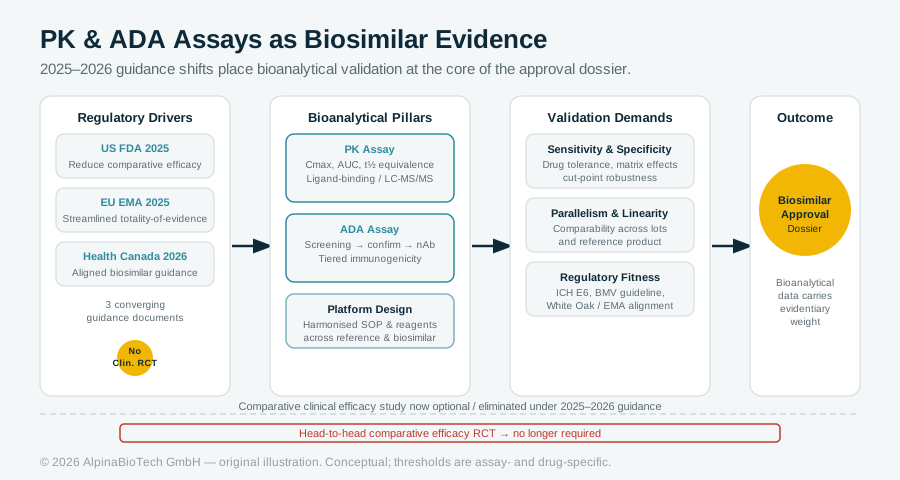
When PK and ADA Assays Become the Whole Argument: Biosimilar Regulatory Reform and What It Demands from Bioanalytical Scientists
Regulatory agencies in the US, EU, and Canada moved in 2025 and 2026 to reduce or eliminate comparative efficacy studies for biosimilar approval, placing pharmacokinetic and anti-drug antibody assays at the center of the evidentiary dossier. This article examines the three converging guidance documents, the validation demands they create, and the platform-level design principles scientists need to build biosimilar bioanalytical programs that can carry that evidentiary weight.
Read more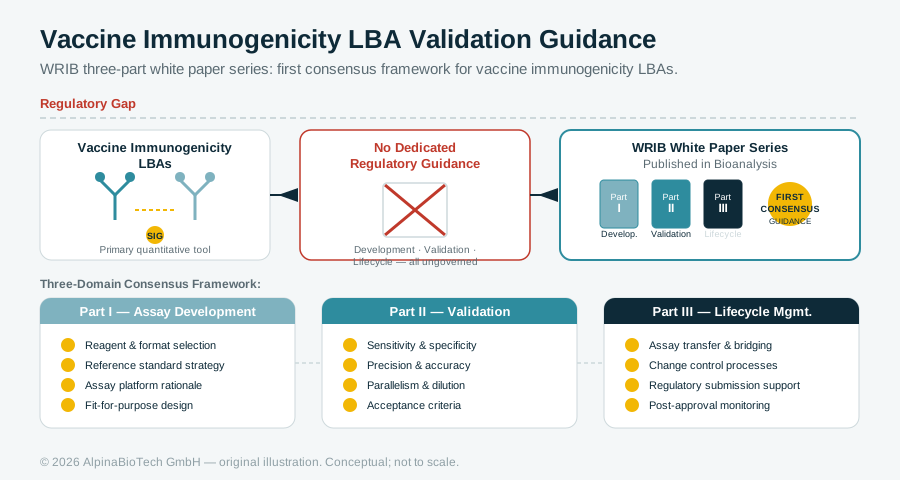
Vaccine Immunogenicity LBAs Have No Dedicated Validation Guidance: A Three-Part WRIB Series Sets Out to Change That
Ligand binding assays are the primary quantitative tool for vaccine immunogenicity studies, yet no dedicated regulatory framework has governed their development, validation, or lifecycle management. A three-part WRIB white paper series, now fully published in Bioanalysis, provides the first consensus-based guidance covering all three domains specifically for vaccine immunogenicity LBAs.
Read more