Article · 27 November 2026
ADC Immunogenicity Assay Design After the Three-Source Framework: Drug Tolerance, Domain Specificity, and What Regulators Are Still Asking For
A November 2026 review in Bioanalysis proposes that antibody-drug conjugate immunogenicity has three distinct sources requiring separate assay strategies: antibody-directed responses, linker-payload neo-epitope responses, and payload-mediated immunomodulation. FDA post-marketing commitments for approved ADCs including datopotamab deruxtecan illustrate what happens when drug tolerance is inadequately characterized during development. This article maps the current regulatory record and emerging platform choices to a practical assay design framework.
AlpinaBioTech
For Research Use Only.
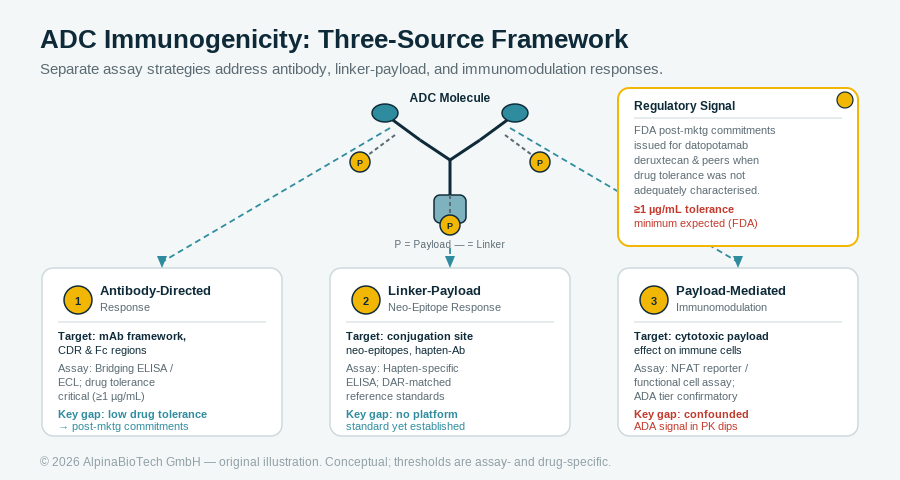
A review published in Bioanalysis on 24 November 2026 sets out a framework that challenges how bioanalytical scientists design and interpret anti-drug antibody assays for antibody-drug conjugates [1]. ADCs are a rapidly growing class of oncology therapeutics, with a clinical pipeline of several hundred candidates, and combining an antibody, linker, and cytotoxic payload introduces immunogenicity risks beyond those of conventional monoclonal antibodies, including neo-epitope formation and payload-mediated effects on antigen-presenting cells. The core argument: ADC immunogenicity has three distinct sources that should be separated. That framing matters because the ADC field has accumulated regulatory history that exposes exactly where current assay practice falls short.
Why ADCs Are Not Just Antibodies With Cargo
An immune response to an ADC can be generated against any part of the molecule, including the antibody, the conjugated payload, or epitopes created by the conjugation linker. The FDA has reinforced this point by recommending that a multi-tiered immunogenicity assessment be conducted to characterize anti-drug antibodies against the ADC, and that it could be appropriate to develop multiple assays to measure immune responses to constituent parts, such as additional epitopes or domains resulting from conjugation [2].
Payload hydrophobicity introduces further structural risk. A higher drug-to-antibody ratio (DAR) may increase payload delivery but can also increase hydrophobicity, aggregation, nonspecific uptake, and clearance, thereby narrowing the therapeutic window [5]. The immunogenicity consequence is direct: ADCs, due to payload hydrophobicity and higher DAR, exhibit greater propensity to aggregation and higher immunogenicity risk than the naked antibody alone [1]. At the structural level, protein aggregation creates or reveals neoepitopes by disrupting the native conformational state, exposing previously buried hydrophobic regions, and generating non-native interfaces [6].
DAR heterogeneity compounds the problem further. Broad DAR distributions can affect batch consistency, dosing precision, safety, and comparability, whereas aggregation may increase immunogenicity risk and reduce bioavailability [10]. Hydrophobic linkers coupled with hydrophobic payloads often promote the aggregation of ADC molecules [5].
Three Sources, Three Assay Problems
The November 2026 Bioanalysis review draws a line that matters for assay design [1]. It distinguishes three sources of ADC immunogenicity: responses to the antibody itself, including anti-idiotypic responses against CDR epitopes that persist in fully human antibodies; responses arising from linker-payload conjugation; and immunomodulation by the released payload, which is not antigenicity. Each source requires a different assay.
The separation matters in practice. The standard bridging ADA assay can detect antibody-directed responses but cannot distinguish whether a positive signal reflects anti-idiotype activity, a conjugation-site neo-epitope, or a pharmacological perturbation of antigen-presenting cells by released payload. That third category is especially important to call out explicitly. Payload-mediated immunomodulation does not generate ADAs directed at the payload molecule. It reflects a pharmacological perturbation of the immune system that can alter the magnitude and character of responses directed at other epitopes. Collapsing this into the standard ADA readout produces interpretively ambiguous data.
A two-tiered preclinical strategy for in vitro assessments is proposed, in which MHC-associated peptide proteomics (MAPPs) on the intact ADC is compared with matched unconjugated and linker-only controls, and DC-PBMC assays are used to test the functional relevance of any ADC-unique peptides [1]. This framework links structural novelty at the linker-payload junction directly to functional immunogenicity risk, rather than inferring risk from homology alone. Immunogenicity assessment should follow a risk-based, adaptive framework in which the extent of evaluation is escalated in response to defined clinical triggers rather than applied uniformly [1].
What the Regulatory Record Shows
The FDA's clinical pharmacology review covering ADC approvals from 2000 through 2025 makes the gaps concrete [2]. That review documents that for datopotamab deruxtecan, ADA was detected in 15.3% of subjects (54 of 352) and neutralizing antibodies in 2.3% (8 of 352), and a post-marketing commitment for ADA assay validation was prompted by low drug tolerance.
The FDA's multidisciplinary review for datopotamab deruxtecan, approved under BLA 761464 in June 2025, documents the regulatory action directly: a post-marketing commitment was issued to complete ADA assay validation and include addendums containing high-resolution drug tolerance data to support that the ADA assays are fit-for-purpose to characterize the effects of ADA on pharmacokinetics [7]. The commitment requires completing the ADA assay tolerance data and justification to support that the ADA assays are fit-for-purpose to characterize the effects of ADA on pharmacokinetics, pharmacodynamics, safety, and effectiveness of datopotamab deruxtecan [7].
Datopotamab deruxtecan is not an isolated case. For trastuzumab deruxtecan, the FDA's conclusion was that no conclusions on the potential impact of immunogenicity on efficacy or safety could be drawn due to the limited number of ADA-positive patients, and a post-marketing commitment to submit an integrated immunogenicity summary report was issued [2]. Across reviewed products, adequacy of immunogenicity evidence depended largely on assay drug tolerance, sufficient sampling duration, and the ability to interpret PK or safety trends among ADA-positive subjects [2].
Drug Tolerance: The Central Technical Problem
Drug tolerance is a critical attribute of ADA assays for assessing clinical immunogenicity, and regulatory bodies including the EMA and FDA have explicitly emphasized drug tolerance in their validation expectations [3]. For ADCs, the problem is structurally compounded. The molecule in circulation is not a single species: biotransformation generates multiple in vivo forms that differ in DAR and in payload or linker modification status, and each of those forms can contribute differently to ADA assay interference.
The AAPS ADC Working Group, whose updated recommendations were published in The AAPS Journal on 1 July 2026, addressed the immunogenicity obligation directly [3]. For ADCs, like all protein therapeutics, an evaluation of the immune responses is important to understand the impact on PK, safety, and efficacy. The bridging ligand-binding assay (LBA) is the most used format for ADA detection against ADCs, and current regulatory guidelines suggest a multi-tiered ADA bioanalytical strategy [3]. The suitability of a reduced-tier approach is determined by a data-driven assessment of assay characteristics including assay range, sensitivity, specificity, and drug tolerance [3].
Low drug tolerance is not a minor technical deficiency. When circulating drug concentrations exceed the drug tolerance level of the ADA assay, the assay cannot detect ADA even when it is present. That failure is invisible in the data: a subject appears ADA-negative when the assay is simply being masked by drug. High circulating drug levels can outcompete assay reagents and suppress true ADA detection, and elevated nonspecific background signals can cause false-negative or false-positive results [9].
Recent work published in Bioanalysis has gone further in defining a principled approach to this problem. Drug tolerance should be presented as a spectrum across ADA (positive control) and drug concentrations, with maximum expected on-treatment levels clearly defined and contextualized against validated tolerance [9]. An emerging tool for this work is Model-Informed Assay Development (MIAD). MIAD has been highlighted as a transformative tool for optimizing drug tolerance and estimating ADA-Reagent-Drug complex (ARC) formation, and has been shown to successfully enhance ADA detectability and mitigate drug tolerance issues [9].
Platform Choices for Drug Tolerance
Building a drug-tolerant ADA assay for an ADC requires deliberate architectural decisions. A universal ADA assay employing generic reagents and a standardized cut point in nonclinical studies can enhance cost efficiency, expedite development, and address limitations in drug tolerance associated with traditional bridging assays [4].
Work published in Frontiers in Immunology from Pfizer's ADC Bioanalytical Group in November 2025 described a Gyrolab-based generic ADA assay developed specifically for ADC programs in cynomolgus monkey studies [4]. The Gyrolab-based generic ADA assay introduces drug to bind all free ADA; immunocomplexes are then collected using an anti-human Fc antibody and detected with an anti-species reagent [4]. Given the high drug doses used in preclinical toxicokinetic studies compared to clinical studies, high drug tolerance is essential for ADA assay performance [4].
A Gyrolab-based ADA assay with a universal cut point of 2.64 was developed, with 16 out of 22 ADCs acceptable for producing a standardized cut point, with an average sensitivity of 99.5 ng/mL and drug tolerance up to 1 mg/mL [4]. When comparing platforms for both PK and ADA performance, Gyrolab demonstrates an expanded dynamic range, enhanced sensitivity, superior signal-to-noise ratio, and greater drug tolerance relative to ELISA [4]. If trough concentration exceeds 0.7 mg/mL, an additional drug tolerance assessment specific to that ADC should be performed [4], which reflects the tiered, molecule-specific logic the field is converging on.
Domain Specificity and the Dual-Payload Challenge
The regulatory expectation is that domain specificity characterization should be proportionate to the immunogenicity risk profile of the specific ADC rather than applied by default to every program [2], [3]. A proposed immunogenicity assay strategy includes ADA domain specificity experiments in addition to the tiered assay approach, covering screening, confirmatory, and possibly neutralizing assays [3].
For dual-payload ADCs, the assay challenge multiplies. The challenge lies in understanding the mechanism of action of each payload and the resulting synergy in effect, the increased number of analytes for bioanalysis, and the potential for added ADA formation due to more available epitopes in the ADC that could be recognized by the immune system [11]. ADAs could be a significant challenge for dual-payload ADCs, necessitating innovations in molecular design, manufacturing, and analytical methods to fully harness their therapeutic potential [11]. To date, no dual-payload ADCs have been approved, and the field is building its guidance framework from single-payload experience.
The assumption that a highly humanized or fully human antibody backbone removes the immunogenicity problem does not hold for the ADC context. Variable-region and CDR epitopes can survive humanization and generate anti-idiotypic responses, even in fully human antibodies [1]. The linker-payload conjugation layer introduces structural novelty that the immune system does not necessarily ignore, even when the clinical ADA rates ultimately observed have been low [1], [2].
What to Prioritize in Your ADC Immunogenicity Strategy
The practical takeaways from the converging guidance documents and the November 2026 Bioanalysis review are specific:
-
Define drug tolerance early and as a spectrum. Drug tolerance should be presented across a range of ADA and drug concentrations, with maximum expected on-treatment levels clearly defined during development, not as a retrospective validation exercise [9]. The datopotamab deruxtecan post-marketing commitment is a concrete example of what happens when this step is deferred [7].
-
Separate the three sources. A generic mAb bridging assay does not characterize linker-payload neo-epitope responses. Build the domain specificity tier to match the structural novelty of your specific ADC [1].
-
Distinguish immunomodulation from antigenicity. Payload-mediated effects on antigen-presenting cells require a different interpretive and assay framework than classic ADA response monitoring [1].
-
Account for DAR heterogeneity in circulation. Elevating DAR imposes a higher burden of hydrophobic payloads on the antibody backbone and expands the overall hydrophobic surface area [5], all of which affect both the drug's interference with ADA detection and the ADA's interference with PK measurement.
-
Align the neutralizing antibody assay timeline with the approval package. Exposure-response interpretation, intrinsic factor analyses, and validated immunogenicity assays including the neutralizing antibody have emerged as primary regulatory scrutiny points across FDA reviews of approved ADC products [2].
All assays and tools referenced in this article are for Research Use Only and are not intended for diagnostic or therapeutic use.
Sources
- [1] tandfonline.com
- [2] pmc.ncbi.nlm.nih.gov
- [3] link.springer.com
- [4] frontiersin.org
- [5] pmc.ncbi.nlm.nih.gov
- [6] pmc.ncbi.nlm.nih.gov
- [7] accessdata.fda.gov
- [8] pubmed.ncbi.nlm.nih.gov
- [9] tandfonline.com
- [10] pmc.ncbi.nlm.nih.gov
- [11] pmc.ncbi.nlm.nih.gov
- [12] ascpt.onlinelibrary.wiley.com
More articles
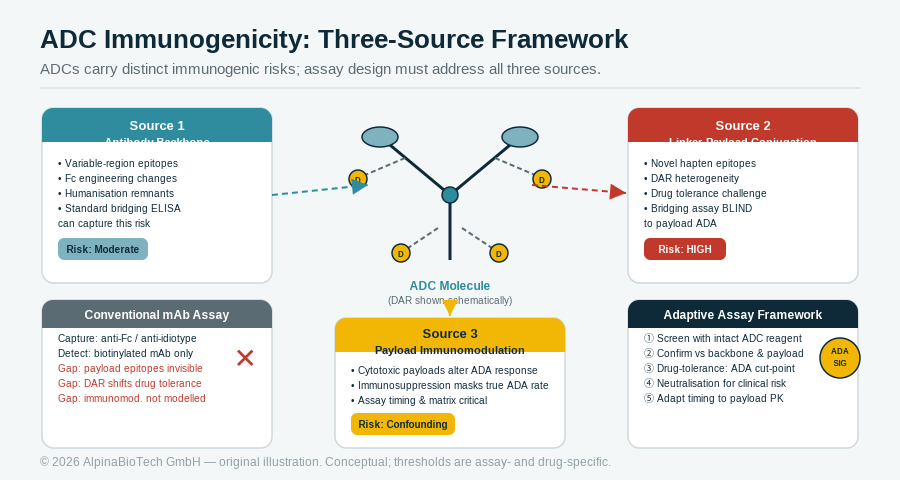
ADC Immunogenicity Is Not Monoclonal Antibody Immunogenicity: What the Three-Source Framework Means for Your Assay Design
Antibody-drug conjugates introduce immunogenicity risks from three distinct sources, including antibody backbone, linker-payload conjugation, and payload immunomodulation, that conventional mAb bridging assays were not designed to address. A November 2026 Bioanalysis review and an AAPS ADC Working Group consensus paper set out a risk-based, adaptive framework for assay design that the FDA review record for approved ADCs makes urgently relevant. This article walks through the framework, the clinical ADA data, drug tolerance challenges, and five practical takeaways for assay scientists.
Read more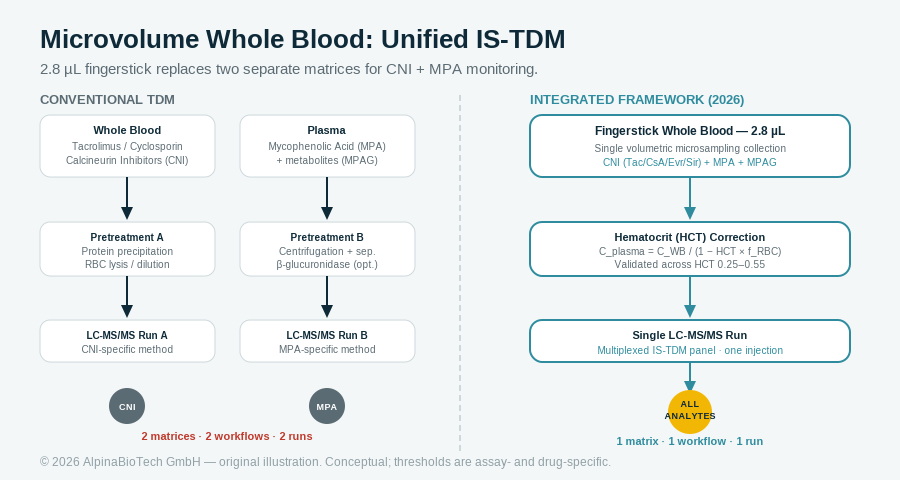
One Platform, All Analytes: Why Microvolume Whole Blood Is Reframing Immunosuppressant TDM
Conventional immunosuppressant TDM splits calcineurin inhibitors and mycophenolic acid across two matrices, two workflows, and two pretreatment pipelines. A 2026 integrated analytical framework published in Bioanalysis, supported by recent LC-MS/MS validation studies using 2.8 µL fingerstick whole blood, challenges that assumption directly. This article reviews the analytical evidence, the hematocrit correction requirement, and what the framework means for assay scientists building fit-for-purpose microvolume methods.
Read more