Article · 18 November 2026
One Platform, All Analytes: Why Microvolume Whole Blood Is Reframing Immunosuppressant TDM
Conventional immunosuppressant TDM splits calcineurin inhibitors and mycophenolic acid across two matrices, two workflows, and two pretreatment pipelines. A 2026 integrated analytical framework published in Bioanalysis, supported by recent LC-MS/MS validation studies using 2.8 µL fingerstick whole blood, challenges that assumption directly. This article reviews the analytical evidence, the hematocrit correction requirement, and what the framework means for assay scientists building fit-for-purpose microvolume methods.
AlpinaBioTech
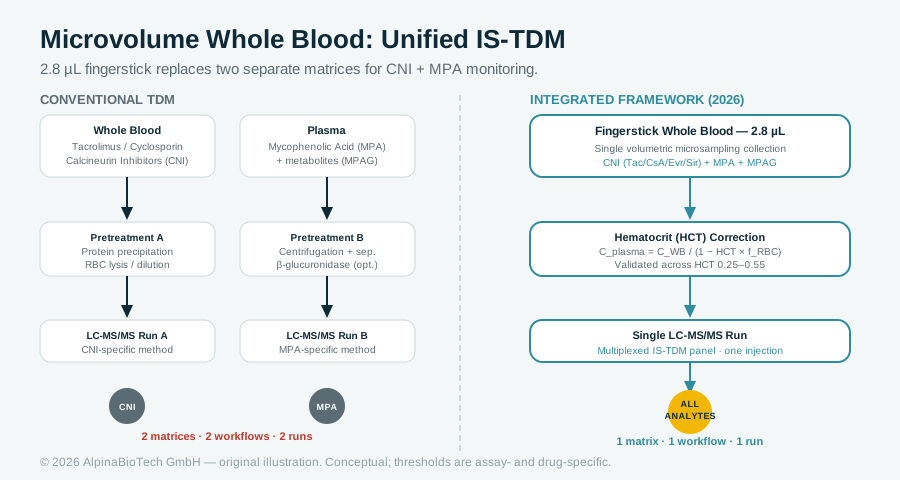
Conventional immunosuppressant therapeutic drug monitoring splits itself across two matrices from the first sample draw. Calcineurin inhibitors are primarily distributed in red blood cells, whereas mycophenolic acid and its metabolites are found in plasma. That biological reality has translated, for decades, into an operational reality: tacrolimus is measured in whole blood, mycophenolic acid is measured in plasma, and the two workflows rarely share a tube, a reagent lot, or a pretreatment step.
A research article by Ramya Ramesh et al., published online November 14, 2026 in Bioanalysis (Volume 18, Issue 14-15), is titled "Reframing immunosuppressant therapeutic drug monitoring: an integrated analytical framework based on microvolume whole blood" [1]. A comment by Kenichi Aizawa accompanies it in the same issue [1]. The article arrives at a moment when several parallel groups have been converging on the same matrix unification problem, and when the clinical stakes for getting the matrix decision right are becoming harder to ignore.
The Core Matrix Problem
The split-matrix problem in immunosuppressant TDM is not simply a matter of laboratory convenience. It reflects genuine pharmacokinetic heterogeneity.
Calcineurin inhibitors, including tacrolimus, everolimus, sirolimus, and cyclosporin A, require simultaneous analysis of their concentrations in whole blood, while MPA and its glucuronide metabolite require a separate plasma workflow under conventional practice [2]. That operational gap carries real clinical weight. Therapeutic drug monitoring of immunosuppressants is crucial to prevent rejection or toxicity after solid organ transplantation [3].
For calcineurin inhibitors specifically, the hematocrit dependence of whole-blood concentration measurements creates an underappreciated layer of analytical ambiguity. Immunosuppressant TDM relies on measuring mostly pharmacologically inactive erythrocyte-bound or plasma protein-bound drug levels, and variable binding of mycophenolic acid to albumin similarly complicates its TDM in plasma [8]. No validated TDM targets currently exist for hematocrit-adjusted CNI concentrations, and published models to adjust blood CNI concentrations for hematocrit or to predict total and unbound plasma immunosuppressant concentrations have yet to be validated in terms of measured concentrations or prediction of clinical outcomes [8].
The case for a unified whole-blood platform rests on resolving these constraints simultaneously, rather than accepting the split-matrix workflow as a fixed constraint.
What Microvolume Sampling Changes
The microvolume whole-blood approach addresses both the matrix split and the sampling burden simultaneously. The goal is a single minimally invasive collection, typically by fingerstick, that yields enough material to quantify all co-administered immunosuppressants in one analytical run.
Microsampling can be used in transplant recipients' care, mainly due to long-term therapy requiring controlled drug concentrations and the long distance between patients' residences and diagnostic laboratories in transplant centers [9]. Microsampling techniques can potentially revolutionize immunosuppressive pharmacotherapy by enabling patient-centric individualization in various subpopulations, significantly improving post-transplant care [9].
The foundational validation work underpinning the integrated framework comes from the group led by Kenichi Aizawa at the Clinical Pharmacology Center, Jichi Medical University Hospital. In that work, the group developed and validated an LC-MS/MS-based method for simultaneously analyzing major immunosuppressants, suitable for integration with various microsampling devices, using only 2.8 µL of blood [2]. The assay was evaluated at two independent laboratories, Jichi Medical University and Shimadzu Corporation, for validation [2].
The method covers tacrolimus, everolimus, sirolimus, cyclosporine A, and MPA in 2.8 µL whole-blood samples, with a hematocrit-based correction to estimate plasma-equivalent MPA concentrations [2]. Performance was assessed by comparison with conventional immunoassay results using linear regression and Bland-Altman analyses, demonstrating excellent agreement, with strong linearity (R² greater than 0.995) [2].
Immunoassay results for tacrolimus showed systematically higher concentrations due to known cross-reactivity, while the LC-MS/MS approach offered superior selectivity through multiple reaction monitoring, significantly reducing interference [2].
Clinical performance data support the approach. The method was evaluated in 60 renal transplant recipients with paired venous samples for comparison. Microsampled and venous concentrations were strongly correlated (R² greater than 0.95), and estimated plasma MPA concentrations derived from whole blood closely approximated plasma concentrations, with a bias below 5% [3]. Reducing the sample volume from 5.6 µL to 2.8 µL improved precision and increased the success rate of blood collection from 72.9% to 94.0% [3]. These findings suggest that the 2.8 µL sampling format represents an optimal balance between patient comfort, sampling success rate, and analytical accuracy [3].
Pediatric validation data extended the approach to a population where minimizing blood volume is especially important. Capillary whole blood of 2.8 µL was collected via fingersticks from pediatric patients receiving mycophenolate mofetil, with or without tacrolimus or cyclosporine A [4]. Hematocrit correction improved agreement for MPA, and Bland-Altman analyses demonstrated acceptable bias across analytes [4]. Fingerstick-based microvolume sampling combined with LC-MS/MS was concluded to provide analytically reliable immunosuppressant quantification in pediatric patients, though larger clinical validation is required [4].
The Hematocrit Correction Requirement
Hematocrit correction is not an optional enhancement in this framework. It is the analytical step that makes whole-blood MPA quantification clinically meaningful.
Hematocrit-based correction was applied to estimate plasma MPA concentrations from whole-blood measurements, with the formula: estimated plasma MPA equals whole-blood MPA multiplied by 100, divided by (100 minus hematocrit) [3]. Scientists applying this formula should note that it assumes negligible partitioning of MPA into erythrocytes, which is the basis for treating whole-blood MPA as a plasma-dilution artifact of hematocrit. That assumption holds reasonably well for MPA given its predominantly plasma-bound distribution, but it should be verified when applying the formula to patient populations with unusual erythrocyte binding characteristics.
Hematocrit correction improved agreement for MPA in the pediatric cohort as well [4], reinforcing that the step is not population-specific but is structurally required by the whole-blood matrix whenever plasma-equivalent MPA concentrations are the clinical target.
All analytes remained stable for up to 72 hours at temperatures at or below 25 degrees Celsius [3], a finding relevant to distributed collection settings where transit time between fingerstick and laboratory receipt must be accounted for in the validation design.
However, practitioners should note that the correction strategy is not yet universally standardized. No validated TDM targets currently exist for hematocrit-adjusted CNI concentrations, and published models to adjust blood CNI concentrations for hematocrit or to predict unbound plasma immunosuppressant concentrations have yet to be validated in terms of prediction of clinical outcomes [8]. The absence of universally agreed hematocrit-adjusted targets remains an open methodological challenge.
Key Analytical Considerations for Assay Scientists
For scientists building or adapting microvolume immunosuppressant assays, the recent literature converges on several design-level requirements:
- Volume targeting: 2.8 µL has emerged as the operationally preferred collection volume, with the improvement from 72.9% to 94.0% blood collection success when moving from 5.6 µL to 2.8 µL representing a clinically meaningful threshold difference [3].
- Hematocrit correction: Plasma-equivalent MPA must be derived from a validated hematocrit-based formula. Without correction, whole-blood MPA values are systematically lower than plasma values and cannot be directly compared with historical trough targets. The assumption of negligible MPA erythrocyte partitioning should be explicitly stated in any validation report [3].
- Simultaneous analyte scope: A fully unified platform should cover tacrolimus, everolimus, sirolimus, cyclosporine A, and MPA at minimum, with hematocrit-based correction applied for MPA [2].
- Cross-reactivity and method selectivity: Immunoassays for immunosuppressants are subjected to significant interferences from metabolites, and liquid chromatography combined with tandem mass spectrometry is recommended for therapeutic drug monitoring [5]. Assay scientists transitioning from immunoassay to LC-MS/MS platforms should build explicit cross-method concordance data into their validation plans.
- Device compatibility: Volumetric microsampling devices have been developed for home-based capillary blood sampling and are now increasingly proposed for the therapeutic drug monitoring of immunosuppressive drugs [9]. Method transfer across different device types still requires individual validation.
- Remote sampling logistics: Long-term therapy requirements and the distance between patients' residences and transplant center laboratories are the primary drivers for distributed collection designs [9]. Home-based workflows introduce pre-analytical variables including sample transit time, temperature excursions, and volume accuracy at the collection site that must be explicitly addressed in validation protocols.
Why This Framework Matters Now
The convergence of microvolume sampling and unified immunosuppressant quantification is not simply a technical refinement. It reframes what decentralized transplant monitoring can look like in practice.
By unifying pretreatment and analytical workflows for plasma and whole-blood analytes, this method can streamline TDM workflows, reduce patient burden, and support precision medicine, particularly in telemedicine and for hospitalized patients with limited venous access [1]. Microsampling can be used in transplant recipients' care primarily because of long-term therapy requirements and the long distance between patients' residences and diagnostic laboratories; implementing these techniques addresses those logistical barriers directly [9].
What the new integrated framework in Bioanalysis addresses is the structural problem: the assumption that whole blood and plasma must be handled separately, that calcineurin inhibitors and MPA require distinct workflows, and that transplant TDM must remain tethered to clinic-based venipuncture. Each of those assumptions is now actively under revision. Even if CNI measurements in novel matrices do not become routine, they may help refine pharmacokinetic-pharmacodynamic relationships and improve mathematical models for TDM using whole blood [8], and the microvolume platform positions the field to generate the evidence those models require.
For assay scientists in regulated bioanalysis, the practical implication is clear: microvolume whole blood is no longer a research curiosity for immunosuppressant TDM. It is a maturing platform requiring full fit-for-purpose validation, matrix-specific hematocrit correction strategies, and careful attention to pre-analytical variables in distributed collection settings. The Ramesh et al. framework provides a timely reference point for that work [1].
Research Use Only. Not for use in diagnostic procedures.
Sources
- [1] tandfonline.com
- [2] ncbi.nlm.nih.gov
- [3] doi.org
- [4] pubmed.ncbi.nlm.nih.gov
- [5] frontierspartnerships.org
- [6] frontiersin.org
- [7] frontiersin.org
- [8] pubmed.ncbi.nlm.nih.gov
- [9] pubmed.ncbi.nlm.nih.gov
More articles

When ADA Titer Is Not Enough: Rethinking the Gate to Neutralizing Antibody Testing
A series of papers published in Bioanalysis throughout 2026 argues that titer-gated neutralizing antibody testing can miss clinically relevant neutralization while generating incidence numbers that mislead development teams. The papers converge on signal-to-noise ratio from the screening tier as a continuous, biologically richer alternative to discretized titer scores, and call for NAb assay sensitivity to be matched to molecule-specific clinical endpoints rather than population-average tier thresholds.
Read more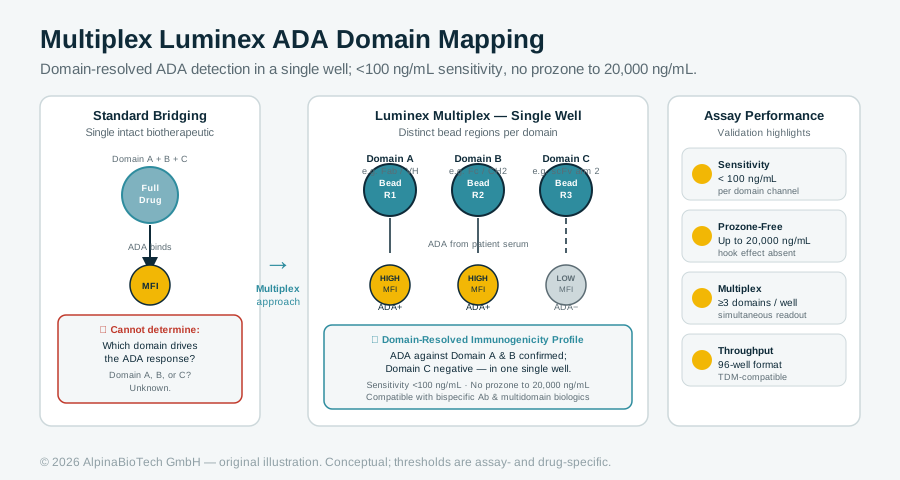
Multiplex Luminex Assay Enables Simultaneous Domain-Specific ADA Detection for Multidomain Biotherapeutics
Standard bridging immunogenicity assays cannot distinguish which domain of a multidomain biotherapeutic is driving an anti-drug antibody response. A Luminex bead-based multiplex approach published in Bioanalysis in November 2026 addresses this gap by enabling simultaneous, domain-resolved ADA detection within a single assay well, with sub-100 ng/mL sensitivity and no prozone effects up to 20,000 ng/mL. This article reviews the method, its validation considerations, and what it means for scientists building immunogenicity programs for bispecific antibodies and other multidomain drugs.
Read more