Article · 25 November 2026
ADC Immunogenicity Is Not Monoclonal Antibody Immunogenicity: What the Three-Source Framework Means for Your Assay Design
Antibody-drug conjugates introduce immunogenicity risks from three distinct sources, including antibody backbone, linker-payload conjugation, and payload immunomodulation, that conventional mAb bridging assays were not designed to address. A November 2026 Bioanalysis review and an AAPS ADC Working Group consensus paper set out a risk-based, adaptive framework for assay design that the FDA review record for approved ADCs makes urgently relevant. This article walks through the framework, the clinical ADA data, drug tolerance challenges, and five practical takeaways for assay scientists.
AlpinaBioTech
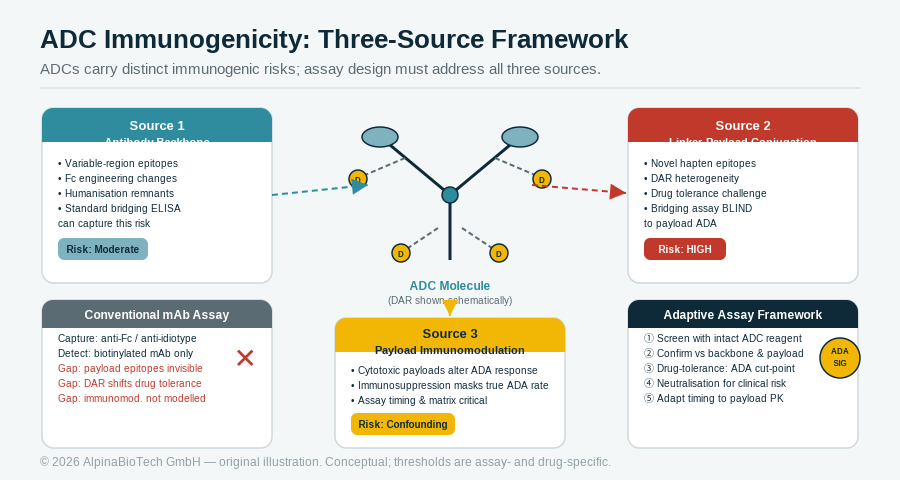
Combining an antibody, linker, and cytotoxic payload introduces immunogenicity risks that the established mAb assay playbook was not designed to address. A review published November 24, 2026 in Bioanalysis sets out a framework distinguishing three sources of ADC immunogenicity: responses to the antibody itself, including anti-idiotypic responses against complementarity-determining region epitopes that persist in fully human antibodies; responses arising from linker-payload conjugation; and immunomodulation by the released payload, which is pharmacological effect rather than antigenicity [1]. Each source requires a distinct analytical strategy, and a single conventional bridging assay cannot do the work of all three.
The practical stakes are high. The FDA approved pivekimab sunirine-pvzy (Decnupaz) on May 27, 2026, for the treatment of adult patients with blastic plasmacytoid dendritic cell neoplasm [4]. With that approval, the FDA has approved 16 antibody-drug conjugates as of 2026, including first-wave agents such as gemtuzumab ozogamicin and trastuzumab emtansine, and newer approvals such as datopotamab deruxtecan, telisotuzumab vedotin, and pivekimab sunirine [7]. Programs at every stage of development now carry an immunogenicity assay question that most conventional mAb playbooks are not equipped to answer.
Three Sources, Three Different Assays
The Bioanalysis review is built around a framework that most practicing bioanalysts will find clarifying rather than obvious. ADC immunogenicity has three distinct sources that should be separated: the antibody itself, including variable-region and CDR epitopes that survive humanization; conjugation of the linker and payload; and immunomodulation by the released payload, which is a pharmacological effect rather than antigenicity [1].
These three sources require different assays. Collapsing all three into a single conventional bridging assay against the intact ADC will detect responses to the antibody backbone reliably, but it risks missing linker-payload neo-epitopes and conflating pharmacological immunomodulation with true adaptive immune responses.
Source 1: The antibody backbone. Anti-idiotypic responses directed at the variable region are a known feature of mAb therapy and survive humanization because CDR epitopes persist in fully human antibodies. Standard bridging assays remain the instrument of choice here.
Source 2: Linker-payload conjugation. This is the genuinely ADC-specific problem. The chemical modification introduced by conjugation changes the three-dimensional surface of the molecule in ways that may generate neo-epitopes not present on the backbone antibody. Clinical studies have not demonstrated increased immunogenicity to ADC compared to conventional therapeutic proteins, but the theoretical risk from antibody, linker, payload, or combined epitopes is real and cannot be assumed away [1].
Source 3: Payload immunomodulation. Released cytotoxic payload can alter antigen-presenting cell function, cytokine environments, and T-cell subset balance. Scoring this pharmacological effect as an ADA response inflates immunogenicity incidence figures, complicates clinical interpretation, and may trigger unnecessary regulatory scrutiny.
A note on drug-to-antibody ratio (DAR) heterogeneity: DAR is defined as the average number of drug molecules covalently attached to each antibody. DAR heterogeneity directly affects both neo-epitope density presented to the immune system and the drug load present in samples used for drug tolerance assessment. The AAPS ADC Working Group paper covers quantification of total antibody, conjugated ADC, and free payload, while also emphasizing the importance of DAR determination, immunogenicity considerations, and the impact of soluble target [6]. Linker design choices that influence DAR distribution have direct downstream consequences for immunogenicity assay performance.
What the Clinical ADA Data Actually Show
Across approved ADCs, ADA incidence is generally low, but the data are complicated by assay limitations that regulators have been explicit about.
The FDA label for trastuzumab deruxtecan provides a detailed illustration. Among patients who received trastuzumab deruxtecan as a single agent and were tested for ADA over a 6-to-9-month treatment period in 12 clinical trials, anti-drug antibodies developed in 1.5% (27/1,798) of patients who received the 5.4 mg/kg dose every three weeks and in 2.6% (21/793) of patients who received the 6.4 mg/kg dose. The incidence of neutralizing antibodies was 0.06% and 0% for the respective dosages [3]. Due to the limited number of patients who developed neutralizing antibodies, the effect of neutralizing antibodies is unknown [3].
Low numbers, however, do not mean clean conclusions. FDA's insistence on robust and validated immunogenicity assessments holds even when clinical incidence appears low. Across reviewed ADC programs, absent neutralizing antibody assays or suboptimal ADA assay validation were near-universal drivers of regulatory actions [2].
The pattern of regulatory actions is consistent. For datopotamab deruxtecan and sacituzumab govitecan, the FDA found that the ADA assay showed low drug tolerance and issued requirements to validate the ADA assay [2]. Across the FDA review record, gaps in immunogenicity were common, with multiple ADCs asked to develop validated neutralizing antibody assays or improve ADA assay drug tolerance [2]. That pattern reveals where the field currently sits: clinical incidence is low enough to avoid overt safety signals, but the assays used to generate that incidence data are frequently inadequate to support definitive conclusions.
Domain-Specific Assays: When They Are and Are Not Warranted
Further ADA characterization for domain specificity and neutralizing antibody should be based on immunogenicity risk assessment for clinical studies [1]. This is a narrow indication, not a blanket requirement.
Domain-specific ADA assays against linker and payload face substantial reagent challenges. There are no commercial kits; every domain-specific assay is a bespoke development project. The technical demand of these assays means the scientific return must be justified by a clear mechanistic or clinical rationale, or by a direct health-authority request.
Defined triggers that warrant expanded domain characterization include: an unexpected drop in drug exposure that cannot be explained by PK variability; a loss of efficacy signal following initial response; injection-site or infusion reactions inconsistent with the expected safety profile; and any direct health-authority request to characterize ADA domain specificity.
When domain-specific assays are warranted, the technical demands are non-trivial. The assay must determine ADA reactivity to different components of the ADC, including the antibody, the linker, and the small-molecule drug [1]. Generating specific reagents, particularly for linker-payload constructs at the relevant epitope density, requires purpose-built development for each program.
What the framework explicitly discourages is uniform application of full multi-domain characterization to every ADC program regardless of mechanism or observed clinical signal. The AAPS ADC Working Group, comprising over 100 members from industry, contract research organizations, and regulatory agencies, provides updated recommendations that address novel immunogenicity assessment considerations alongside quantitation strategy, DAR, and regulatory submissions [6].
Drug Tolerance: The ADC-Specific Complication
Drug tolerance is an assay performance parameter that is difficult enough in the mAb setting. ADCs make it harder for two independent reasons.
First, preclinical toxicokinetic studies use doses that are substantially higher than anticipated clinical exposures, requiring the assay to function across a wide dynamic range. A universal ADA assay employing generic reagents and a standardized cut point in nonclinical studies can enhance cost efficiency, expedite development, and address limitations in drug tolerance associated with traditional bridging assays [5].
Second, the bridging assay format is structurally disadvantaged in the ADC context. A standard ADA bridging assay uses labeled drug as both capture and detection reagent; this approach requires dedicated reagents for each program and involves acid dissociation to process the sample [5]. Acid dissociation is labor-intensive and potentially destructive, and it does not always recover all ADA species effectively.
A Gyrolab-based generic approach addresses both limitations. Drug-ADA complexes are isolated using an anti-human Fc antibody, followed by detection with an anti-cynomolgus detection antibody [5]. A total of 22 distinct ADCs were assessed across 50 cynomolgus subjects, each evaluated in six replicates to determine the cut point. A Gyrolab-based ADA assay with a universal cut point of 2.64 was developed, with 16 out of 22 ADCs acceptable for producing a standardized cut point [5].
Compared to the total ADA ELISA, the Gyrolab assay exhibited a wider signal dynamic range and increased drug tolerance [5]. While this assay is compatible with both ELISA and Gyrolab platforms, the Gyrolab method is the recommended platform for the plug-and-play preclinical ADA approach [5].
The choice of platform is not an academic distinction. When the ADA assay submitted with a marketing application shows inadequate drug tolerance, as it did for datopotamab deruxtecan and sacituzumab govitecan, the FDA issues a post-marketing commitment requiring assay re-validation [2]. That is a regulatory burden that front-loading investment in assay design can prevent.
The Risk-Based Adaptive Framework
Both the Bioanalysis review and the AAPS ADC Working Group converge on an adaptive, risk-based model [1, 6]. The core principle is that immunogenicity assay scope should match the actual risk profile of the specific molecule and program, not a one-size-fits-all checklist.
Across FDA reviews, adequacy of immunogenicity evidence depended largely on assay drug tolerance, sufficient sampling duration, and the ability to interpret PK or safety trends among ADA-positive subjects [2]. These observations suggest that future ADC programs may need more robust, mechanism-informed immunogenicity strategies to reduce post-marketing obligations.
In the absence of risk-triggering signals, a validated screening and confirmatory assay against the intact ADC, designed to meet drug tolerance requirements at clinically relevant drug concentrations, is the appropriate floor. What the framework explicitly discourages is uniform application of full multi-domain characterization to every ADC program regardless of mechanism or observed clinical signal [1].
What Remains Unresolved
The structural limitation facing the field is that when neutralizing ADA incidence is at or near 0.06%, no clinical dataset will ever be large enough to definitively characterize PK or safety consequences. Due to the limited number of patients who developed neutralizing antibodies against trastuzumab deruxtecan, the effect of neutralizing antibodies is unknown [3], and this limitation applies broadly across approved ADCs with similarly low neutralizing ADA rates.
What the field needs is validated neutralizing antibody assays sensitive enough to detect low-incidence responses, with enough drug tolerance to work at real trough concentrations, and deployed early enough that any emerging signal can be correlated with clinical outcomes before the late-stage dataset is locked. A notable gap in the current literature is that many generic ADA papers did not specify a universal cut point or outline a workflow for assessing the suitability of new test articles [5], leaving individual programs to resolve methodological questions from scratch.
Domain-specific neutralizing antibody assays for ADCs remain bespoke development projects, without the methodological consensus that would allow cross-program comparison or regulatory harmonization.
For the Assay Scientist: Five Practical Takeaways
-
Identify which of the three immunogenicity sources is clinically relevant for your molecule before committing to an assay format. Linker-payload neo-epitopes require domain-specific tools; payload immunomodulation requires pharmacological investigation, not serology [1].
-
Characterize drug tolerance early. Target circulating drug concentrations that reflect your anticipated clinical Ctrough, not a generic benchmark. Absent neutralizing antibody assays and suboptimal ADA assay validation are near-universal drivers of regulatory actions across ADC programs [2].
-
Treat neutralizing antibody assessment as a development milestone, not a regulatory afterthought. FDA's insistence on robust immunogenicity assessment holds even when clinical incidence appears low [2]. For programs with low screening-positive rates, the neutralizing antibody assay may be the most interpretively important data in the immunogenicity package.
-
Document the rationale for domain-specific assays explicitly. Health authorities want to know why a particular domain was characterized, not just the results. Mechanistic rationale and clinical trigger data belong in the bioanalytical plan. Further ADA characterization for domain specificity and neutralizing antibody should be based on immunogenicity risk assessment for clinical studies [1].
-
Platform selection matters at the ADC level. The generic Gyrolab ADA assay, using a standard positive control and a universal cut point of 2.64, offers an efficient, adaptable solution for most ADCs in non-clinical studies [5]. This body of evidence, validated across 22 ADC molecules, should inform clinical-phase assay design.
All assays referenced in this article are for Research Use Only. Not for use in diagnostic procedures.
Sources
- [1] tandfonline.com
- [2] pmc.ncbi.nlm.nih.gov
- [3] accessdata.fda.gov
- [4] onclive.com
- [5] pmc.ncbi.nlm.nih.gov
- [6] link.springer.com
- [7] tenovapharma.com
- [8] sciencedirect.com
- [9] tcpharm.org
More articles
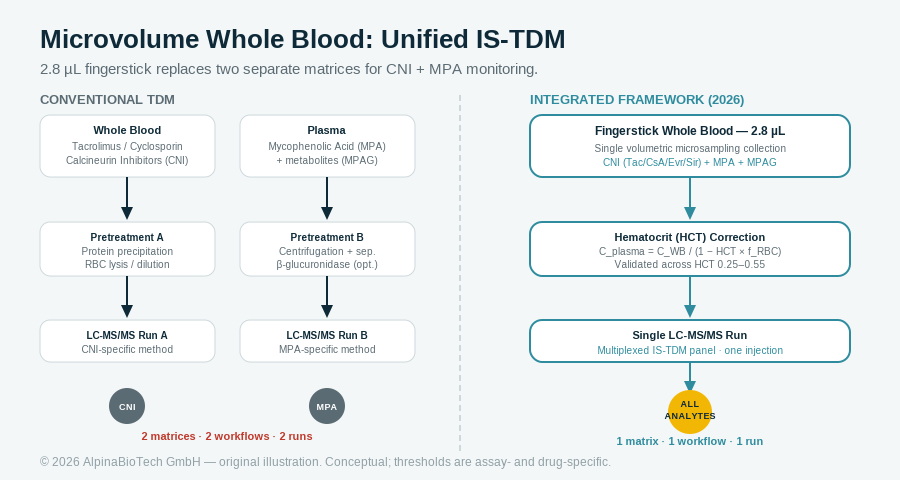
One Platform, All Analytes: Why Microvolume Whole Blood Is Reframing Immunosuppressant TDM
Conventional immunosuppressant TDM splits calcineurin inhibitors and mycophenolic acid across two matrices, two workflows, and two pretreatment pipelines. A 2026 integrated analytical framework published in Bioanalysis, supported by recent LC-MS/MS validation studies using 2.8 µL fingerstick whole blood, challenges that assumption directly. This article reviews the analytical evidence, the hematocrit correction requirement, and what the framework means for assay scientists building fit-for-purpose microvolume methods.
Read more
When ADA Titer Is Not Enough: Rethinking the Gate to Neutralizing Antibody Testing
A series of papers published in Bioanalysis throughout 2026 argues that titer-gated neutralizing antibody testing can miss clinically relevant neutralization while generating incidence numbers that mislead development teams. The papers converge on signal-to-noise ratio from the screening tier as a continuous, biologically richer alternative to discretized titer scores, and call for NAb assay sensitivity to be matched to molecule-specific clinical endpoints rather than population-average tier thresholds.
Read more