Article · 7 August 2026
What "Highly Similar" Actually Requires: Analytical Methods for mAb Biosimilar Characterization
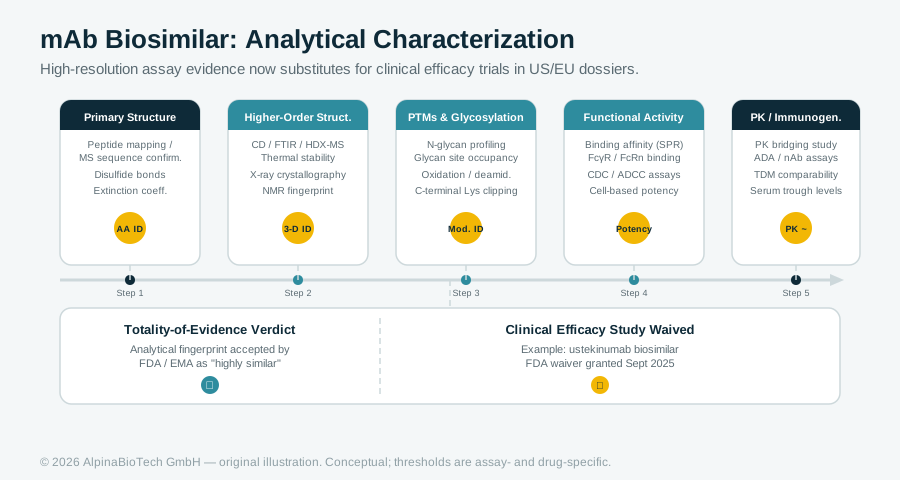
Regulatory approval of mAb biosimilars now depends less on replicating clinical trial results and more on high-resolution analytical characterization. A 2026 BioDrugs review of successful US and EU dossiers maps the assay strategies that matter, while the FDA's September 2025 waiver of a clinical efficacy study for a ustekinumab biosimilar makes the principle concrete for immunoassay and TDM scientists.
AlpinaBioTech
What "Highly Similar" Actually Requires: Analytical Methods for mAb Biosimilar Characterization
The regulatory case for a monoclonal antibody biosimilar no longer rests primarily on replicating clinical trial results. Analytical characterization supports monoclonal antibody biosimilar approvals and may reduce clinical testing needs, according to a review published in BioDrugs that examined successful mAb biosimilar dossiers filed in the US and EU [1]. A parallel regulatory shift made that principle concrete: the FDA's first-of-its-kind action in September 2025 waived the requirement for a clinical efficacy study in an application for a biosimilar referencing Stelara (ustekinumab) [6]. For immunoassay and therapeutic drug monitoring (TDM) scientists, both developments carry direct consequences for how comparability packages and drug monitoring studies are designed.
The Core Problem: Complexity Cannot Be Copied, Only Measured
A monoclonal antibody biosimilar is not a generic drug. A biosimilar developer uses a different cell line, raw materials, equipment, processes, process controls, and acceptance criteria from those of the reference product, and has no direct knowledge of the manufacturing process for the reference product [3]. What closes that gap is not clinical replication but analytical measurement, head-to-head, attribute by attribute.
Aithal R, Majedi OM, McCarthy D, Atouf F, and Peckham N conducted a review of quality attributes and analytical methods used for comparative analytical assessment of monoclonal antibodies as part of successful biosimilar approvals in the United States and European Union, published in BioDrugs 2026;40(4):713-732 (doi:10.1007/s40259-026-00786-w) [1]. The findings have direct implications for scientists designing comparability packages, immunogenicity studies, and pharmacokinetic assays.
The Scale of What Has Been Approved
The approval landscape puts the analytical stakes in context. As of December 2024, the FDA had approved 63 biosimilars, including 43 mAb biosimilars, whereas the European Medicines Agency had approved more than 90 biosimilars, including 54 mAb biosimilars [1]. As of March 2025, the FDA had approved a total of 73 biosimilars across 19 unique biological molecules [3].
The more consequential change is structural, not numerical. The FDA's October 2025 draft guidance, titled "Scientific Considerations in Demonstrating Biosimilarity to a Reference Product: Updated Recommendations for Assessing the Need for Comparative Efficacy Studies," is based on the agency's accrued data and experience since the first biosimilar was approved in 2015 [3]. Despite requiring one to three years and costing $24 million on average, comparative efficacy studies generally have low sensitivity compared to many other analytical assessments [3]. The guidance reduces the requirement for developers to conduct comparative human clinical studies, allowing them to rely instead on analytical testing to demonstrate product differences [3].
A further revision followed: the FDA announced additional draft guidance recommending streamlined unnecessary clinical pharmacokinetic testing when scientifically justified, with the potential to save biosimilar developers up to 50% of their PK study costs, or approximately $20 million [5].
The first concrete application of the waiver pathway was the ustekinumab biosimilar referenced above. The FDA agreed to waive, for the first time, the clinical efficacy study requirement for a monoclonal antibody biosimilar, with the decision applying to a potential version of Johnson and Johnson's immunology product Stelara (ustekinumab), making it the first such FDA biosimilar application to be filed without requiring clinical testing [6]. This is the first time the FDA exercised its waiver authority under the Food, Drug, and Cosmetic Act to reduce the evidence that would normally be required to establish biosimilarity [7]. The FDA has approved other biosimilar versions of Stelara, all of which included a clinical study demonstrating effectiveness in at least one indication, and to that point all other approved biosimilar mAb products had included at least one clinical efficacy study [8].
Instead of requiring clinical efficacy studies, the agency agreed that analytical similarity testing and immunogenicity studies were sufficient to demonstrate biosimilarity [6]. The FDA's own statement confirmed efficacy studies cost an average of $24 million and take one to three years [3]. In practical terms, the analytical package is no longer just supporting evidence for a clinical program. For certain mAbs, it is the program.
What the BioDrugs Review Found
Using publicly available regulatory documents, Aithal and colleagues identified the quality attributes and analytical approaches used in successful mAb biosimilar applications [1]. The review's central finding is that orthogonal analytical strategy, using multiple complementary methods to evaluate the same quality attributes, is now a regulatory expectation rather than a best practice. Analytical similarity has emerged not as a surrogate for clinical evidence but as a higher-resolution predictor of clinical performance.
The Critical Quality Attributes Under the Microscope
Regulatory submissions for mAb biosimilars center on a defined set of critical quality attributes (CQAs) that must be measured comparatively against the reference product. Understanding which assays cover which attributes is the starting point for any analytical comparability program.
Molecular size and aggregation. SEC-HPLC, optionally with multi-angle light scattering (MALS) detection, quantifies monomer purity and resolves high-molecular-weight aggregates and low-molecular-weight fragments. Aggregates carry direct immunogenicity risk; even small differences in aggregate levels between a biosimilar and its reference can require justification during regulatory review [2].
Charge heterogeneity. Charge variant analysis by capillary isoelectric focusing (cIEF) assesses acidic and basic species. Glycosylation patterns and charge variants can influence Fc-mediated functions, serum half-life, and effector activity, requiring demonstration that these attributes fall within an acceptable similarity range relative to the reference product [2].
Glycosylation. This is the most analytically demanding attribute in the comparability package. Variations in glycosylation can affect the efficacy and safety of therapeutic proteins, influencing their biological activity, serum half-life, and immunogenicity [4]. N-glycan profiling by HILIC-UPLC-FLR or LC-MS must characterize glycoform distribution, fucosylation, sialylation, high-mannose content, and galactosylation patterns.
Real-world data on approved biosimilars reinforce why glycan analysis matters. One study systematically characterized Rituxan and its three FDA-approved biosimilars using advanced mass spectrometry-based techniques: native intact MS assessed molecular weight variations, LC-FLR-MS glycan profiling evaluated glycoform distributions, and LC-MS/MS peptide mapping examined sequence integrity and modifications [9]. Notably, the greatest glycan-related variation was observed between biosimilars rather than between biosimilars and the reference product [9]. Overall heterogeneity between biosimilars and the reference product was relatively small compared to that observed among biosimilars, and these findings provide insights into acceptable structural variation and support efforts to refine regulatory assessment practices [9].
Higher-order structure. Hydrogen-deuterium exchange mass spectrometry (HDX-MS) is increasingly expected by regulators for domain-level conformational fingerprinting at peptide resolution. Circular dichroism covers secondary structure, while NMR can provide orthogonal tertiary structure data for smaller biosimilar proteins [2].
Disulfide bonds and sequence integrity. Disulfide bond mapping detects incorrect pairing that could alter tertiary structure or trigger immunogenicity responses. Peptide mapping by LC-MS/MS confirms primary sequence and identifies post-translational modifications such as oxidation and deamidation [2].
Where LC-MS Now Sits in the Workflow
Mass spectrometry-based methods have moved from specialist confirmation tools to central workflow components. Several analytical methods are now routinely employed for biosimilar characterization, including intact mass spectrometry, tandem mass spectrometry (LC-MS/MS), and released glycan analysis via liquid chromatography [1].
The multiplexing capability of LC-MS is particularly relevant now that antibody cocktails and multi-component biologics are entering clinical development. A single-workflow LC-MRM-MS assay capable of quantifying multiple mAbs simultaneously has been described, with a unified sample preparation procedure that simultaneously quantifies mAbs in human serum, a practical advance for combination therapy pharmacokinetics [10]. Rather than requiring independent bioanalytical methods for each antibody, this approach simplifies the analytical burden considerably.
The regulatory acceptance of LC-MS/MS for quantitative bioanalysis of biologics continues to expand, driven by the technique's inherent selectivity and the ability to avoid anti-drug antibody (ADA) interference. Ligand-binding assays can be confounded by circulating drug or ADA when measuring drug concentrations, whereas surrogate peptide methods by LC-MS/MS sidestep this interference by targeting the antibody's unique proteotypic sequence.
The multiplexing approach also has direct TDM applications. One study developed and validated an LC-MS/MS method for the simultaneous quantification of bevacizumab, trastuzumab, rituximab, and pertuzumab in human serum to evaluate clinical applicability [11]. The method demonstrated excellent linearity (1 to 200 ug/mL), precision (CV less than 8.9%), and accuracy (plus or minus 9.8%) [11].
The Tension Between Biological Variability and Analytical Resolution
Biosimilar characterization is defined not by a lack of analytical technology, but by the inherent biological complexity of the molecules themselves. Each method introduces interpretational constraints, validation challenges, and statistical complexity that must be transparently managed in comparability studies. Quality attributes of approved adalimumab and bevacizumab biosimilars have varying concordance with reference product similarity ranges, and clinical efficacy data played a limited role in addressing quality concerns [1]. This underscores that analytical data, not clinical study outcomes, carry the primary evidentiary weight.
To be confident in analytical results, it is recommended to verify each tested parameter using at least two orthogonal methods [2]. Functional assays sit at the intersection of this tension, translating structural attributes into biological effect. Potency biological assays are inherently variable and difficult to validate to the precision levels expected in small-molecule analytics [2]. The gap between structural measurement precision and functional assay variability remains an active area in regulatory submissions, and one that immunoassay scientists are well placed to address.
Host Cell Protein Monitoring: A New Compendial Standard
Host cell protein (HCP) monitoring has its own compendial standard as of 2025. The USP convened an expert panel in 2020 to draft a new subchapter 1132.1 entitled "Residual Host Cell Protein Measurement in Biopharmaceuticals by Mass Spectrometry" [16]. General Chapter 1132.1 was released in December 2024 and became official on May 1, 2025 [15]. The chapter highlights three quantitative methods for HCP measurement, providing industry guidance on study design and analytical standards, and emphasizes critical factors such as proper sample preparation, instrument selection, protein or peptide standards selection, quantitative algorithms, and analysis software [15].
Residual HCPs can impact product quality, patient safety, and long-term immunogenicity risk [15], making HCP measurement a direct concern for immunogenicity program design. The chapter applies to biopharmaceutical manufacturers using mass spectrometry-based workflows, and the official status as of May 2025 means it now shapes expectations in regulatory submissions [12].
Practical Implications for Immunoassay and TDM Scientists
The shift toward analytical-data-led biosimilar development has three concrete consequences for scientists working on drug monitoring and immunogenicity assays.
First, comparability packages now travel upstream into clinical monitoring design. If a biosimilar's glycan profile or charge variant distribution differs subtly from its reference, those differences inform which functional endpoints are most sensitive and which TDM thresholds may need re-evaluation after a therapeutic switch.
Second, USP General Chapter 1132.1 sets a new bar for HCP programs. Scientists designing immunogenicity studies must account for HCP-driven immunogenicity risks using MS-based methods that are now compendially defined, not just internally validated [12].
Third, FDA guidance is explicit that stronger analytical similarity can reduce the scope of clinical studies. The updated draft guidance allows developers to rely on analytical testing to demonstrate product differences [3]. For scientists designing immunogenicity programs for biosimilar development, the analytical characterization data produced in development directly shapes whether a comparative clinical immunogenicity arm will be required, and how large it needs to be.
Conclusion
The BioDrugs review published in 2026 (Aithal et al., doi:10.1007/s40259-026-00786-w) consolidates what works across the mAb biosimilar dossiers it examined [1]. Analytical characterization supports monoclonal antibody biosimilar approvals and may reduce clinical testing needs. The evolution toward approval without mandatory comparative efficacy studies, first realized as an accepted application pathway in September 2025 with a ustekinumab biosimilar [6][7][8], did not reduce the analytical burden. It transferred it.
For immunoassay and TDM scientists, the practical message is that the assay package built during biosimilar development, covering glycan profiles, charge heterogeneity, aggregation, and higher-order structure, does not end at the regulatory submission. It sets the interpretive context for every drug level and ADA result generated during the product's clinical lifetime.
All assay tools and methods described in this article are for Research Use Only (RUO) unless otherwise specified for a particular cleared or approved intended use.
Sources
- [1] centerforbiosimilars.com
- [2] mabion.eu
- [3] fda.gov
- [4] mabion.eu
- [5] fda.gov
- [6] europeanpharmaceuticalreview.com
- [7] hlc.com
- [8] natlawreview.com
- [9] ncbi.nlm.nih.gov
- [10] bioanalysis-zone.com
- [11] ncbi.nlm.nih.gov
- [12] uspnf.com
- [13] gmp-compliance.org
- [14] alphalyse.com
- [15] anaquant.com
- [16] bebpa.org
- [17] analyticalsciencejournals.onlinelibrary.wiley.com
- [18] bioprocessintl.com
More articles
When ADA Positivity Is Not the Answer: Rethinking the Three-Tier Immunogenicity Paradigm
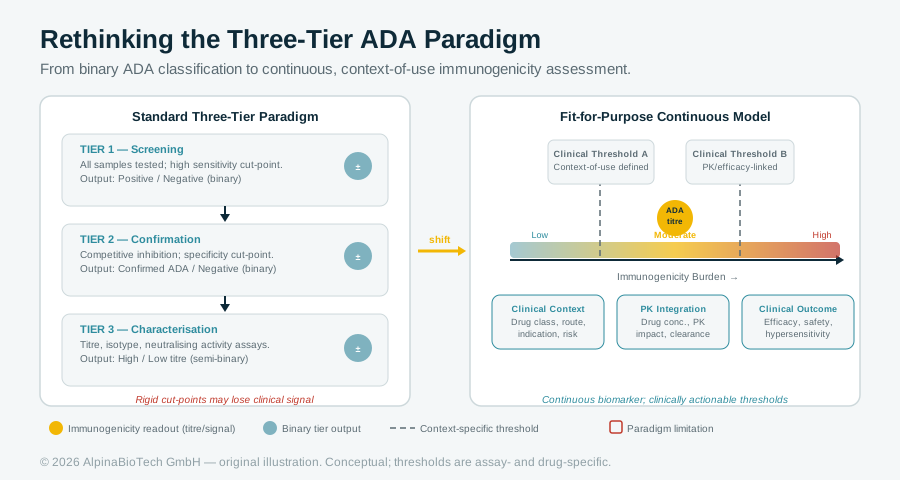
The standard three-tier ADA testing paradigm has governed biologic immunogenicity assessment for more than two decades, but a growing body of evidence questions whether it consistently delivers clinically meaningful data. New publications from Immunologix Laboratories, the European Bioanalysis Forum, and IQVIA Laboratories converge on a fit-for-purpose, context-of-use-driven alternative that treats immunogenicity as a continuous biomarker endpoint rather than a binary classification.
Read more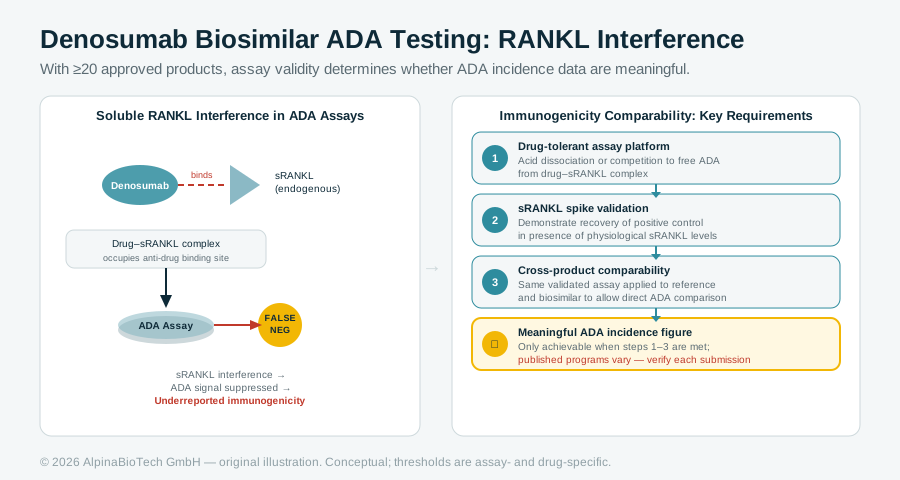
Degevma's FDA Approval and a Market with More Than 20 Denosumab Biosimilars: What Immunogenicity Comparability Testing Actually Requires
The FDA's approval of denosumab-adet (Degevma) on September 28, 2026 brings the cumulative total of approved denosumab products to at least 20, raising a concrete methodological question: in a market this saturated, with interchangeability-driven pharmacy substitutions, what does a reported ADA incidence figure actually tell you? The answer depends entirely on whether the assay has solved the soluble RANKL interference problem, and the published literature shows that not every program has.
Read more