Article · 26 June 2026
Anti-Drug Antibodies and Immunogenicity: Why ADA Testing Belongs in Every Biologic Workflow
Biologics can provoke an immune response against themselves. Detecting those anti-drug antibodies, and interpreting them correctly, is essential to making sense of drug levels and loss of response.
AlpinaBioTech Scientific Team
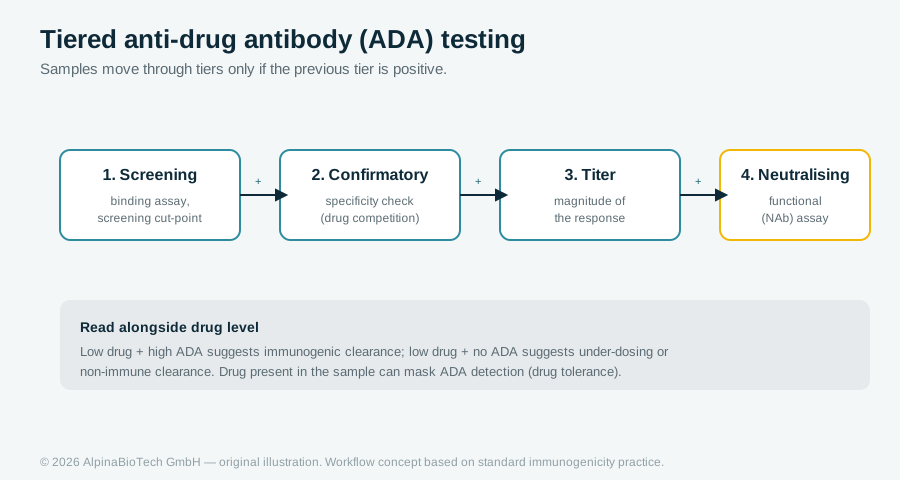
When a patient is treated with a therapeutic protein, their immune system may treat the drug as foreign and raise antibodies against it. These anti-drug antibodies (ADAs) are not a rare curiosity; across chronic inflammatory diseases, systematic reviews report immunogenicity to biologic therapies in a clinically meaningful fraction of treated patients, with rates that differ markedly by molecule, regimen and concomitant immunosuppression. Because ADAs can accelerate drug clearance and neutralise activity, an immunogenicity result is often the missing piece that explains an otherwise puzzling drug level.
What ADAs do
ADAs fall on a spectrum. Binding antibodies attach to the drug without necessarily blocking its function, but in doing so they can form complexes that are cleared more quickly, dragging circulating drug concentrations down. Neutralising antibodies bind at or near the functional site and directly abolish activity. Both matter, and both tend to be more likely when drug exposure has been low or intermittent, one of several reasons sustained, adequate dosing is itself a strategy for limiting immunogenicity. The practical consequence is a feedback loop: low drug encourages ADA formation, and ADA formation lowers drug further, which is how a patient can slide from response into secondary loss of response.
The tiered testing strategy
Detecting and characterising ADAs is not a single measurement but a sequence, and regulatory guidance has converged on a tiered approach. A sensitive screening assay flags potentially positive samples against a statistically defined cut-point, accepting some false positives in exchange for not missing true ones. A confirmatory step then tests specificity, typically by showing that excess drug competes the signal away. Confirmed positives proceed to titer determination, which quantifies the magnitude of the response, and, where functional impact is in question, to a neutralising assay. Each tier answers a different question, and reporting only a screening result risks overstating immunogenicity.
Drug interference: the central analytical challenge
The hardest problem in ADA testing is that the drug and its antibody are present in the same sample and bind each other. Circulating drug can occupy the ADA and hide it from the assay, a phenomenon called drug tolerance, so a sample drawn at peak drug concentration may read falsely negative. This is why ADA results are most reliable at trough, why assay developers work hard to raise the drug-tolerance ceiling, and why an ADA value should never be read in isolation from the corresponding drug level. A negative ADA in the presence of high drug means much less than a negative ADA when drug is undetectable.
Validation is not optional
Because the readout drives interpretation, the cut-points and performance of an immunogenicity assay have to be established with statistical rigour rather than assumed. The widely cited validation recommendations for host-antibody immunoassays set out how to determine screening and confirmatory cut-points, assess sensitivity and drug tolerance, and control for matrix effects, and regulatory guidance for therapeutic protein products formalises these expectations. For a research laboratory, the takeaway is that an ADA assay carries its validation with it: the number only means something against the cut-point and tolerance under which it was generated.
Reading drug and ADA together
The most useful immunogenicity workflow pairs an ADA result with a quantitative drug level on the same sample. Together they separate the three situations that look identical at the bedside, underdosing, immune clearance, and a drug acting on the wrong target, and point to genuinely different next steps. That combined readout is the reason drug-level and ADA ELISAs are designed as companions rather than alternatives.
As with all assays in this series, the kits referenced are for research use only and are not intended to guide patient care without appropriate independent validation.
Part of AlpinaBioTech's educational series. Explore our anti-drug-antibody ELISAs.
References
-
U.S. Food and Drug Administration. Immunogenicity Testing of Therapeutic Protein Products: Developing and Validating Assays for Anti-Drug Antibody Detection. Guidance for Industry. January 2019.
-
Shankar G, Devanarayan V, Amaravadi L, et al. Recommendations for the validation of immunoassays used for detection of host antibodies against biotechnology products. J Pharm Biomed Anal. 2008;48(5):1267-1281.
-
Strand V, Balsa A, Al-Saleh J, et al. Immunogenicity of biologics in chronic inflammatory diseases: a systematic review. BioDrugs. 2017;31(4):299-316.
More articles
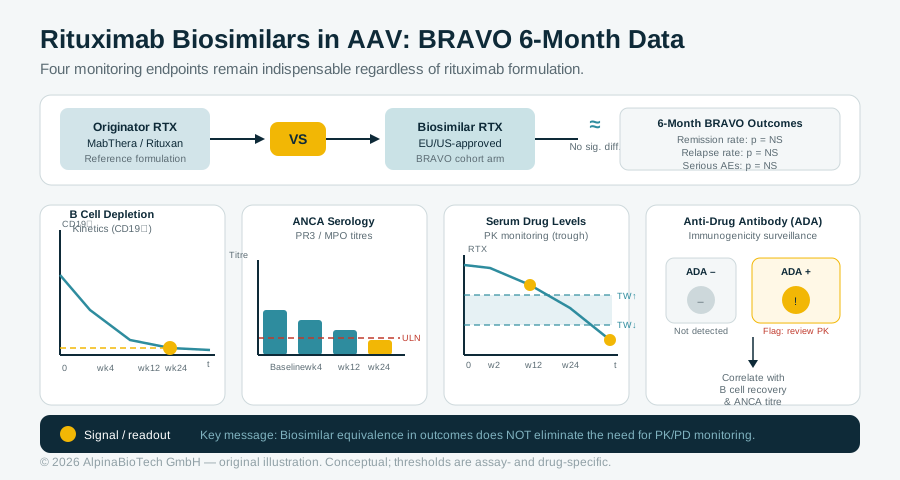
Rituximab Biosimilars in AAV: What Six-Month Real-World Data Tell Monitoring Scientists
The BRAVO multicenter cohort study found no statistically significant differences in remission rates, relapse rates, or serious adverse events between biosimilar and originator rituximab at six months in granulomatosis with polyangiitis and microscopic polyangiitis. For laboratories supporting drug-level and immunogenicity testing in biosimilar-treated AAV populations, the findings reinforce rather than reduce the case for structured pharmacokinetic and pharmacodynamic monitoring. B cell depletion kinetics, ANCA serology, serum drug levels, and anti-drug antibody assays each remain indispensable endpoints regardless of which rituximab formulation the patient receives.
Read more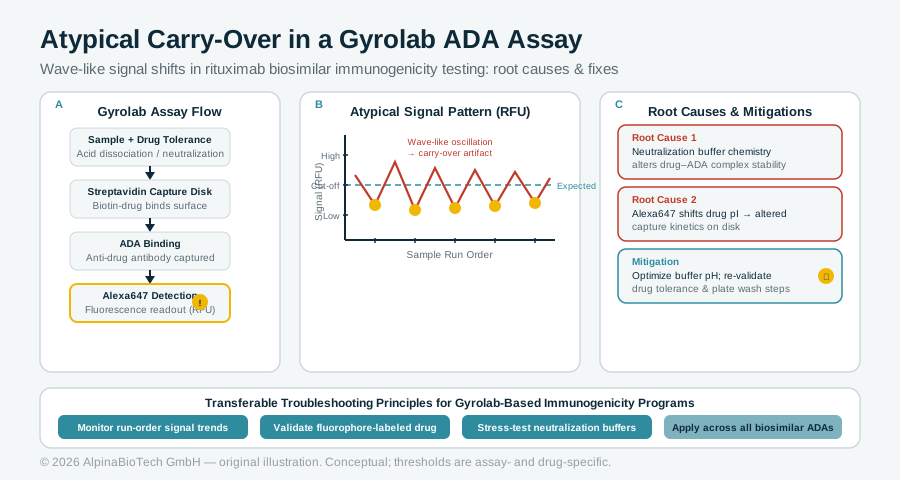
Atypical Carry-Over in a Gyrolab ADA Assay: Lessons from a Rituximab Biosimilar Case Study
A published case study targeting MabionCD20, a rituximab biosimilar, identified wave-like signal fluctuations in Gyrolab-based ADA assays caused by neutralization buffer chemistry and fluorophore-induced isoelectric point shifts. The investigation offers transferable troubleshooting principles for any laboratory running Gyrolab-based immunogenicity programs, particularly around drug tolerance and repeatability.
Read more