Article · 26 June 2026
Anti-TNF Therapy in IBD: Reactive, Proactive, and the Case for Measuring Early
Inflammatory bowel disease is where therapeutic drug monitoring of biologics first proved its worth. The live debate now is timing: measure when response is lost, or measure before it is.
AlpinaBioTech Scientific Team
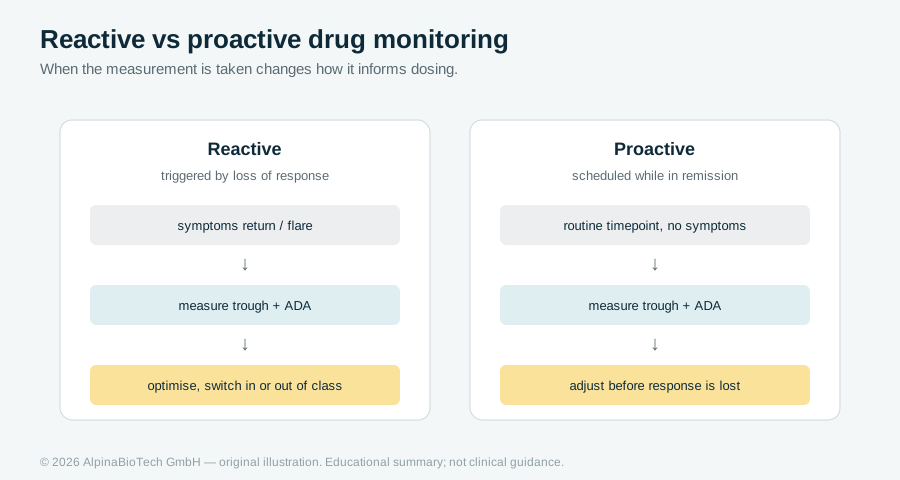
Inflammatory bowel disease, Crohn's disease and ulcerative colitis, was the setting where therapeutic drug monitoring of biologics first earned widespread acceptance. Anti-TNF antibodies such as infliximab and adalimumab transformed treatment, but a substantial share of patients either never respond or lose response over time. A large part of that failure turns out to be pharmacokinetic rather than biological: the drug simply is not present at adequate concentrations. That insight made IBD the proving ground for measuring exposure rather than assuming it.
Reactive monitoring: the established standard
The American Gastroenterological Association's guideline recommends reactive TDM, measuring trough concentration and anti-drug antibodies when a patient with active disease is losing response, to guide the next decision. The logic is decision-tree clean. Adequate drug with active disease implies the anti-TNF mechanism is not the problem, so switching out of class is rational. Low drug with anti-drug antibodies implies immune clearance, favouring a switch within class to a different molecule. Low drug without antibodies implies underdosing, favouring intensification. The guideline pairs this with indicative maintenance trough targets, on the order of 5 µg/mL for infliximab and 7.5 µg/mL for adalimumab, that give the decision a quantitative anchor. Reactive TDM has the strongest evidence base and is widely treated as standard practice.
Proactive monitoring: measuring before response is lost
The more contested idea is proactive TDM: checking drug levels on a schedule in patients who are doing well, and adjusting dose to keep exposure in target range so that loss of response is pre-empted rather than chased. The appeal is mechanistic, low and fluctuating drug levels are precisely the conditions that favour anti-drug-antibody formation, and once antibodies are established the original molecule is often unsalvageable. Measuring early, the argument goes, catches the slide before it becomes irreversible.
The TAXIT trial brought early controlled evidence, showing that dosing infliximab to a concentration target produced more efficient and more stable exposure than clinically guided dosing. The NOR-DRUM programme then tested proactive monitoring head-on: NOR-DRUM A examined TDM during infliximab induction, and NOR-DRUM B examined it during maintenance across chronic immune-mediated diseases. The maintenance results supported a benefit of proactive monitoring for sustaining disease control, while the induction results were less clear-cut, a nuanced picture that explains why guidelines have moved cautiously and why proactive TDM remains an active research question rather than a settled recommendation.
What this means for the laboratory
Whether monitoring is reactive or proactive, the analytical requirement is identical: an accurate trough concentration and a reliable anti-drug-antibody result, ideally from the same sample. Proactive strategies actually raise the bar, because decisions are being made in clinically stable patients where the only signal is the number itself. That puts a premium on assay precision, lot-to-lot consistency, and a drug-tolerance ceiling high enough that antibodies are not masked by circulating drug.
For research groups studying IBD cohorts, the reactive-versus-proactive debate is also a study-design question, and it depends entirely on having assays that produce comparable numbers across many timepoints and many patients. The science of when to measure can only advance on a foundation of trustworthy measurement.
As with all assays in this series, the kits referenced are for research use only and are not intended to guide patient care without appropriate independent validation.
Part of AlpinaBioTech's educational series. Explore our drug-level and anti-drug-antibody ELISAs.
References
-
Feuerstein JD, Nguyen GC, Kupfer SS, Falck-Ytter Y, Singh S; AGA Institute Clinical Guidelines Committee. American Gastroenterological Association Institute Guideline on Therapeutic Drug Monitoring in Inflammatory Bowel Disease. Gastroenterology. 2017;153(3):827-834.
-
Vande Casteele N, Ferrante M, Van Assche G, et al. Trough concentrations of infliximab guide dosing for patients with inflammatory bowel disease (TAXIT). Gastroenterology. 2015;148(7):1320-1329.e3.
-
Syversen SW, Goll GL, Jorgensen KK, et al. Effect of therapeutic drug monitoring vs standard therapy during infliximab induction on disease remission in patients with chronic immune-mediated inflammatory diseases (NOR-DRUM A). JAMA. 2021;325(17):1744-1754.
-
Syversen SW, Jorgensen KK, Goll GL, et al. Effect of therapeutic drug monitoring vs standard therapy during maintenance infliximab therapy on disease control (NOR-DRUM B). JAMA. 2021;326(23):2375-2384.
More articles
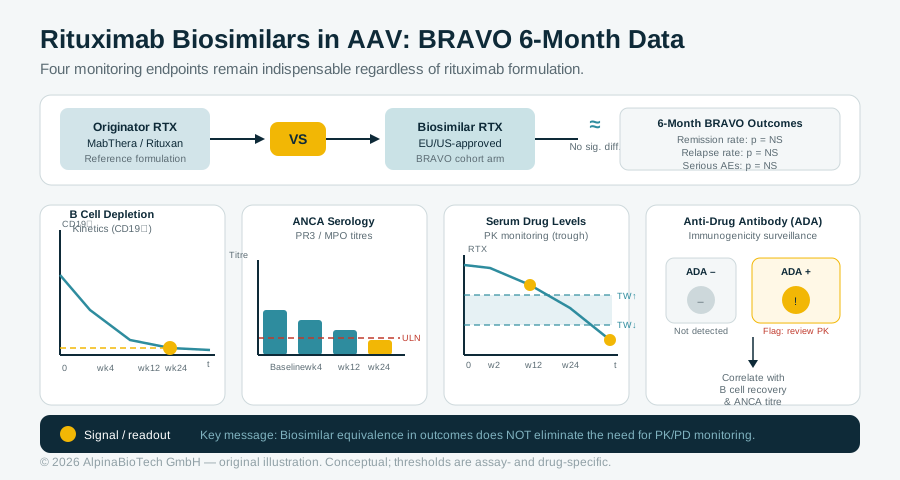
Rituximab Biosimilars in AAV: What Six-Month Real-World Data Tell Monitoring Scientists
The BRAVO multicenter cohort study found no statistically significant differences in remission rates, relapse rates, or serious adverse events between biosimilar and originator rituximab at six months in granulomatosis with polyangiitis and microscopic polyangiitis. For laboratories supporting drug-level and immunogenicity testing in biosimilar-treated AAV populations, the findings reinforce rather than reduce the case for structured pharmacokinetic and pharmacodynamic monitoring. B cell depletion kinetics, ANCA serology, serum drug levels, and anti-drug antibody assays each remain indispensable endpoints regardless of which rituximab formulation the patient receives.
Read more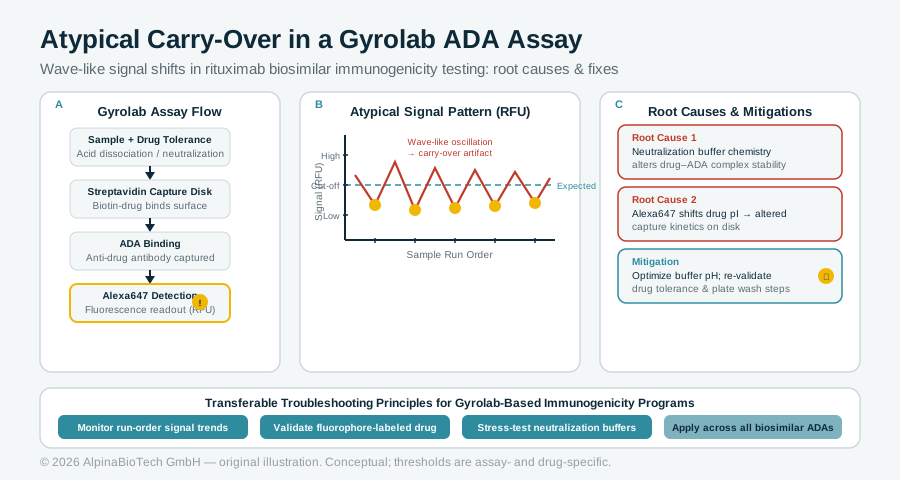
Atypical Carry-Over in a Gyrolab ADA Assay: Lessons from a Rituximab Biosimilar Case Study
A published case study targeting MabionCD20, a rituximab biosimilar, identified wave-like signal fluctuations in Gyrolab-based ADA assays caused by neutralization buffer chemistry and fluorophore-induced isoelectric point shifts. The investigation offers transferable troubleshooting principles for any laboratory running Gyrolab-based immunogenicity programs, particularly around drug tolerance and repeatability.
Read more