Article · 26 June 2026
Biosimilar Immunogenicity Data Cannot Be Read the Same Way Everywhere: What the 2026 Regulatory Shifts Mean for ADA Assay Scientists
A May 2026 scoping review in JAMA Health Forum and the FDA's March 2026 "Revision 4" draft guidance together expose a widening gap: global biosimilar supply chains are pooling immunogenicity data across jurisdictions while the standards governing that data remain sharply uneven. For scientists running ADA assays and therapeutic drug monitoring panels, this divergence determines whether the immunogenicity profile attached to a biosimilar was generated under a validated, tiered assay strategy or under a framework that may have waived that requirement entirely.
AlpinaBioTech
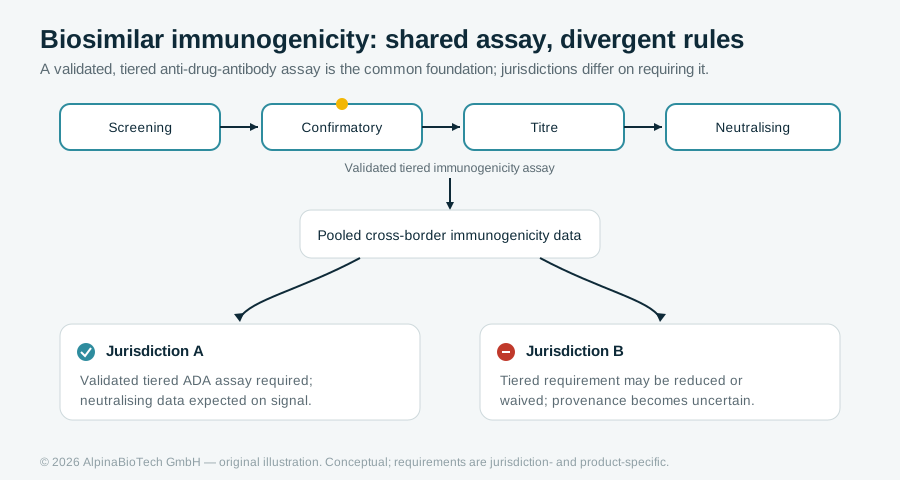
A scoping review published on May 31, 2026 in JAMA Health Forum put a precise number on a problem that bioanalytical scientists already sense when evaluating biosimilar dossiers from outside their own jurisdiction: the evidentiary floor for what counts as an adequate immunogenicity assessment is not the same everywhere, and in many markets it does not exist at all [1][2]. That finding arrived less than three months after the FDA released its formally designated "New and Revised Draft Q&As on Biosimilar Development and the BPCI Act (Revision 4)" on March 9, 2026, a document that simultaneously raises the analytical bar in the United States while reducing the requirement for certain comparative clinical pharmacokinetic study data [4][5][6]. Together, these two developments define the current tension in biosimilar science: global supply chains are internationalizing the data pool, while the standards governing that data remain jurisdiction-specific.
For scientists running anti-drug antibody (ADA) assays, therapeutic drug monitoring (TDM) panels, and post-marketing immunogenicity surveillance programs, this regulatory divergence is not an abstraction. It determines whether the immunogenicity profile attached to a biosimilar you are monitoring in the clinic was generated under a validated, tiered assay strategy, or under a framework that may have waived that requirement entirely.
What the JAMA Health Forum Scoping Review Found
The scoping review by Watanabe, Strand, Walvekar, and Alfonso-Cristancho followed the PRISMA Extension for Scoping Reviews (PRISMA-ScR) methodology, searching CINAHL, PubMed, and Scopus databases through March 1, 2026, and drew on 37 regulatory guidance documents from 19 countries [1][2]. Twelve countries were classified as emerging and developing economies (EDEs) and 7 as advanced economies by the International Monetary Fund as applied by the review's authors [1][2].
The advanced economies, namely Canada, France, Germany, Japan, South Korea, the UK, and the US, served as comparators given their longer histories of biosimilar development [1]. The EDE cohort spanned all 6 WHO regions and included Brazil, China, Egypt, India, Indonesia, Mexico, Nigeria, the Philippines, Poland, Saudi Arabia, Tanzania, and Turkey [1].
One classification in that list requires an explicit editorial note. Poland is a high-income European Union member state and has been classified as an Advanced Economy in the IMF's World Economic Outlook since 2014. The scoping review places Poland in its EDE cohort under the IMF taxonomy as applied by the review's authors [1][2]. That classification diverges from the IMF's own World Economic Outlook groupings, and readers reviewing the review's EDE-specific findings should weight them accordingly when considering Poland's regulatory data.
The findings on immunogenicity and pharmacovigilance are the most directly relevant to laboratory scientists. All advanced economies permitted waivers of clinical efficacy and immunogenicity testing when scientifically justified, but guidelines from emerging and developing economies differed on whether such waivers were permitted at all [1][2]. The review found persistent inconsistencies in how countries approach comparability requirements, clinical study waivers, interchangeability designation, and pharmacovigilance, differences that may complicate the approval process and limit medication availability [1][2].
Pharmacovigilance showed even sharper divergence: Japan, the Philippines, and the Republic of Korea were the only countries that explicitly mandated post-marketing pharmacovigilance studies [1][2]. Sixteen countries explicitly required comparability exercises to demonstrate biosimilarity, and 13 countries specified that the same reference product must be used in those studies [2].
Interchangeability designation, which determines whether a biosimilar can be substituted for its reference product, sometimes at the pharmacy level without physician consultation, appeared in the guidance documents of only 2 of the 12 EDEs in the review's sample [1][2]. Per the review's own language, interchangeability guidance was absent in all emerging and developing economies except Nigeria and Poland [2]. Readers should note that this finding reflects what the guidance documents explicitly address, not necessarily what individual national regulatory practice permits or prohibits in the absence of formal guidance.
The review's authors were direct about the practical consequence: clinicians and policymakers who review biosimilar data from other countries often assume those data were produced under standards similar to their own, and that assumption may be incorrect, and acting on it could introduce bias about a biosimilar's validated safety and efficacy profile [1][2].
A 2025 descriptive review published in Therapeutic Innovation and Regulatory Science examined individual national regulatory requirements and guidelines for biosimilars in more than 70 countries as of July 2024, including both emerging countries and those with extensive biosimilar experience [3]. That review, by Kirchlechner and Cohen, documented meaningful heterogeneity in post-approval safety follow-up timelines: some authorities require six months of follow-up after the last dose for a primary endpoint while others require twelve months, meaning a biosimilar developer must default to the longer interval, delaying submission and approval in countries requiring the shorter follow-up [3].
The Analytical Assay as the Common Foundation
Despite this regulatory patchwork, one principle holds globally. All countries and regions surveyed accept the concept that biosimilars are developed to match the key characteristics of the reference biologic, with analytical assays forming the initial level of evidence [10]. Regulatory strategies in emerging markets have occasionally been inconsistent, with several nations initially permitting biocopy products without thorough comparability data, but this has been shifting as international collaboration and WHO recommendations have pushed for greater standards [10].
This convergence on analytical science as a shared evidentiary foundation is precisely what the FDA formalized in its March 2026 guidance.
FDA Revision 4: Analytical and Immunogenicity Evidence Move to the Center
On March 9, 2026, the FDA issued new draft guidance formally designated "New and Revised Draft Q&As on Biosimilar Development and the BPCI Act (Revision 4)" [4][5][6]. This document revises and replaces the September 17, 2021 Revision 3 draft, updating Q&As I.8, I.10, and I.19 [6][12]. It is a companion to the September 2021 final guidance and operates by moving specific Q&As back into draft form for public comment before they are finalized [12].
The March 2026 announcement builds on an earlier FDA initiative announced in October 2025, under which the FDA proposed guidance reducing certain unnecessary comparative efficacy studies (CES), which, according to the FDA's own stated figures, can require one to three years to complete and cost approximately $24 million [8][14][15]. The March Revision 4 guidance then targeted a second category of clinical burden: unnecessary pharmacokinetic study requirements. According to the FDA's own press release, this change could save biosimilar developers up to 50% of their PK study costs, or approximately $20 million per development program [4].
The policy shift underlying both initiatives has direct consequences for how immunogenicity data will be generated and used going forward. The October 2025 guidance proposed that adequate data from comparative analytical, pharmacokinetic, and immunogenicity assessments will generally suffice to support biosimilar application approvals, reducing the routine requirement for data from comparative clinical efficacy studies for therapeutic protein products [6][7][8]. The FDA explained that many comparative analytical assessments are more sensitive to potential product differences than clinical efficacy studies, whose outcomes can be affected by factors such as dose selection and patient population variability [8][15].
The conditions under which this streamlined pathway applies are specific. Under the framework described in the October 2025 draft guidance and reinforced by Revision 4, a comparative efficacy study may not be needed if the two products are highly purified, derived from clonal cell lines, and analytically well characterized; if the relationship between key quality attributes and clinical efficacy is generally understood and measurable in the comparative analytical assessment; and if a human pharmacokinetic similarity study is feasible and clinically meaningful [7][8].
The FDA explicitly frames its evolving stance as being grounded in maturing analytical technology. As FDA Commissioner Makary stated in the March 2026 announcement, the agency is "embracing more precise analytical testing approaches than have been used in the past" [4]. In a related action accompanying Revision 4, the FDA also withdrew its April 2015 final guidance, "Scientific Considerations in Demonstrating Biosimilarity to a Reference Product," stating it no longer represents the agency's current thinking after gaining significant experience reviewing biosimilar applications [6].
What this means in practice for bioanalytical labs: the immunogenicity assessment is no longer a secondary endpoint appended to a clinical efficacy study. It is, under the new framework, a primary pillar of the biosimilarity demonstration. The ADA assay is doing more evidentiary work, not less.
What Immunogenicity Assays Must Now Deliver
The FDA's tiered ADA testing framework, codified in the January 2019 final guidance "Immunogenicity Testing of Therapeutic Protein Products: Developing and Validating Assays for Anti-Drug Antibody Detection," remains the foundational document for assay development [13]. That guidance finalizes the revised April 2016 draft and covers recommendations for the development and validation of screening assays, confirmatory assays, titration assays, and neutralization assays [13].
Both the FDA and the EMA specify what a credible biosimilar immunogenicity package requires. The EMA, through its own ongoing modernization efforts, has indicated in draft reflection paper work that structural and functional comparability combined with PK data may be sufficient to demonstrate biosimilarity without the need for large-scale clinical efficacy trials [9]. For comparative immunogenicity specifically, guidance addressing ADA assays in biosimilar comparability programs describes a preference for assays capable of detecting antibodies to both the biosimilar and the reference product using a single validated approach, provided antigenic equivalence is demonstrated during ADA and neutralizing antibody assay validation [9]. An essential element of the comparability exercise is demonstrating that there are no clinically meaningful differences in the immunogenicity profile compared to the reference product [9].
Regulators also frequently demand continuous post-market immunogenicity surveillance to detect uncommon or long-term immunological effects that might not manifest in pre-approval trials [11]. This post-market obligation is where the geographic divergence documented in the JAMA Health Forum review becomes operationally significant: the rigor and structure of the pre-approval immunogenicity package determines the baseline against which post-market signals are interpreted, and that baseline is not uniform globally [1][2].
The Implication for Cross-Border Data Interpretation
For organizations tracking global biosimilar pipelines, the JAMA Health Forum findings underscore the risk of equating international biosimilar evidence with FDA-reviewed data [1][2]. The FDA's moves toward analytical and PK-based justifications may position the U.S. as a potential model for streamlined approval that other national regulatory agencies could follow [8]. The EMA's parallel modernization efforts signal that this direction is not uniquely American [9].
The net effect is a global shift that elevates bioanalytical method performance. As comparative clinical efficacy studies are deemphasized at the FDA and EMA, the immunogenicity assay must carry more of the evidentiary weight for both demonstrating biosimilarity and supporting post-marketing surveillance. At the same time, wide variation in how countries define, evaluate, and approve biosimilar medications may be undermining access to more affordable biological treatments [1][2]. The pharmacovigilance obligations that trigger real-world ADA testing remain patchy, unenforced, or simply absent across much of the globe [1][2].
What This Means for Your Laboratory
For scientists designing or validating immunogenicity assays in biosimilar programs, several practical considerations follow from these concurrent regulatory developments.
-
Assay bridging across jurisdictions. If your program generates immunogenicity data under a non-U.S. framework, verify whether interchangeability and pharmacovigilance requirements in the target market require additional validation work before that data can be used directly [2][3]. The scoping review confirms that 13 of 19 countries surveyed require the same reference product to be used in comparability exercises, a constraint that affects which lots and which bridging designs are acceptable [2].
-
Single-assay strategies for comparative immunogenicity. Guidance addressing ADA assays in biosimilar programs describes a preference for a single assay capable of detecting antibodies to both the biosimilar and the reference product, provided antigenic equivalence is demonstrated before validation is finalized [9]. This approach reduces detection bias between products and streamlines the comparative immunogenicity package.
-
Post-market surveillance design. While clinical trial burdens are easing, agencies still expect robust post-marketing safety monitoring, making pharmacovigilance a key component of strategy [11]. A pre-approval immunogenicity assay developed for a single pivotal study may not be fit for the longitudinal sampling plans that post-market programs require.
-
Safety follow-up duration. Some health authorities require six months of safety follow-up after the last dose for the primary endpoint, while others require twelve months [3]. Assay stability and long-term sample integrity planning should reflect the longer window by default.
-
Assay sensitivity as regulatory currency. The FDA's framework emphasizes that comparative analytical assessments are often more sensitive to product differences than clinical efficacy studies [8][15]. An ADA assay that cannot detect low-titer or transient antibody responses against both the biosimilar and the reference product will not meet the evidentiary standard the new framework implies.
The biosimilar landscape is becoming simultaneously more analytically rigorous at the level of regulatory science and more fragmented at the level of global enforcement. Both trends are good reasons to treat the ADA assay, and the validated immunogenicity monitoring program built around it, as central infrastructure rather than a box to check.
All AlpinaBioTech reagents and assay kits referenced in this content are for Research Use Only and are not intended for use in clinical diagnostic procedures.
Sources
- [1] centerforbiosimilars.com
- [2] jamanetwork.com
- [3] ncbi.nlm.nih.gov
- [4] fda.gov
- [5] fiercepharma.com
- [6] bigmoleculewatch.com
- [7] lw.com
- [8] ajmc.com
- [9] pmc.ncbi.nlm.nih.gov
- [10] sciencedirect.com
- [11] iconplc.com
- [12] federalregister.gov
- [13] fda.gov
- [14] fda.gov
- [15] hhs.gov
More articles
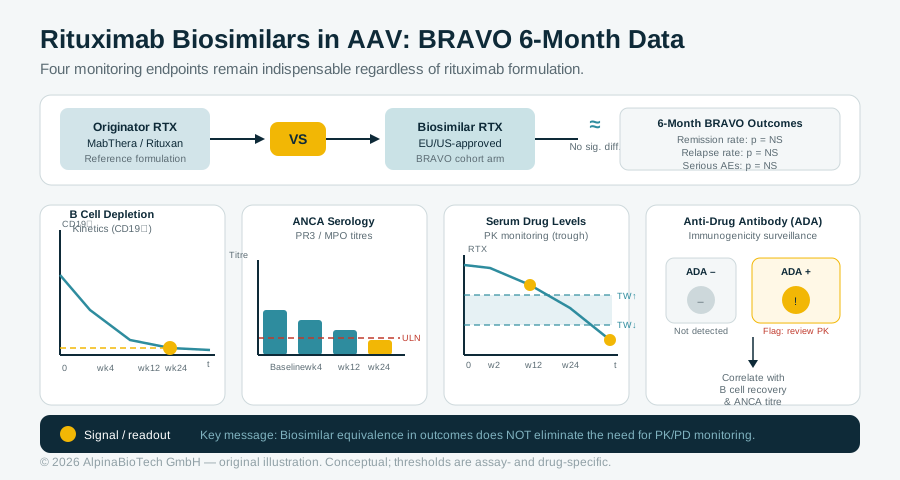
Rituximab Biosimilars in AAV: What Six-Month Real-World Data Tell Monitoring Scientists
The BRAVO multicenter cohort study found no statistically significant differences in remission rates, relapse rates, or serious adverse events between biosimilar and originator rituximab at six months in granulomatosis with polyangiitis and microscopic polyangiitis. For laboratories supporting drug-level and immunogenicity testing in biosimilar-treated AAV populations, the findings reinforce rather than reduce the case for structured pharmacokinetic and pharmacodynamic monitoring. B cell depletion kinetics, ANCA serology, serum drug levels, and anti-drug antibody assays each remain indispensable endpoints regardless of which rituximab formulation the patient receives.
Read more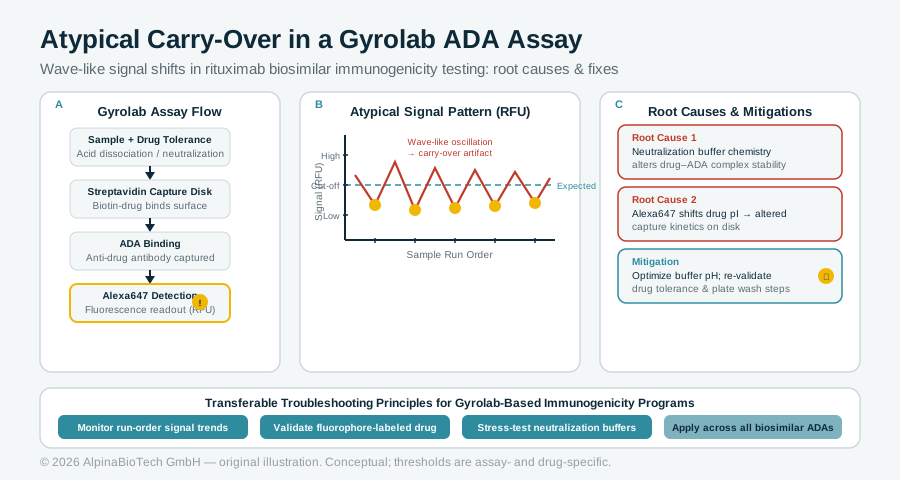
Atypical Carry-Over in a Gyrolab ADA Assay: Lessons from a Rituximab Biosimilar Case Study
A published case study targeting MabionCD20, a rituximab biosimilar, identified wave-like signal fluctuations in Gyrolab-based ADA assays caused by neutralization buffer chemistry and fluorophore-induced isoelectric point shifts. The investigation offers transferable troubleshooting principles for any laboratory running Gyrolab-based immunogenicity programs, particularly around drug tolerance and repeatability.
Read more