Article · 26 June 2026
Global Biosimilar Regulatory Divergence and What It Means for Your ADA Assay Design
A scoping review published in JAMA Health Forum in May 2026 mapped biosimilar regulatory frameworks across 19 countries and found persistent inconsistencies in immunogenicity requirements, clinical study waivers, and pharmacovigilance expectations. For scientists designing anti-drug antibody assays for global biosimilar programs, those inconsistencies translate into concrete decisions about validation scope, sampling schedules, and cut-point frameworks before a single sample is collected.
AlpinaBioTech

A scoping review published in JAMA Health Forum on May 31, 2026 documented a finding with direct practical consequences for immunogenicity scientists: the biosimilar anti-drug antibody data a lab generates under one national framework may not carry the same evidentiary weight when read by regulators in another region. [1][2] For scientists running anti-drug antibody (ADA) assays and pharmacokinetic comparability studies, that gap resolves into concrete decisions about how biosimilar data packages are designed, validated, and interpreted across borders.
All assay products and protocols discussed in this article are for Research Use Only (RUO) and are not intended for use in diagnostic procedures.
The Review and What It Found
The scoping review, authored by Watanabe, Strand, Walvekar, and Alfonso-Cristancho of UCSF and GSK, examined biosimilar regulatory frameworks across all six WHO regions. [2][3] The authors followed PRISMA Extension for Scoping Reviews (PRISMA-ScR) methodology, searching CINAHL, PubMed, and Scopus databases through March 1, 2026. [1] Their corpus drew on 37 regulatory guidance documents from 19 countries: 12 classified as emerging and developing economies and 7 as advanced economies by the International Monetary Fund. [1] The advanced economies, including Canada, France, Germany, Japan, South Korea, the UK, and the US, served as comparators given their longer histories of biosimilar development. [1] Emerging and developing economies spanned all six WHO regions, including Brazil, China, Egypt, India, Indonesia, Mexico, Nigeria, the Philippines, Poland, Saudi Arabia, Tanzania, and Turkey. [1]
The findings documented persistent inconsistencies in how countries approach comparability requirements, clinical study waivers, interchangeability designation, and pharmacovigilance. [1] The researchers noted that clinicians and policymakers reviewing biosimilar data from other countries often assume those data were produced under standards similar to their own, and that acting on that assumption could introduce bias about a biosimilar's validated safety and efficacy profile. [1]
A 2025 descriptive review in Therapeutic Innovation and Regulatory Science reinforced this picture, examining individual national regulatory requirements and guidelines for biosimilars in more than 70 countries as of July 2024 and identifying key differences that complicate global development efforts. [5] Together, the two analyses describe a regulatory landscape that has yet to cohere around shared standards.
Where the Divergence Hits Assay Scientists
For labs running ADA work in a biosimilar development program, the divergence resolves into three concrete areas: the immunogenicity sampling schedule, the post-approval safety follow-up window, and what the data are expected to demonstrate.
Post-approval safety follow-up is one of the clearest fault lines. National frameworks differ in how long safety data must be collected after last dose, and developers filing across multiple jurisdictions must default to the longest required window. [5] That difference alone can delay a submission and shift the practical scope of an ADA monitoring plan.
Immunogenicity comparability sits at the core of the biosimilar demonstration package. When administered to patients, all biologics, including biosimilars, may elicit unwanted immune responses that can significantly impact clinical efficacy and safety. Head-to-head immunogenicity assessment of biosimilars and their reference biologics is therefore considered a critical component of a biosimilar's clinical development program. The FDA, EMA, and other international health authorities recommend using a tiered strategy for immunogenicity sample testing with sequential screening and confirmatory assays, followed by semi-quantitation and characterization of ADA in terms of titer assessment and evaluation of neutralizing capacity. [6][7] Specifically, the FDA's current immunogenicity guidance recommends a multi-tiered testing approach, spelling out the development and validation of screening assays, confirmatory assays, titration assays, and neutralization assays. [8]
The recommended architecture is itself broadly consistent across the FDA, EMA, and WHO. The problem is not the architecture. The problem is that national frameworks diverge on what the data package must demonstrate, how long samples must be collected, and whether comparative clinical efficacy data is required to contextualize the ADA results. [5]
The one-assay approach matters here too. Clinical samples should be tested for immunogenicity using a tiered, one-assay strategy for the detection of ADA and neutralizing antibodies (NAbs) as recommended by health authorities to minimize the confounding influence of inter-assay variability. [6] Yet contemporary ADA and NAb assay methods applied in biosimilar clinical studies frequently have higher sensitivity and drug tolerance compared with those used to support authorization of the reference medicine. [6][7] More sensitive assays typically reveal a higher incidence of treatment-emergent ADA than reported for earlier studies of the reference medicine. [7] When reference product ADA data were generated years earlier under older platforms, a direct numerical comparison between reference product and biosimilar immunogenicity rates is not always interpretable, regardless of which national framework governs the program.
Reducing Clinical Study Requirements: FDA and EMA Move in Parallel
On October 29, 2025, the FDA issued draft guidance titled "Scientific Considerations in Demonstrating Biosimilarity to a Reference Product: Updated Recommendations for Assessing the Need for Comparative Efficacy Studies," under which developers will generally no longer be required to conduct comparative efficacy studies when analytical testing can sufficiently demonstrate biosimilarity. [9][10] The FDA stated in its October 29, 2025 press release that comparative efficacy studies, despite requiring 1 to 3 years and costing $24 million on average, generally have low sensitivity compared to many other analytical assessments. [11] The FDA's new guidance reduces this requirement, allowing sponsors to rely instead on analytical testing to demonstrate product differences. [11]
The draft guidance proposes a streamlined approach when: the reference product and proposed biosimilar are manufactured from clonal cell lines, are highly purified, and can be well characterized analytically; the relationship between quality attributes and clinical efficacy is understood and evaluable; and a human pharmacokinetic similarity study is feasible and clinically relevant. [9] The draft cautions that this framework may not be appropriate for all biosimilars, citing locally acting products such as intravitreally administered drugs as an example where comparative pharmacokinetics may not be feasible. [9]
Overall biosimilar development costs, not just the comparative efficacy study component, are widely estimated at $100 million to $300 million per program, with clinical efficacy studies typically accounting for roughly half of that total. [12][13] These are industry estimates rather than figures drawn from a single primary audit, but they are consistent across sources including the Biosimilars Council and peer-reviewed analyses in Expert Opinion on Biological Therapy. [12][13]
The EMA moved in a parallel direction. Its reflection paper EMA/CHMP/BMWP/60916/2025, titled "Reflection Paper on a Tailored Clinical Approach in Biosimilar Development," was released for public consultation on April 1, 2025 and adopted by CHMP on March 16, 2026. [14][15] The document proposes that structural, functional, and pharmacokinetic comparability data may be sufficient to demonstrate biosimilarity, reducing or eliminating the need for comparative clinical efficacy studies. [14][15] A peer-reviewed analysis of EMA marketing authorization applications for 36 monoclonal antibodies and antibody-derived fusion proteins evaluated between July 2012 and November 2022 concluded that comparative efficacy trial outcomes were never a decisive criterion for the regulatory decision, and that two applications that were withdrawn had been rejected on quality or CMC grounds despite comparative efficacy data suggesting biosimilarity. [16]
The practical consequence for an assay lab is that the analytical and immunogenicity data package is taking on more evidentiary weight, not less, even as clinical study requirements shrink. [9][10] Sponsors must anticipate that regulators expect a well-characterized, validated ADA package in compensation for a leaner clinical dossier.
Interchangeability: A Separate Fault Line
Interchangeability designation is the regulatory category that most directly drives patient-level switching decisions, and it is one of the starkest divergences across frameworks. The FDA maintains a formal interchangeability designation that allows an approved biosimilar to be substituted at the pharmacy without prescriber involvement. [17] The EMA and WHO, by contrast, consider approved biosimilars suitable for substitution from a scientific standpoint but leave switching and substitution decisions to national authorities or physicians. [17] Within the EU, pharmacy-level substitution falls within the remit of individual member states. [17]
The October 29, 2025 FDA announcement also addressed interchangeability directly: the agency stated it is taking action to make it easier for biosimilars to be developed as interchangeable with brand-name biologics, helping patients and pharmacists choose lower-cost options more easily. [11] The FDA now generally does not recommend switching studies, which it characterizes as slowing development and creating public confusion about biosimilar safety. [11]
That distinction matters for immunogenicity monitoring because switching introduces the clinical question of whether repeated transitions between originator and biosimilar alter ADA incidence or titer. For labs designing sampling schedules in programs where switching protocols are under evaluation, the regulatory expectation for what immunogenicity data must capture differs between the FDA framework and those of individual EU member states.
Pharmacovigilance: The Post-Approval Gap
The divergence does not end at approval. Regulators expect biosimilar developers to maintain pharmacovigilance programs capable of detecting rare immunogenic events or safety signals not apparent in pre-approval clinical programs. What those systems must collect, how long they must run, and which adverse immune events trigger formal reporting vary by jurisdiction. [5]
For an ADA assay scientist, this creates a concrete planning problem. An immunogenicity monitoring plan validated for an EMA submission may not map cleanly onto a parallel dossier filed in a WHO Southeast Asia Region country with a locally sourced reference product and different post-marketing reporting requirements. Designing one assay package that satisfies all jurisdictions simultaneously requires identifying the most conservative requirements and defaulting to those, which adds cost and development time. [1][5]
The practical impact of this divergence is patient-level. Wide variation in how countries define, evaluate, and approve biosimilar medications may be limiting patient access to more affordable biological treatments. [2][4]
What This Means If You Are Running ADA Assays Now
The scoping review's core argument is methodological. For scientists at the bench, the regulatory concern resolves into concrete assay design questions.
Validation scope: Analytical assays capable of detecting binding and neutralizing antibodies against both the biosimilar and the reference product in the same manner are preferred, provided antigenic equivalence is demonstrated during ADA and NAb assay validation. [6][7] For programs targeting multiple regulatory submissions, antigenic equivalence validation is not optional.
Sampling schedule: The ADA sampling schedule should allow assessment of transient and persistent ADA responses and, where appropriate, the magnitude of ADA-positive samples. It should support the overall comparative evaluation of any potential impact of immunogenicity on pharmacokinetics, pharmacodynamics, efficacy, and safety. [6]
Assay sensitivity documentation: There is a regulatory expectation that biosimilar developers use state-of-the-art bioanalytical assays. Contemporary methods may reveal higher incidence of treatment-emergent ADA compared with the reference product's historical data, not because the biosimilar is more immunogenic, but because assay sensitivity has improved. [6][7] That apparent deviation must be documented and explained, not treated as a discrepancy.
Cut-point and framework alignment: The FDA's screening assay cut-point recommendation targets a false-positive rate of approximately 5%, chosen to maximize detection of true positives. [8] That threshold is consistent with EMA and WHO guidance at the architectural level. But the evidentiary context, that is, which populations are sampled, over which follow-up windows, and under which national framework, still varies enough across the six WHO regions to require explicit cross-jurisdictional mapping before a program begins. [1][2][5]
The JAMA Health Forum scoping review provides a current map of that variation as of a March 1, 2026 literature cutoff. For assay scientists designing immunogenicity packages for global biosimilar programs, the implication is direct: know which national frameworks apply to your submission before you define your assay cut-points, your sampling intervals, and your follow-up windows. The data you generate is only as portable as the framework it was built under.
All assay products and protocols referenced in this article are for Research Use Only (RUO) and are not intended for use in diagnostic procedures.
Sources
- [1] centerforbiosimilars.com
- [2] researchgate.net
- [3] ucsf.edu
- [4] eurekalert.org
- [5] link.springer.com
- [6] frontiersin.org
- [7] ncbi.nlm.nih.gov
- [8] drug-dev.com
- [9] natlawreview.com
- [10] bigmoleculewatch.com
- [11] fda.gov
- [12] biosimilarscouncil.org
- [13] ajmc.com
- [14] ema.europa.eu
- [15] ema.europa.eu
- [16] link.springer.com
- [17] sciencedirect.com
More articles
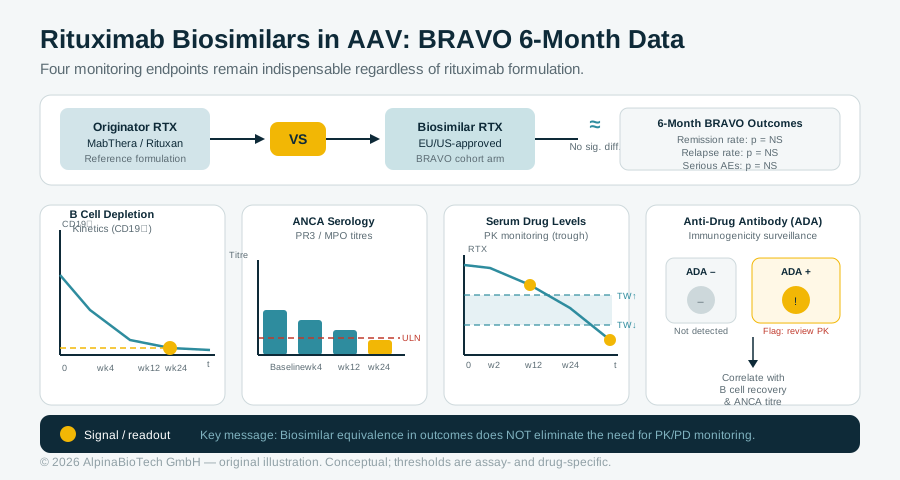
Rituximab Biosimilars in AAV: What Six-Month Real-World Data Tell Monitoring Scientists
The BRAVO multicenter cohort study found no statistically significant differences in remission rates, relapse rates, or serious adverse events between biosimilar and originator rituximab at six months in granulomatosis with polyangiitis and microscopic polyangiitis. For laboratories supporting drug-level and immunogenicity testing in biosimilar-treated AAV populations, the findings reinforce rather than reduce the case for structured pharmacokinetic and pharmacodynamic monitoring. B cell depletion kinetics, ANCA serology, serum drug levels, and anti-drug antibody assays each remain indispensable endpoints regardless of which rituximab formulation the patient receives.
Read more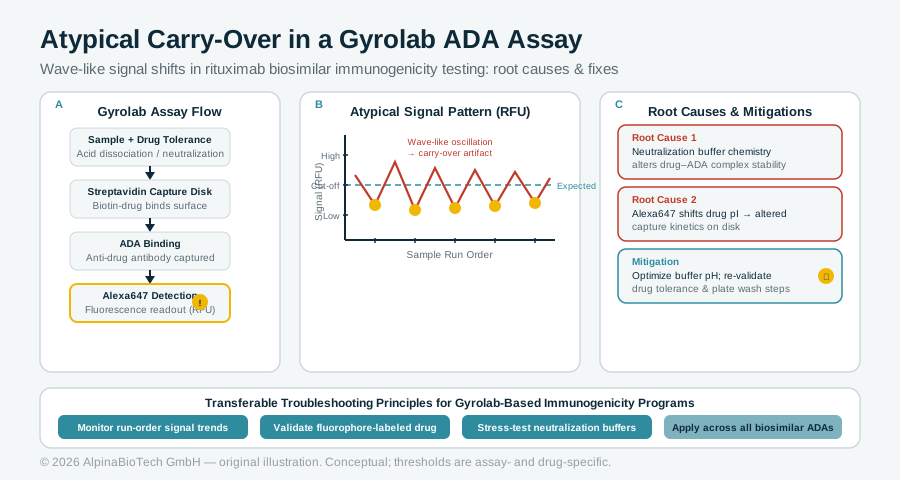
Atypical Carry-Over in a Gyrolab ADA Assay: Lessons from a Rituximab Biosimilar Case Study
A published case study targeting MabionCD20, a rituximab biosimilar, identified wave-like signal fluctuations in Gyrolab-based ADA assays caused by neutralization buffer chemistry and fluorophore-induced isoelectric point shifts. The investigation offers transferable troubleshooting principles for any laboratory running Gyrolab-based immunogenicity programs, particularly around drug tolerance and repeatability.
Read more