Article · 1 July 2026
Merck KGaA's $11.3 Billion Acquisition of Bio-Techne: What It Means for Immunoassay and TDM Scientists
Merck KGaA's agreement to acquire Bio-Techne for US$11.3 billion places R&D Systems, Ella/Simple Plex, and hundreds of thousands of immunoassay reagents under new corporate ownership. Scientists running ELISA, multiplexed, and TDM workflows should document validated assay lots and monitor catalog changes before the deal closes in late 2026 or early 2027.
AlpinaBioTech
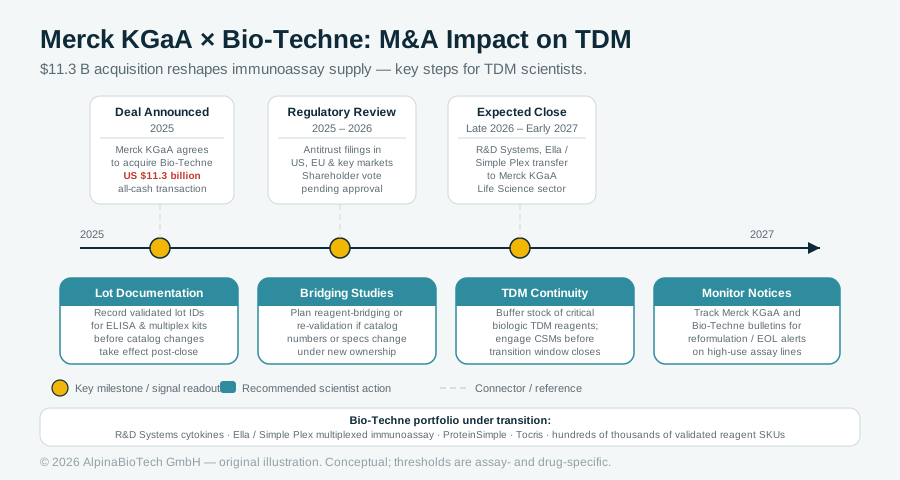
A single acquisition announced on June 25, 2026 could reshape the reagent and platform landscape that immunoassay scientists depend on every day. Merck KGaA, Darmstadt, Germany and Bio-Techne Corporation (NASDAQ: TECH), a Minneapolis-based global provider of life science tools, analytical technologies, and consumables, entered into a definitive agreement under which Merck KGaA will acquire Bio-Techne for US$73 per share in cash, representing a total enterprise value of approximately US$11.3 billion (EUR 9.9 billion) [18]. That figure represents a 36% premium to Bio-Techne's one-month volume weighted average trading price [18].
The proposed transaction has been approved by Bio-Techne's Board of Directors and the relevant corporate bodies of Merck KGaA, and is expected to close by late 2026 or early 2027, subject to customary closing conditions including regulatory approvals and Bio-Techne shareholder approval [16].
For scientists running ELISA-based cytokine quantification, multiplexed immunoassays, anti-drug antibody (ADA) assays, or therapeutic drug monitoring (TDM) workflows, Bio-Techne is not a peripheral name. It is often the name on the reagent box. Understanding what this transaction is, and what consolidation at this scale historically implies for supply, pricing, and assay continuity, matters now.
What Bio-Techne Actually Is
Bio-Techne is a global life sciences company providing innovative tools and bioactive reagents for the research and clinical diagnostic communities [16]. With hundreds of thousands of products in its portfolio, Bio-Techne generated over $1.2 billion in net sales in fiscal 2025 and has approximately 3,100 employees worldwide [6].
The company's relevance to immunoassay scientists runs deep. R&D Systems, a Bio-Techne brand, is the source of the widely cited Quantikine ELISA series, DuoSet development kits, and a broad range of research-grade immunoassay reagents [8]. Merck's Life Science CEO Jean-Charles Wirth stated on a media call that Bio-Techne brings scale with a catalog that includes 6,000 proteins and 425,000 antibodies [4].
The product menu extends well beyond plate-based formats. Bio-Techne's Luminex-based multiplex immunoassay catalog provides the ability to simultaneously assess multiple analytes using magnetic microparticles, covering hundreds of targets across cytokines, chemokines, and related proteins [15].
The Ella automated platform, built on Simple Plex microfluidic cartridge technology, is a central piece of the portfolio relevant to immunogenicity and TDM work. Ella is a compact, cartridge-based immunoassay system that delivers accurate biomarker results in under 90 minutes with minimal hands-on time [17]. By simplifying the manual steps of traditional immunoassays, Ella reduces operator variability and provides high-quality, reproducible data suitable for both translational research and clinical applications [17]. Simple Plex assays run on the Ella platform deliver sub-picogram sensitivity with 4 to 5 logs of dynamic range, enabling detection of even subtle protein expression changes [20]. The full Simple Plex catalog spans more than 390 validated analytes [14].
Critically, Simple Plex assays remain for Research Use Only and are powered by R&D Systems antibodies and proteins [14].
The Strategic Logic of the Deal
The transaction marks the first major acquisition under CEO Kai Beckmann, who took over on May 1, 2026 from Belén Garijo [1]. The Board of Partners of E. Merck KG appointed Beckmann as Chair of the Executive Board and CEO of Merck KGaA, ensuring a seamless transition from Garijo, who led the company for six years as CEO and had been with Merck KGaA for 15 years [3].
This is Merck's largest acquisition since it agreed to buy Sigma-Aldrich in 2014, and one of three transactions each exceeding $10 billion announced in a single week across the life science sector [7]. The Sigma-Aldrich board of directors approved the merger agreement on September 22, 2014, under which Merck KGaA would acquire Sigma-Aldrich for $140.00 per share in cash [10], and Merck KGaA completed that acquisition on November 18, 2015 [11].
The strategic case centers on filling gaps in Merck KGaA's Life Science portfolio. Over the past two decades, the company has invested more than US$35 billion (EUR 30 billion) through inorganic growth, including acquisitions such as Millipore in 2010, Sigma-Aldrich in 2015, Versum in 2019, and SpringWorks Therapeutics in 2025 [18]. The SpringWorks deal was itself substantial: Merck KGaA announced the definitive agreement to acquire SpringWorks Therapeutics on April 28, 2025, for an enterprise value of $3.4 billion (approximately EUR 3 billion), and closed that acquisition on July 1, 2025 [9].
From Merck's perspective, Bio-Techne brings an industry-leading multi-omics offering, analytical technologies, and integrated workflow solutions [18]. Merck KGaA expects annual cost synergies of approximately EUR 140 million, anticipated to be fully realized by year 3 after closing [18].
What Labs Should Watch: Reagent Supply and Assay Continuity
For scientists in TDM and immunogenicity laboratories, consolidation of this scale raises four concrete questions.
Lot continuity. Immunoassay-based TDM and ADA testing depends on lot-to-lot consistency across antibody pairs, diluents, and calibrators. Any change in manufacturing site, raw material sourcing, or quality system introduced post-acquisition can propagate directly into assay performance. Laboratories with validated methods anchored to specific Bio-Techne catalog numbers should document current lot performance now, before integration is complete, so that they have comparator data if they need to qualify a new lot under changed conditions.
Catalog rationalization. Large portfolio acquisitions are routinely followed by product-line rationalization. The Quantikine ELISA series spans hundreds of analytes across multiple species [8]. The Simple Plex portfolio lists more than 390 validated analytes across neuroscience, immunology, oncology, and cell and gene therapy [14]. Post-acquisition overlap analysis between Merck's MilliporeSigma catalog and Bio-Techne's R&D Systems lines will likely result in some rationalizations. Watch product discontinuation notices closely.
Pricing structure. Synergy targets of EUR 140 million in life science tools acquisitions historically include procurement consolidation and commercial restructuring [18]. That can translate to changes in list pricing, contract structures, or academic versus commercial pricing tiers.
The CE-IVD pathway. On February 16, 2026, Bio-Techne announced that the Ella benchtop immunoassay platform received CE-IVD marking and became available for sale in the European Union [6]. CE-IVD marking signifies compliance with the EU's In Vitro Diagnostic Regulation (IVDR, Regulation (EU) 2017/746), confirming safety, performance, and reliability for clinical use [6]. With CE-IVD marking in place, hospitals, clinical laboratories, or other European organizations may use Ella as a validated platform for in-house test development, clinical trials, or other translational activities, and diagnostic assay developers may also develop clinical applications on the Ella CE-IVD validated platform [13]. Note that Simple Plex assays run on that instrument remain for Research Use Only [6]. How Merck KGaA integrates and potentially accelerates this CE-IVD pathway is worth tracking for European laboratories with translational ambitions.
A Pattern of Toolmaker Acquisitions
This deal fits a deliberate strategic pattern. Every major Merck KGaA acquisition, from Millipore in 2010 through Sigma-Aldrich in 2015 and Versum in 2019, targeted a toolmaker or technology platform company [18]. The precedents with MilliporeSigma show that brand names can survive at the product level even as corporate ownership changes. R&D Systems, ProteinSimple, Novus Biologicals, Tocris, and the other brands within Bio-Techne's portfolio may persist on labels and catalog pages for years. What changes is the supply chain, the contract terms, and eventually the product development roadmap.
On January 28, 2026, Bio-Techne announced the launch of Simple Plex Ultra-Sensitive Assays on the Ella automated benchtop platform [12]. The new assays deliver step-change improvements in analytical sensitivity and reliable quantification of key neurological biomarkers, including NFL, GFAP, pTau 217, and Amyloid beta (aa1-42) [12]. These assays achieve femtogram-level analytical sensitivity with an automated Ella workflow and under three-hour total runtime [12]. Bio-Techne's neurology-focused Ella applications are supported by more than 200 peer-reviewed publications [12]. These assays are for Research Use Only [12].
Whether Merck KGaA's larger R&D budget accelerates further investment in this direction, or whether integration priorities slow it down, is the open question for the field.
Practical Steps for Immunoassay Laboratories
The proposed transaction is expected to close by late 2026 or early 2027 [16]. The window before integration is the right time to act.
- Inventory validated assay versions. Catalog numbers, lot numbers, and the specific antibody pairs underlying any internally validated TDM or ADA assay should be documented fully before any transition.
- Establish contact with current Bio-Techne account representatives. Supply continuity commitments, if any, will be made at the account level before they appear in public communications.
- Review custom assay agreements. Bio-Techne's custom Luminex and custom Simple Plex services involve proprietary reagent sets and service contracts. Understand how those agreements transfer under a change of ownership.
- Monitor the CE-IVD Ella rollout. For European translational laboratories, the combination of Merck KGaA's European regulatory infrastructure with Bio-Techne's platform may accelerate or redirect the CE-IVD validated workflow opportunity [6] [13].
The acquisition does not change what any individual assay measures today. It does change who controls the supply of the antibodies, proteins, calibrators, and instruments needed to measure it. For laboratories where a single discontinued lot or a repriced reagent cascade can stall a study or break a validated method, that is not an abstract concern.
All Bio-Techne immunoassay products, including Quantikine ELISAs, Simple Plex assays on the Ella platform, and Luminex panels, are designated Research Use Only (RUO) unless otherwise specified [14]. The CE-IVD marked Ella instrument is available for sale in the EU, but Simple Plex assays run on that instrument remain RUO [6].
Sources
- [1] emdgroup.com
- [2] chemistryviews.org
- [3] europeanpharmaceuticalreview.com
- [4] cnbc.com
- [5] sec.gov
- [6] prnewswire.com
- [7] bioxconomy.com
- [8] bio-techne.com
- [9] emdgroup.com
- [10] sec.gov
- [11] bioinformant.com
- [12] prnewswire.com
- [13] investors.bio-techne.com
- [14] bio-techne.com
- [15] bio-techne.com
- [16] investors.bio-techne.com
- [17] bio-techne.com
- [18] prnewswire.com
- [19] cen.acs.org
- [20] bio-techne.com
More articles
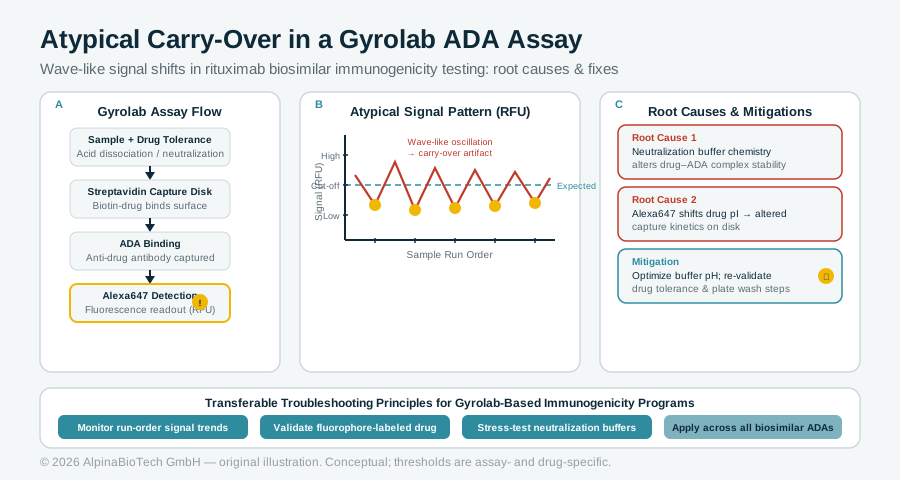
Atypical Carry-Over in a Gyrolab ADA Assay: Lessons from a Rituximab Biosimilar Case Study
A published case study targeting MabionCD20, a rituximab biosimilar, identified wave-like signal fluctuations in Gyrolab-based ADA assays caused by neutralization buffer chemistry and fluorophore-induced isoelectric point shifts. The investigation offers transferable troubleshooting principles for any laboratory running Gyrolab-based immunogenicity programs, particularly around drug tolerance and repeatability.
Read more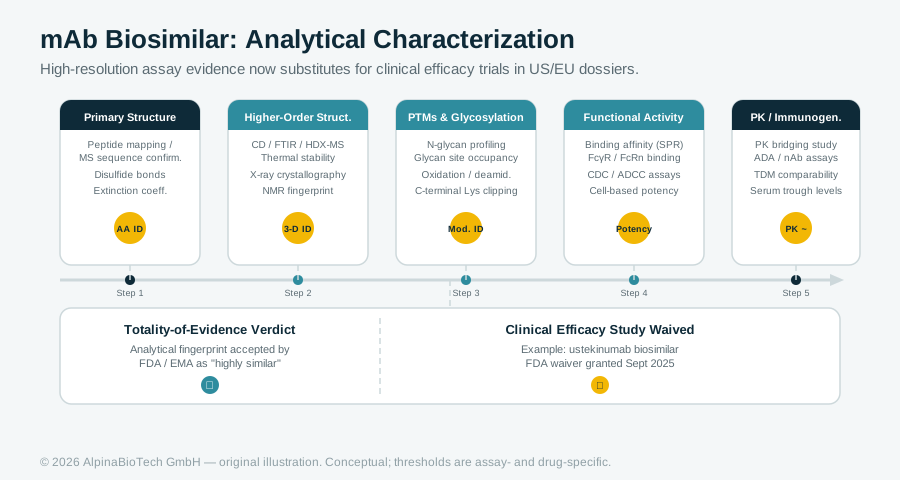
What "Highly Similar" Actually Requires: Analytical Methods for mAb Biosimilar Characterization
Regulatory approval of mAb biosimilars now depends less on replicating clinical trial results and more on high-resolution analytical characterization. A 2026 BioDrugs review of successful US and EU dossiers maps the assay strategies that matter, while the FDA's September 2025 waiver of a clinical efficacy study for a ustekinumab biosimilar makes the principle concrete for immunoassay and TDM scientists.
Read more