Article · 26 June 2026
Monitoring Biosimilars: What Switching Means for Drug-Level and ADA Testing
As biosimilars become routine, laboratories need to know whether their drug-level and anti-drug-antibody assays still apply after a switch. The short answer is usually yes, with caveats worth understanding.
AlpinaBioTech Scientific Team
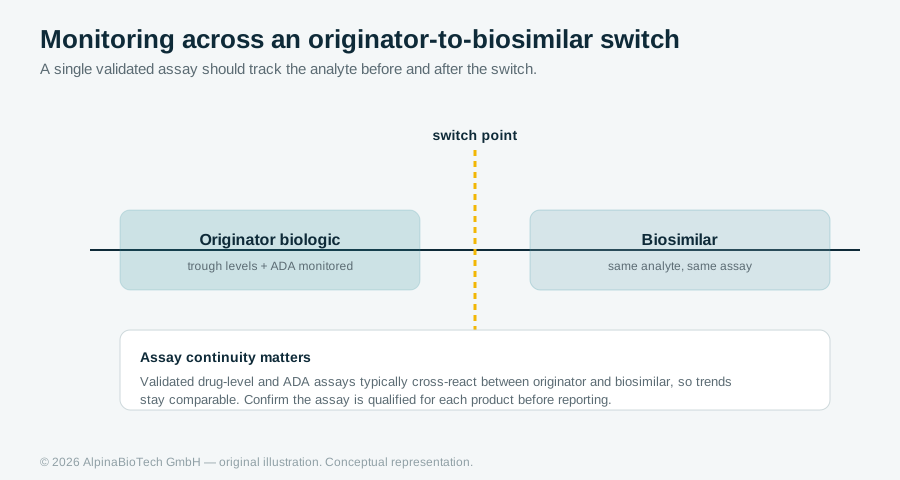
A biosimilar is a biologic that is highly similar to an already-approved reference product, with no clinically meaningful differences in safety, purity or potency. Over the last decade, biosimilars of the major anti-TNF antibodies, infliximab and adalimumab in particular, have moved from novelty to standard of care, driven largely by cost. For laboratories that measure these drugs, the rise of biosimilars raises a practical question: when a patient switches from the originator to a biosimilar, does the assay that tracked their drug levels and anti-drug antibodies still work?
What the switching evidence shows
The landmark NOR-SWITCH trial randomised 482 patients on stable originator infliximab to either continue or switch to the biosimilar CT-P13 and followed them for 52 weeks. Switching was not inferior to continued originator treatment on the prespecified margin, and immunogenicity rates were comparable between groups. The open-label extension that followed patients further reached the same conclusion. While the trial was not powered to prove non-inferiority within each individual disease, its breadth across indications made it a reference point for the clinical acceptability of switching, and it normalised the expectation that monitoring should continue seamlessly through a switch rather than restarting.
Assay continuity: the analytical question
From a measurement standpoint, the reassuring finding is that drug-level and ADA assays developed for an originator generally recognise its biosimilars. Because a biosimilar shares the reference product's amino-acid sequence and binding characteristics, an assay's capture and detection reagents typically bind both. Method-comparison work has shown that assays validated for originator infliximab also quantify CT-P13 biosimilars, and that anti-originator-antibody assays cross-react with biosimilar-induced antibodies, yielding consistent positive and negative calls with well-correlated titers. In practice this means a laboratory can usually maintain one assay and one set of reference ranges across a switch, preserving the longitudinal trend that makes monitoring useful in the first place.
The caveats worth keeping
"Generally" is not "always". A few points deserve attention. First, cross-reactivity should be confirmed, not assumed: before reporting biosimilar concentrations on an assay validated for the originator, a laboratory should verify performance against the specific product, ideally with spike-recovery in the relevant matrix. Second, calibrator identity matters, a kit calibrated against the originator will report biosimilar concentrations in originator-equivalent units, which is fine for trend monitoring but should be stated clearly. Third, as new biosimilars and formulations enter the market, each is a fresh analyte until shown otherwise; the safest assumption is that qualification is product-specific even when the science predicts cross-reactivity.
Why this matters for research workflows
Biosimilar adoption multiplies the number of products a laboratory may encounter while the underlying analyte, the therapeutic antibody and the immune response to it, stays conceptually the same. An assay strategy that travels across originator and biosimilar lets investigators pool and compare data rather than fragmenting it by brand. That continuity is especially valuable in pharmacokinetic and real-world studies, where the whole point is to follow exposure and immunogenicity over time and across the switches that now happen routinely in practice.
As with every assay in this series, the kits referenced are supplied for research use only and are not intended to direct patient management without appropriate independent validation. Used as research tools, cross-reactive drug-level and ADA assays make the biosimilar era far easier to study than it would otherwise be.
Part of AlpinaBioTech's educational series. Explore our drug-level and anti-drug-antibody ELISAs.
References
-
Jorgensen KK, Olsen IC, Goll GL, et al. Switching from originator infliximab to biosimilar CT-P13 compared with maintained treatment with originator infliximab (NOR-SWITCH): a 52-week, randomised, double-blind, non-inferiority trial. Lancet. 2017;389(10086):2304-2316.
-
Gecse KB, Lovasz BD, Farkas K, et al. J Crohns Colitis. 2016;10(2):133-140. doi:10.1093/ecco-jcc/jjv220. PMID:26661272. (Drug-level and ADA assays validated for originator infliximab cross-react with CT-P13 biosimilars.)
-
European Medicines Agency & European Commission. Biosimilars in the EU: Information guide for healthcare professionals. 2019 (updated edition).
More articles
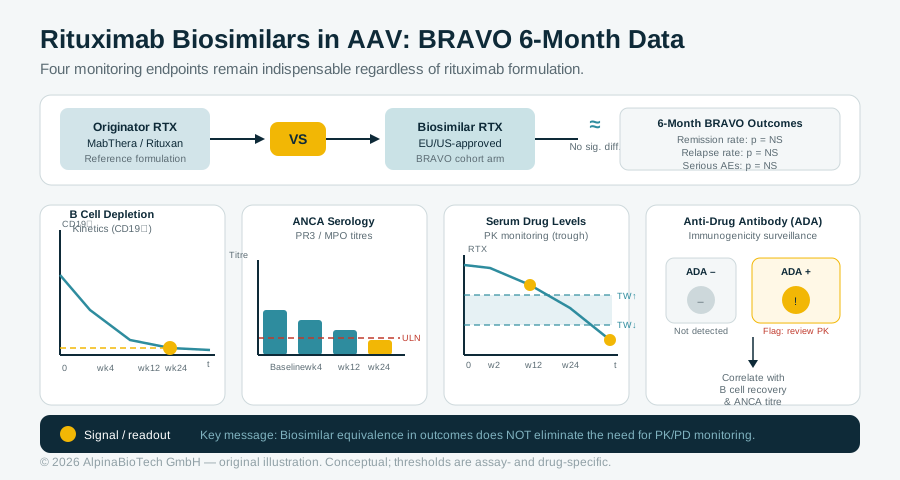
Rituximab Biosimilars in AAV: What Six-Month Real-World Data Tell Monitoring Scientists
The BRAVO multicenter cohort study found no statistically significant differences in remission rates, relapse rates, or serious adverse events between biosimilar and originator rituximab at six months in granulomatosis with polyangiitis and microscopic polyangiitis. For laboratories supporting drug-level and immunogenicity testing in biosimilar-treated AAV populations, the findings reinforce rather than reduce the case for structured pharmacokinetic and pharmacodynamic monitoring. B cell depletion kinetics, ANCA serology, serum drug levels, and anti-drug antibody assays each remain indispensable endpoints regardless of which rituximab formulation the patient receives.
Read more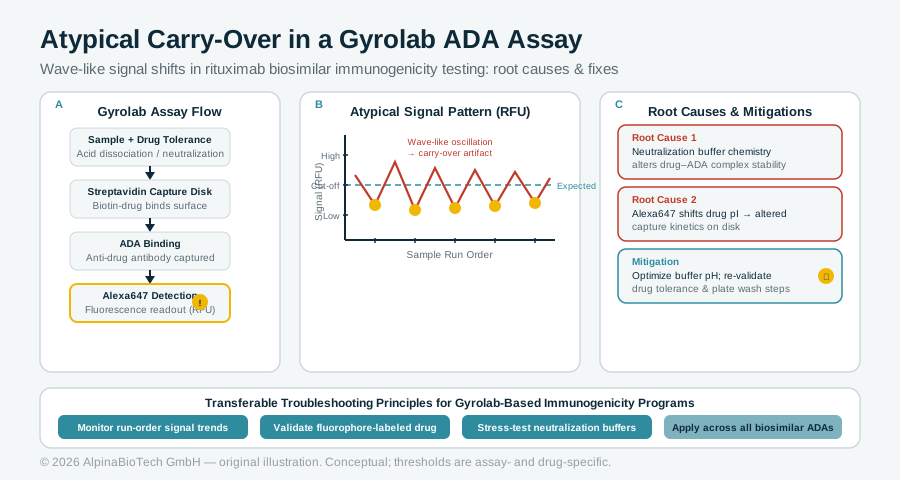
Atypical Carry-Over in a Gyrolab ADA Assay: Lessons from a Rituximab Biosimilar Case Study
A published case study targeting MabionCD20, a rituximab biosimilar, identified wave-like signal fluctuations in Gyrolab-based ADA assays caused by neutralization buffer chemistry and fluorophore-induced isoelectric point shifts. The investigation offers transferable troubleshooting principles for any laboratory running Gyrolab-based immunogenicity programs, particularly around drug tolerance and repeatability.
Read more