Article · 26 June 2026
Therapeutic Drug Monitoring of Biologics: From Trough Levels to Treatment Decisions
Measuring how much drug is actually in circulation turns a fixed-dose biologic into a measurable, adjustable therapy. Here is why trough concentrations have become central to biologic research and care.
AlpinaBioTech Scientific Team
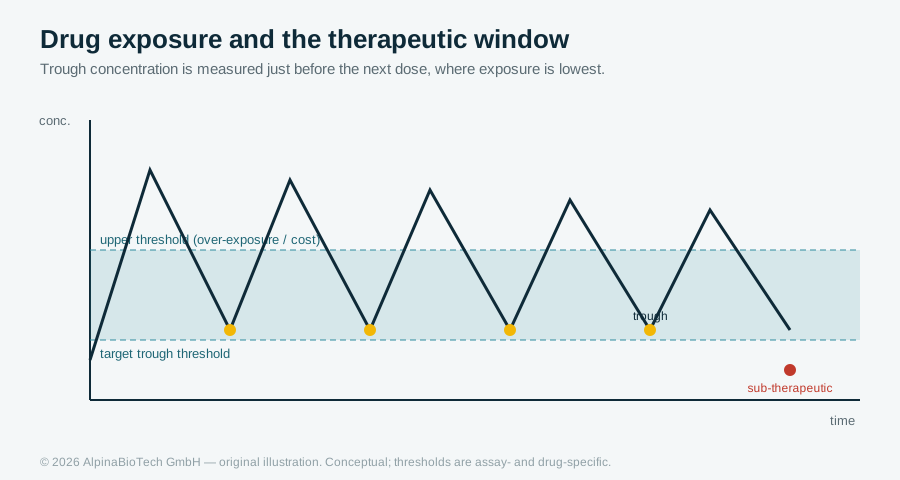
A small-molecule drug taken by mouth tends to behave predictably from one person to the next. A therapeutic antibody does not. Monoclonal antibodies are large proteins, cleared by a mix of immune and non-immune mechanisms, and their circulating concentrations can vary several-fold between individuals on an identical dose. That variability is the entire rationale for therapeutic drug monitoring (TDM): rather than assuming a dose produces an exposure, TDM measures the exposure directly.
What "trough" means and why it is the standard
Drug concentration rises after each infusion or injection and then falls until the next dose. The lowest point, immediately before the next administration, is the trough. Trough sampling has become the reference timepoint for two reasons. It is the most reproducible part of the curve to sample, since it does not depend on catching a moving peak, and it is the concentration most consistently linked to sustained biological effect. When a trough sits below a drug-specific threshold, the target is unlikely to be continuously engaged between doses.
Published thresholds give a sense of scale. The American Gastroenterological Association's guideline, drawing on the underlying evidence base, points to target trough concentrations on the order of 5 µg/mL for infliximab and 7.5 µg/mL for adalimumab during maintenance, with higher figures for certolizumab pegol. These are population-level reference points, not universal cut-offs, and they shift with assay, indication and treatment phase, but they illustrate that "enough drug" is a number, not a guess.
Reading a low level correctly
A subtherapeutic trough has more than one explanation, and distinguishing between them is where TDM earns its place. Low drug with no detectable anti-drug antibodies often points to underdosing or rapid clearance, and may respond to dose intensification. Low drug accompanied by anti-drug antibodies points instead to immune-mediated clearance, where escalating the same molecule is frequently futile and switching is the more rational move. A perfectly adequate trough in a patient who is not responding suggests the disease is being driven by a pathway the drug does not target, a signal to change mechanism rather than dose. This is why drug-level and anti-drug-antibody assays are most informative when run together, ideally on the same sample with compatible methods.
Evidence that measuring changes outcomes
The case for TDM is not merely mechanistic. The TAXIT trial showed that dosing infliximab to a target concentration achieved more efficient drug use and more stable trough levels than dosing by clinical features alone. Consensus statements from international working groups have since codified when and how to apply anti-TNF monitoring, reflecting how far the practice has moved from niche to mainstream in the decade since. The active research question now is less whether to measure and more when, a theme taken up in our article on proactive versus reactive monitoring.
Implications for assay choice
For laboratories supporting this work, the assay has to do two things well: report an accurate absolute concentration across the clinically relevant range, and behave consistently from lot to lot so that a value measured this quarter is comparable to one measured next year. Quantitative sandwich ELISAs remain a practical backbone for drug-level measurement because they combine specificity, an interpretable calibration curve, and throughput suited to longitudinal sampling.
As with every assay in this series, the kits referenced here are for research use only and are not intended to direct patient management without appropriate validation. Used as research tools, they let investigators connect a measured exposure to a measured outcome, which is the whole point of monitoring a biologic rather than simply administering one.
Part of AlpinaBioTech's educational series. Explore our drug-level ELISAs.
References
-
Feuerstein JD, Nguyen GC, Kupfer SS, Falck-Ytter Y, Singh S; AGA Institute Clinical Guidelines Committee. American Gastroenterological Association Institute Guideline on Therapeutic Drug Monitoring in Inflammatory Bowel Disease. Gastroenterology. 2017;153(3):827-834.
-
Vande Casteele N, Ferrante M, Van Assche G, et al. Trough concentrations of infliximab guide dosing for patients with inflammatory bowel disease (TAXIT). Gastroenterology. 2015;148(7):1320-1329.e3.
-
Mitrev N, Vande Casteele N, Seow CH, et al. Review article: consensus statements on therapeutic drug monitoring of anti-tumour necrosis factor therapy in inflammatory bowel diseases. Aliment Pharmacol Ther. 2017;46(11-12):1037-1053.
More articles
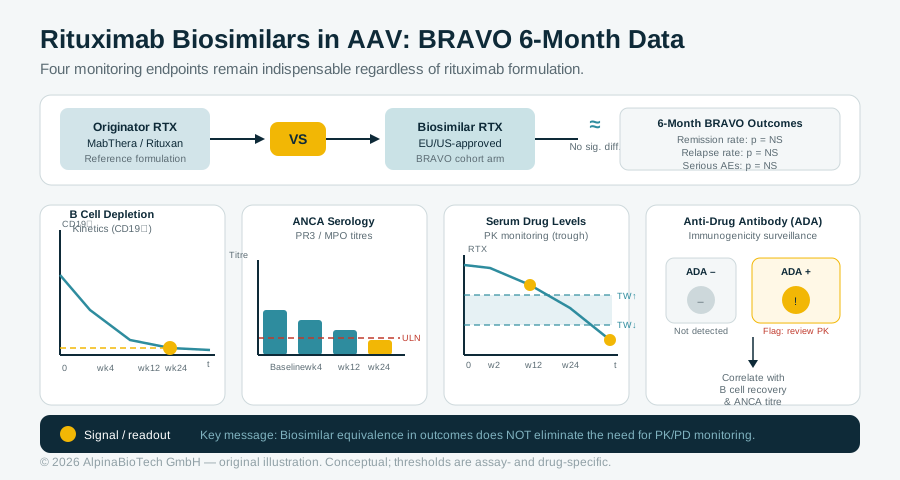
Rituximab Biosimilars in AAV: What Six-Month Real-World Data Tell Monitoring Scientists
The BRAVO multicenter cohort study found no statistically significant differences in remission rates, relapse rates, or serious adverse events between biosimilar and originator rituximab at six months in granulomatosis with polyangiitis and microscopic polyangiitis. For laboratories supporting drug-level and immunogenicity testing in biosimilar-treated AAV populations, the findings reinforce rather than reduce the case for structured pharmacokinetic and pharmacodynamic monitoring. B cell depletion kinetics, ANCA serology, serum drug levels, and anti-drug antibody assays each remain indispensable endpoints regardless of which rituximab formulation the patient receives.
Read more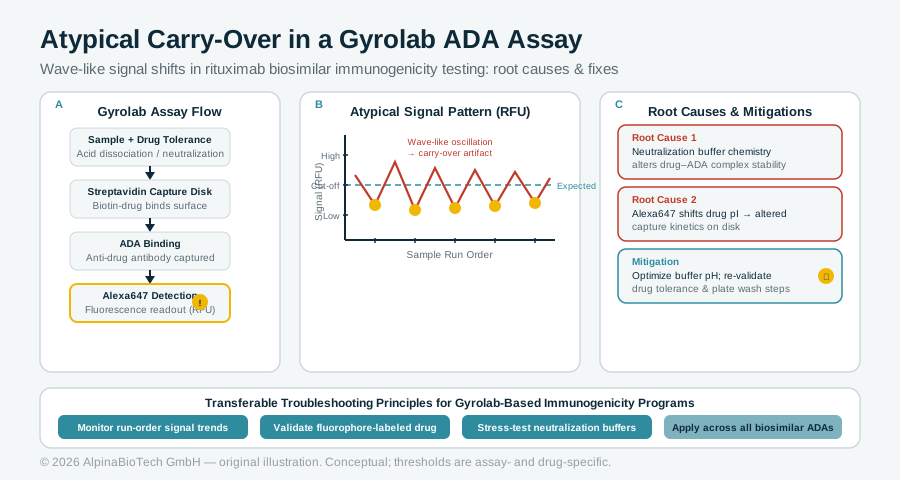
Atypical Carry-Over in a Gyrolab ADA Assay: Lessons from a Rituximab Biosimilar Case Study
A published case study targeting MabionCD20, a rituximab biosimilar, identified wave-like signal fluctuations in Gyrolab-based ADA assays caused by neutralization buffer chemistry and fluorophore-induced isoelectric point shifts. The investigation offers transferable troubleshooting principles for any laboratory running Gyrolab-based immunogenicity programs, particularly around drug tolerance and repeatability.
Read more