Article · 26 June 2026
Building Confidence in RUO Immunoassays: Validation, Reproducibility, and Fit-for-Purpose Design
A research-use ELISA is only as good as the validation behind it. Here are the parameters that separate a number you can build on from one you cannot.
AlpinaBioTech Scientific Team
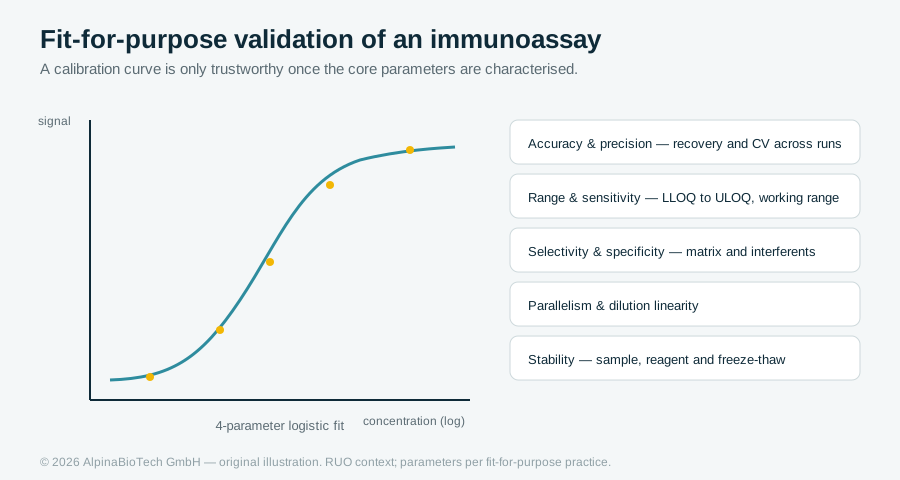
Two laboratories can run the same kit on the same samples and report different numbers. When that happens, the problem is rarely the antibody chemistry, it is almost always validation, or the lack of it. A research-use-only (RUO) immunoassay is a research instrument, and like any instrument its output is meaningful only within the conditions under which it was characterised. Understanding those conditions is what lets a scientist treat a measured concentration as data rather than an estimate.
Fit-for-purpose, not one-size-fits-all
The guiding idea in modern bioanalysis is fit-for-purpose validation: the rigour applied to a method should match the decisions that will rest on it. A screening assay used to triage samples does not need the same tight precision as a method that will anchor a pharmacokinetic model. The fit-for-purpose framework, articulated for biomarker assays and reflected in regulatory guidance, asks the developer to define the intended use first and then validate to that standard, rather than chasing arbitrary perfection or, worse, skipping characterisation entirely. For an RUO kit, this means the documentation should make the validated context explicit so users can judge whether it fits their question.
The parameters that matter
A handful of parameters do most of the work in establishing trust in a quantitative immunoassay.
Accuracy and precision describe how close results are to the true value and how reproducible they are across replicates, runs, days and operators. Reported as recovery and coefficient of variation, they are the backbone of any validation; intra- and inter-assay CV in particular tells a user how much of an observed difference is real and how much is noise.
Range and sensitivity define the working window between the lower and upper limits of quantification. Results read from outside that window, including from the flat top and bottom of a sigmoidal curve, carry error that the validation does not cover.
Selectivity and specificity ask whether the assay measures the intended analyte and nothing else, in the actual sample matrix. Serum and plasma are crowded environments; haemolysis, lipaemia, rheumatoid factor and the target drug itself can all interfere, and each should be tested rather than assumed away.
Parallelism and dilution linearity confirm that diluting a sample changes the measured concentration proportionally. A failure here is a classic sign of matrix interference and undermines any result that required dilution to fall in range.
Stability covers whether the analyte, calibrators and reagents survive the handling they will actually receive, bench time, storage, and freeze-thaw cycles, without drifting.
Reproducibility is built, not hoped for
Beyond a single validation report, day-to-day reproducibility depends on controls that travel with every plate, calibration curves fitted with an appropriate model (commonly four-parameter logistic for immunoassays), and lot-to-lot consistency so that a calibrator change does not silently shift results. The discipline that catches drug-interference and cut-point problems in immunogenicity assays is the same discipline that keeps a drug-level assay comparable across a multi-year study. Reproducibility, in other words, is a property of how an assay is run, not just how it was designed.
What to expect from a well-documented kit
A buyer evaluating an RUO immunoassay should be able to find the validated range, the precision profile, the tested interferents, and the calibration model without guesswork. That transparency is not a formality, it is what allows a result to be interpreted correctly and compared to results generated elsewhere. The strongest argument for a research immunoassay is a validation file that tells you exactly what the number means and where it stops being reliable.
These kits are supplied for research use only and are not validated as in-vitro diagnostic devices; results should not be used to direct patient care without appropriate independent validation. Within research, well-validated assays are what turn a binding reaction into a number you can build a conclusion on.
Part of AlpinaBioTech's educational series. Explore the full portfolio.
References
-
U.S. Food and Drug Administration. Bioanalytical Method Validation: Guidance for Industry. May 2018.
-
ICH Harmonised Guideline M10: Bioanalytical Method Validation and Study Sample Analysis. 2022.
-
Lee JW, Devanarayan V, Barrett YC, et al. Fit-for-purpose method development and validation for successful biomarker measurement. Pharm Res. 2006;23(2):312-328.
-
Shankar G, Devanarayan V, Amaravadi L, et al. Recommendations for the validation of immunoassays used for detection of host antibodies against biotechnology products. J Pharm Biomed Anal. 2008;48(5):1267-1281.
More articles
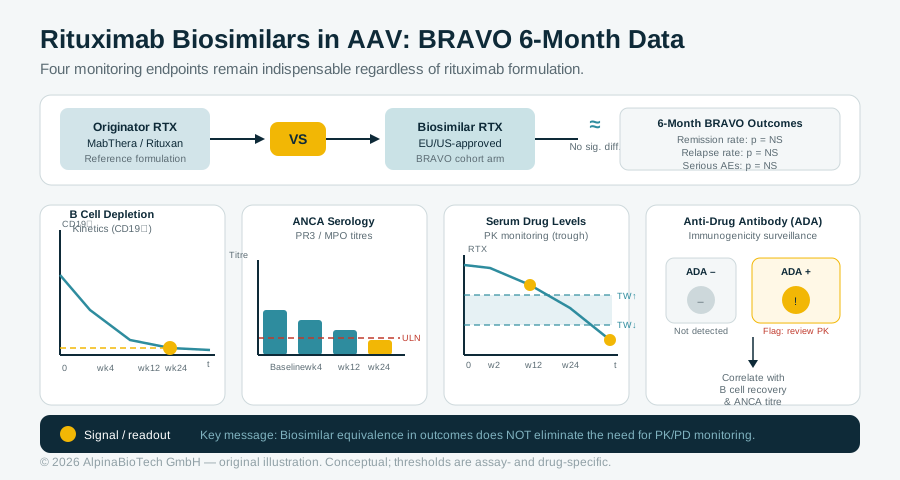
Rituximab Biosimilars in AAV: What Six-Month Real-World Data Tell Monitoring Scientists
The BRAVO multicenter cohort study found no statistically significant differences in remission rates, relapse rates, or serious adverse events between biosimilar and originator rituximab at six months in granulomatosis with polyangiitis and microscopic polyangiitis. For laboratories supporting drug-level and immunogenicity testing in biosimilar-treated AAV populations, the findings reinforce rather than reduce the case for structured pharmacokinetic and pharmacodynamic monitoring. B cell depletion kinetics, ANCA serology, serum drug levels, and anti-drug antibody assays each remain indispensable endpoints regardless of which rituximab formulation the patient receives.
Read more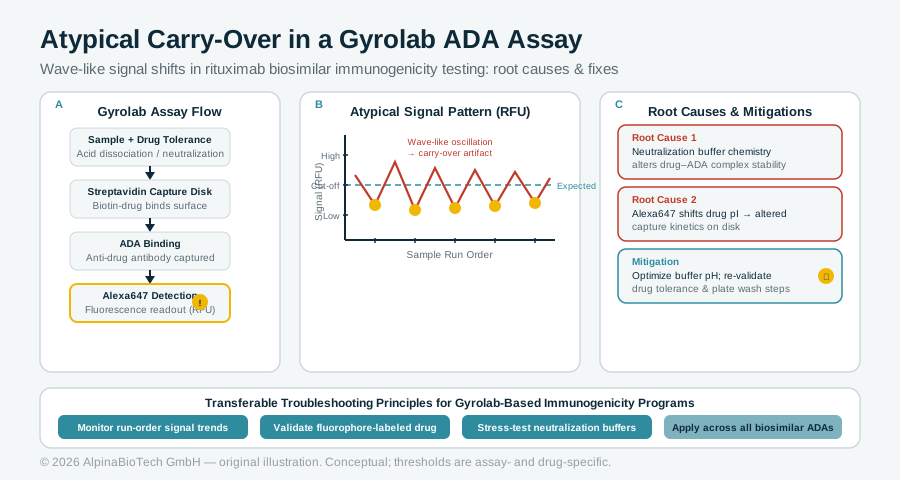
Atypical Carry-Over in a Gyrolab ADA Assay: Lessons from a Rituximab Biosimilar Case Study
A published case study targeting MabionCD20, a rituximab biosimilar, identified wave-like signal fluctuations in Gyrolab-based ADA assays caused by neutralization buffer chemistry and fluorophore-induced isoelectric point shifts. The investigation offers transferable troubleshooting principles for any laboratory running Gyrolab-based immunogenicity programs, particularly around drug tolerance and repeatability.
Read more