Newsletter / September 2026
AlpinaBioTech Digest - September 2026
September's articles cover a wide methodological range, but a common thread runs through several of them: the analyte you intend to measure is not always the analyte circulating in the sample. That problem appears in different forms in ADC bioanalysis, where deconjugation and DAR shift alter the species present after dosing; in multi-biomarker Alzheimer's panels, where femtomolar sensitivity requirements and cross-reactivity between tau isoforms make harmonization across platforms difficult; and in denosumab ADA programs, where soluble RANKL interference in the assay determines whether a reported incidence figure is interpretable at all.
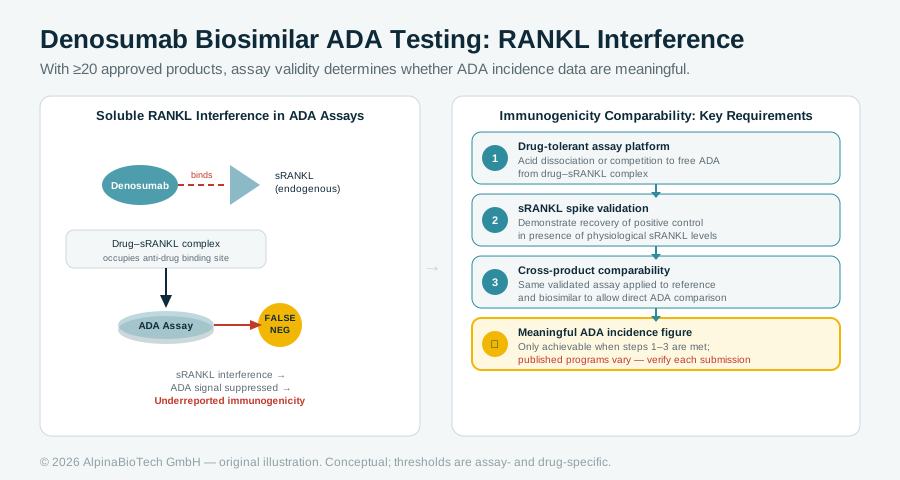
On the immunogenicity side, two articles address assay design problems that lack finalized regulatory guidance. The piece on LNP-based therapeutics maps the full panel of endpoints, including cytokine, complement, anti-PEG, and cellular readouts, that a fit-for-purpose strategy must address across carrier and cargo independently, against a background of pre-existing anti-PEG antibodies. The denosumab article examines what RANKL interference comparability testing actually requires now that FDA-approved denosumab products number at least 20 and interchangeability-driven pharmacy substitution is routine.
Two shorter articles round out the month. The CPS1 serum immunoassay piece examines a hepatocyte-selective mitochondrial enzyme biomarker with a roughly 126-minute serum half-life, drawing on ELISA data from 764 serial samples across 270 acute liver failure patients to assess what it adds to standard aminotransferase panels. All AlpinaBioTech CPS1 immunoassay products are for Research Use Only. The final article covers Fortrea's $45 million acquisition of Worldwide Clinical Trials' bioanalytical laboratory, and what the consolidation of a 60,000-square-foot GLP facility with an integrated clinical pharmacology unit means for assay scientists running early-phase PK and immunogenicity programs.
Biosimilars / Anti-Drug Antibodies / Assay Validation
Degevma's FDA Approval and a Market with More Than 20 Denosumab Biosimilars: What Immunogenicity Comparability Testing Actually Requires
30 September 2026
The FDA's approval of denosumab-adet (Degevma) on September 28, 2026 brings the cumulative total of approved denosumab products to at least 20, raising a concrete methodological question: in a market this saturated, with interchangeability-driven pharmacy substitutions, what does a reported ADA incidence figure actually tell you? The answer depends entirely on whether the assay has solved the soluble RANKL interference problem, and the published literature shows that not every program has.
Read the article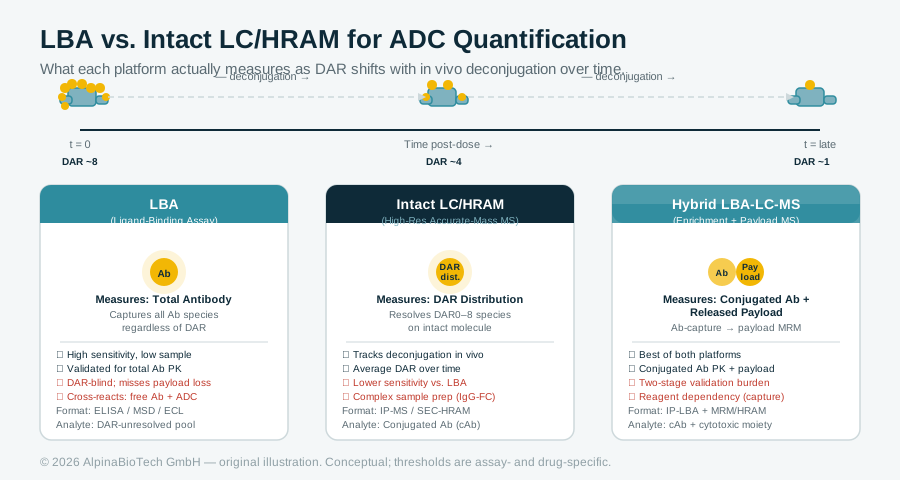
ELISA / Therapeutic Drug Monitoring / Assay Validation
LBA vs. Intact LC/HRAM for ADC Quantification: What Each Method Actually Measures
28 September 2026
Selecting a bioanalytical platform for antibody-drug conjugates is a structural decision: deconjugation and DAR shift mean the circulating analyte changes continuously after dosing. Two 2026 publications, an AAPS ADC Working Group white paper and a peer-reviewed PPD hybrid assay validation, sharpen the practical framework for LBA, intact LC/HRAM, and hybrid LBA-LC-MS approaches in regulated ADC studies.
Read the article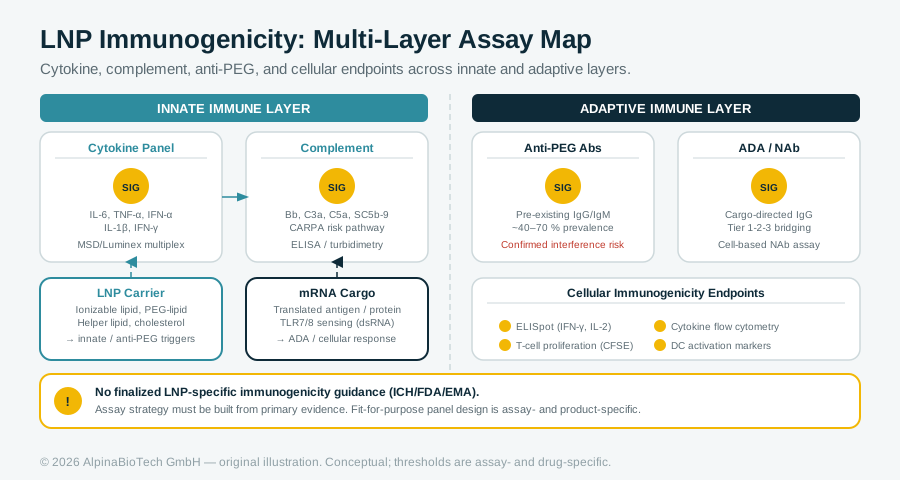
ELISA / Immunogenicity / Anti-Drug Antibodies
Immunogenicity Assessment for LNP-Based Therapeutics: Mapping the Assay Demands Across Innate and Adaptive Endpoints
21 September 2026
LNP-based therapeutics generate immunogenicity signals across at least two immune layers, involving carrier and cargo independently, against a background of pre-existing anti-PEG antibodies in a substantial fraction of patients. No finalized LNP-specific immunogenicity guidance exists, leaving bioanalytical scientists to build assay strategies from the LNP-specific evidence base up. This article maps the cytokine, complement, anti-PEG, and cellular endpoints that a fit-for-purpose panel must address.
Read the article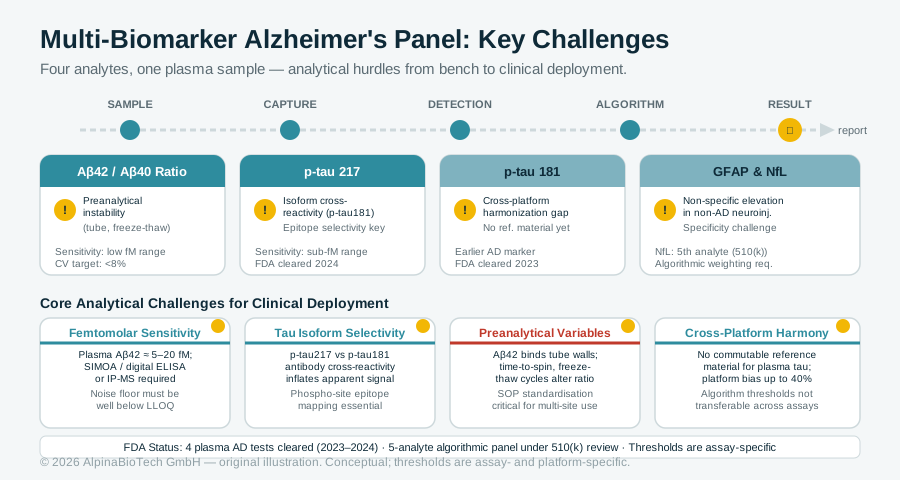
ELISA / Assay Validation / Therapeutic Drug Monitoring
Four Analytes, One Plasma Sample: The Assay Science Behind Multi-Biomarker Alzheimer's Testing
16 September 2026
Four blood-based Alzheimer's disease biomarker tests were cleared by the FDA within fifteen months, and a five-analyte algorithmic panel is under 510(k) review. For immunoassay scientists deploying these panels, the analytical challenges of femtomolar sensitivity, cross-reactivity between tau isoforms, preanalytical instability of Aβ42, and cross-platform harmonization are the least-settled problems in making multi-biomarker results hold up outside a research cohort.
Read the article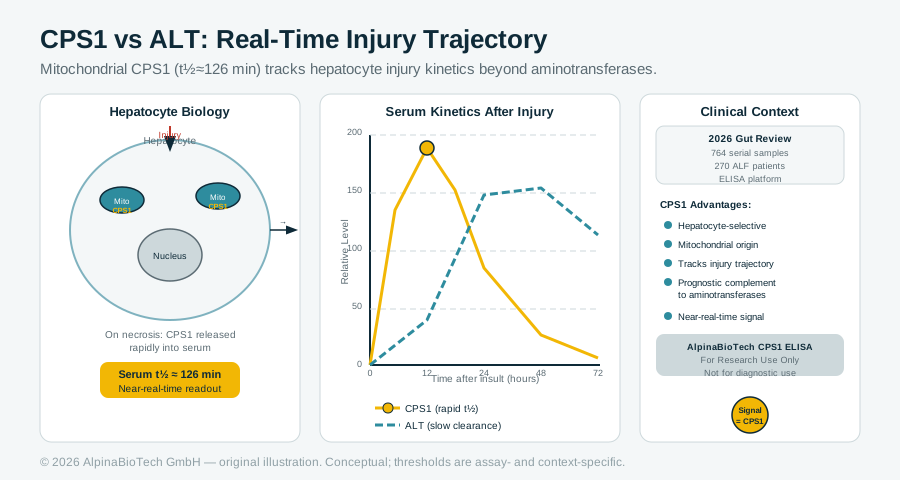
ELISA / Therapeutic Drug Monitoring / Assay Validation
CPS1 Serum Immunoassay: What a Mitochondrial Enzyme Biomarker Tells You That ALT Cannot
14 September 2026
Carbamoyl phosphate synthetase 1 (CPS1) is a hepatocyte-selective mitochondrial enzyme with a serum half-life of roughly 126 minutes, making it a near-real-time indicator of injury trajectory rather than injury presence. A 2026 Gut review synthesizes a decade of mechanistic and clinical work, including ELISA data from 764 serial samples across 270 acute liver failure patients, establishing CPS1 as a prognostically informative complement to standard aminotransferase panels. All AlpinaBioTech CPS1 immunoassay products are for Research Use Only.
Read the article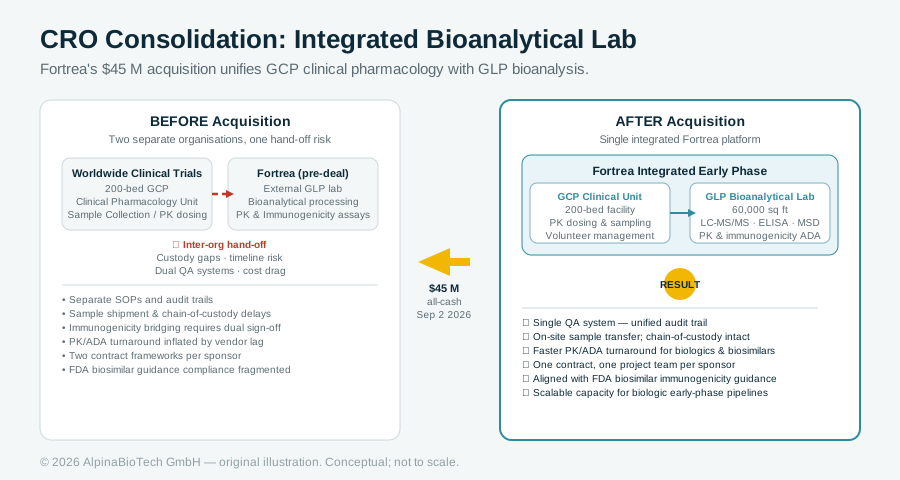
Assay Validation / Therapeutic Drug Monitoring
Fortrea Acquires Worldwide Clinical Trials' Bioanalytical Lab: What the $45 Million CRO Deal Means for Assay Scientists
11 September 2026
On September 2, 2026, Fortrea announced a $45 million all-cash acquisition of Worldwide Clinical Trials' Early Phase Services division, bringing a 60,000-square-foot GLP bioanalytical laboratory and a 200-bed GCP clinical pharmacology unit under one operational roof. For assay scientists running PK and immunogenicity programs, the deal changes the vendor map by eliminating inter-organization hand-offs between sample collection and bioanalytical processing. Broader CRO consolidation and pending FDA biosimilar guidance shifts make integrated bioanalytical infrastructure increasingly valuable for early-phase biologic programs.
Read the articleAll articles cited in this digest are indexed on the AlpinaBioTech publications page, and all referenced AlpinaBioTech immunoassay products are for Research Use Only unless otherwise labeled.